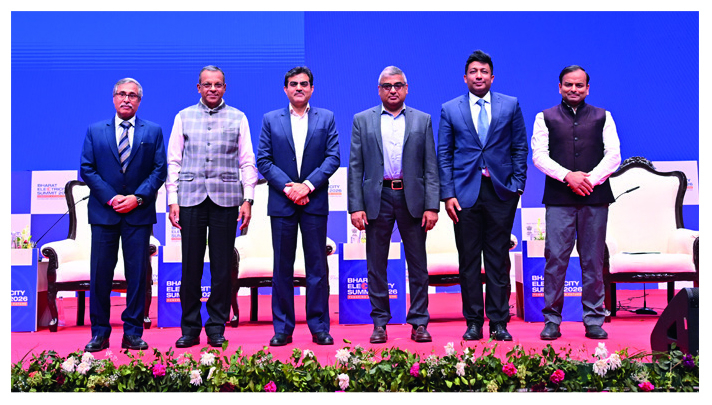
 The BES 2026 session on “Building Intelligent Grid Systems: From smart metering and ADMS-DERMS platforms to next generation TSO-DSO co-ordination” was moderated by Satyendra Nath Kalita, Director, Regulatory Affairs, All India Discoms Association, and featured remarks by Hemant Jain, Member, Grid Operation and Distribution, Central Electricity Authority (CEA); Anil Rawal, CEO and MD, Intellismart Infrastructure; Madan Mohan Chakraborty, MD and CEO, GridCrest Technologies (Kaynes Group); Saurav Kumar Shah, ED, Power Finance Corporation, and Abhishek Ranjan, CEO, BSES Rajdhani Power. The session highlighted the crucial role of advanced distribution management systems (ADMS), distributed energy resource management systems (DERMS) and smart meter data in forming the data backbone of a modern, renewable‑rich distribution grid in India. Key takeaways from the discussion…
India’s electricity grid is no longer just a network of wires and transformers – it is rapidly becoming a digital ecosystem. The sector has transitioned from data scarcity to data abundance. Initiatives such as mass-scale smart metering roll-out have created an entirely new “data estate” for the grid. However, the data abundance is not the same as data intelligence. The real challenge now is not collecting more data but ensuring that the data is clean, harmonised, and actionable. A good data hygiene must become as fundamental to utility operations, and every insight derived must ultimately serve one purpose: keeping the consumer at the centre while ensuring power is procured and delivered at the right cost.
The data must be integrated across AMI, ADMS, SCADA, and GIS layers to accurately map assets, generation sources, and consumers in real time. Without this harmonisation, there is a risk in building planning models on fragmented, duplicated, or simply unusable datasets – leading to poor investment decisions, over-procurement, or under-provisioning of capacity.
Further, as distributed generation proliferates across the grid – rooftop solar, small wind installations, behind-the-meter storage – the question of how to manage this complexity in real time becomes urgent. Distributed generation feeds real-time inputs into the ADMS on local generation levels, load conditions, and voltage profiles – significantly enhancing visibility at the grid edge. This is a leap forward in situational awareness. However, assuming that the ADMS needs all available data from every distributed resource can overload the system. This can create a real operational risk and flood the system with information that is not essential to monitor grid parameters or support decision-making.
As a result, a hybrid architecture model could be considered where the ADMS focuses on network-level data – real-time monitoring, control, and system-wide optimisation. Meanwhile, distributed energy resource management system (DERMS), handles the granular management of distributed energy resources: their precise locations, intermittency profiles, and local controllability. Hence, well-defined data exchange protocols between these two layers ensure that the electricity system operates as a coherent whole, rather than as a collection of siloed platforms.
Rapid growth in per-capita electricity consumption in urban centres – driven by air conditioning, EVs, and data-intensive lifestyles – is making demand increasingly volatile and difficult to forecast. The consequences of this mismatch are already being felt: over-voltage conditions, transformer failures, and frequency instability are emerging challenges in grids with high renewable penetration. State load despatch centres, designed for a centralised, conventional grid, simply do not have the tools or the mandate to manage distributed energy resources, smart loads, and demand-side response at the distribution level. Hence, the solution lies in the evolution of distribution licensees into distributed system operators (DSOs).
A DSO does not merely manage meters and billing; it actively orchestrates a complex, renewable-rich, consumer-centric distribution grid. It coordinates flexible loads, enables demand response, manages EV charging patterns, and ensures that distributed resources are integrated into the broader grid in a stable, efficient manner. Without a DSO layer positioned between the transmission system operator and the end-consumer, the distribution grid is likely to become a bottleneck rather than an enabler of the energy transition.
Hence, building an intelligent grid is not a single technological project with a defined end point. It is a continuous, evolving process of integrating data, platforms, institutions, and people into a coherent system capable of managing complexity in real time.