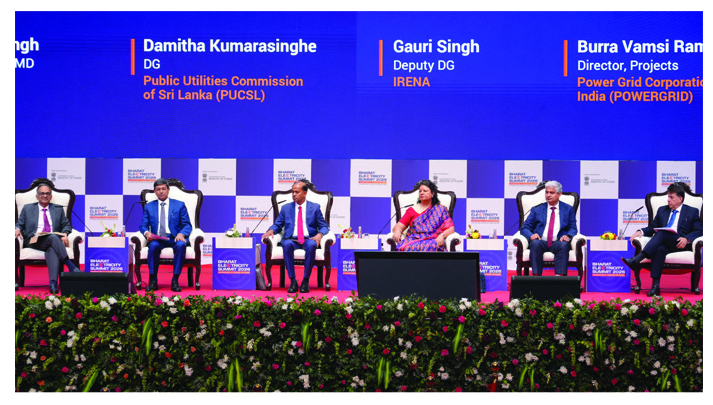
 The session on “Resilient Global Energy Mix: Strengthening reliability, affordability and clean growth” featured a panel discussion among Gurdeep Singh, Chairman and Managing Director (MD), NTPC Limited; Burra Vamsi Rama Mohan, Director – Projects, Power Grid Corporation of India Limited; Guilherme Mendonca, Chief Executive Officer and MD, Siemens Energy India Limited; Damitha Kumarasinghe, Director General (DG), Public Utilities Commission of Sri Lanka; and Gauri Singh, Deputy DG, International Renewable Energy Agency. The session was moderated by Alok Kumar, DG, All India Discoms Association. The session explored the challenges and opportunities associated with integrating large-scale renewable energy while maintaining grid reliability and affordability. Edited excerpts…
The panellists noted that the rapid growth of solar energy in India is creating new operational challenges for the power system, particularly in terms of grid flexibility and balancing. Coal-based power plants, which have traditionally been the backbone of the country’s electricity supply, were not originally designed to operate with the level of flexibility required to support large-scale variable renewable energy. Increasingly, these plants are being required to ramp up and down frequently to accommodate fluctuations in solar generation, placing operational stress on existing infrastructure.
To manage high levels of solar penetration more effectively, flexibility must become a shared responsibility across the entire power system rather than relying solely on coal-based generation. A diversified set of solutions will be necessary. Energy storage technologies are expected to play an increasingly important role in this context, including battery energy storage systems (BESSs), pumped storage projects and emerging storage technologies that can absorb surplus renewable energy and release it when required.
Another potential approach involves developing new generation assets that are specifically designed for flexible operations. Instead of forcing existing baseload plants to operate in ways for which they were not originally designed, smaller and more flexible thermal units could be developed to handle daily cycling and rapid ramping requirements. Looking ahead, nuclear power is being considered as a potential contributor to India’s long-term energy mix. Expanding nuclear capacity will require stronger public awareness, streamlined regulatory processes, improved financing mechanisms and the development of a robust domestic supply chain and skilled workforce.A key issue is the mismatch between the pace of generation capacity additions and the availability of adequate transmission infrastructure. While there are instances where generation capacity remains stranded due to transmission constraints, there are also cases where transmission systems have already been developed and are waiting for generation to come online.Supply chain constraints have also emerged as a key issue. Equipment shortages have affected the timely implementation of transmission projects. To address this, a shift towards bulk procurement strategies is being adopted.
Storage systems are increasingly being considered not only as standalone assets but also as solutions that can support grid operations and enhance the efficiency of transmission networks. The development of supportive regulatory frameworks is expected to play an important role in enabling investment in such technologies and strengthening the overall reliability and flexibility of the power system.The panellists highlighted that policy stability is one of the most critical factors influencing investment decisions in the energy sector. Infrastructure investments in areas such as transformers, switchgear and other grid equipment involve high capital costs and long payback periods. Manufacturers and investors, therefore, require clear and consistent policies that provide long-term visibility and reduce regulatory uncertainty.
The renewable energy transition has reached a stage where traditional approaches to evaluating costs are no longer sufficient. In the earlier phase of renewable energy deployment, the primary objective was to reduce the cost of generation, particularly for technologies such as solar power. Significant progress has been made in this area, with renewable energy costs declining substantially over the past decade. However, as renewable energy now accounts for a major share of new electricity capacity additions, a broader and more systematic framework is required to assess costs.
The panellists concluded that a diversified portfolio of flexibility solutions will be essential for maintaining grid stability. This could include smaller flexible power plants, BESS, pumped storage hydropower and demand-side reforms.