
The Damodar Valley Corporation (DVC) is a statutory body established on July 7, 1948, by an act of the Constituent Assembly of India. It was formed through joint participation of the Government of India and the state governments of West Bengal and Jharkhand (formerly Bihar) to promote the development of the Damodar Valley. Modelled on the Tennessee Valley Authority of the US, DVC is the first multipurpose river valley project of independent India.
Since its inception, DVC has achieved significant milestones that have contributed to the growth of India’s power sector. In 1953, it commissioned the Bokaro Thermal Power Station (BTPS) Unit-A, Asia’s first pulverised fuel power plant, followed by India’s first reheat unit at the Chandrapura Thermal Power Station (CTPS) in 1963. At the turn of the century, DVC partnered with Tata Power to establish Maithon Power Limited, which is India’s first public-private partnership in the power sector.
Generation portfolio and performance
As of FY 2024-25, DVC has a total installed capacity of 6,715 MW, comprising 6,540 MW of thermal power (97 per cent), 147 MW of hydel (2 per cent) and 28 MW of solar power (1 per cent).
The thermal capacity has expanded significantly from 172.5 MW in 1953 to 6,540 MW in FY 2024-25, through the retirement of ageing units and the addition of 500 MW and 600 MW subcritical units. This capacity is distributed across six plants, which include the 2,340 MW Mejia, 1,000 MW Durgapur Steel and 1,200 MW Raghunathpur thermal power stations in West Bengal, along with the 500 MW Bokaro, 500 MW Chandrapura and 1,000 MW Koderma Thermal Power Station (KTPS) in Jharkhand.
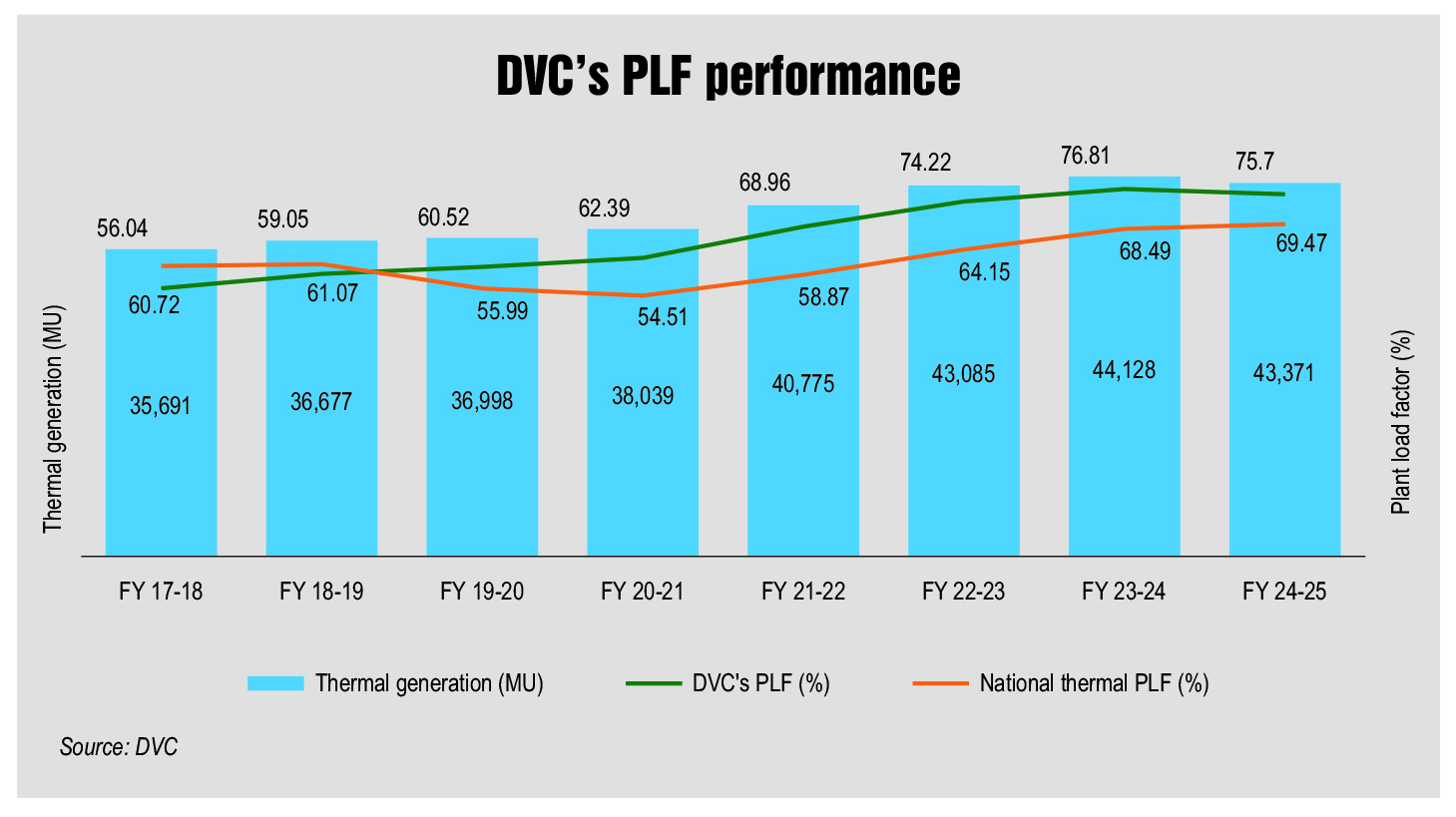
Over the years, the plant load factor (PLF) has shown steady improvement, rising from 56.04 per cent in FY 2017-18 (35,691 MUs) to 76.81 per cent in FY 2023-24, when DVC recorded its highest-ever thermal generation of 44,128 MUs. Notably, DVC’s PLF has consistently remained above the national thermal PLF over the past six years.
 Key initiatives
At present, DVC relies on external coal supplies, which expose it to variations in coal quality and grade slippage. To mitigate these challenges, DVC is pursuing coal self-sufficiency through captive mining. In January 2026, it secured the Pirpainti Barahar, Dhulia North and Mandakini-B coal blocks, with a combined production capacity of 49 mtpa. It also operates the 6 mtpa tubed coal block in Jharkhand, further reducing dependence on external procurement.
With increasing renewable energy penetration, DVC is enhancing the flexibility of its thermal fleet. Pilot initiatives at the Durgapur, Koderma, Chandrapura and Mejia thermal power stations have demonstrated the capability to operate at loads as low as 40 per cent.
DVC is also undertaking renovation and modernisation (R&M), alongside capacity upgrades using cleaner and more efficient ultra-supercritical technology. Additionally, the renovation of 11 substations is in progress, including four in West Bengal and seven in Jharkhand. The corporation is also reconductoring 132 kV transmission lines with high-temperature low-sag conductors along with 18 33 kV distribution lines.
In compliance with environmental norms, flue gas desulphurisation (FGD) systems, de-NOx systems, and upgraded electrostatic precipitators are being installed. In 2023-24, the first FGD unit was commissioned at Mejia Thermal Power Station (MTPS) Unit 7. By early 2025, FGD systems had been deployed across 4,200 MW of capacity, covering all 500 MW and 600 MW units.
De-NOx systems have also been installed across all 500 MW, 600 MW and 250 MW units, while ESP augmentation is being undertaken for older 210 MW units. These measures have significantly reduced sulphur dioxide emissions and particulate matter. In addition, DVC is striving to achieve 100 per cent coal ash utilisation.
To enable rapid ramping, automatic generation control systems are being deployed. Furthermore, DVC is set to implement an integrated asset management system, a real-time centralised monitoring system for generation stations and advanced transmission asset management systems to optimise network performance.
Flexibilisation
In line with the phasing plan of the Central Electricity Authority, DVC conducted two pilot trials to assess the operational performance of its thermal fleet under flexible operating conditions. The first trial was undertaken at the Durgapur Steel Thermal Power Station (DSTPS) Unit 2 (500 MW), during which the unit achieved a stable minimum load of 155 MW, equivalent to 32 per cent of its rated capacity. The second trial was conducted at KTPS Unit 2 (500 MW). Although a stable minimum load of 252 MW was achieved, the unit could not operate below 50 per cent load due to challenges such as temperature excursions, wide drum-level fluctuations and low wind-box pressure.
During both trials, instability in feedwater control was observed at low loads, primarily due to on-off type recirculation valves. Notably, the trials indicated that all 500 MW and above units are capable of operating at 55 per cent load, provided coal consumption remains within 0.6 kg per kWh.
To address these challenges, retrofit contracts have been awarded to Bharat Heavy Electricals Limited for all 500 MW units. The pilot phase has been carried out at MTPS Unit 8 and CTPS Unit 7, with roll-out under way across other 500 MW units. These upgrades include advanced process control systems, replacement of conventional on-off recirculation valves with modulating control valves, stall protection systems and boiler stress monitoring systems for fatigue analysis.
At MTPS Unit 8, retrofitting enabled a technical minimum load of 40 per cent. Similarly, at CTPS Unit 7 (250 MW), trials with a BBD ball-and-tube mill demonstrated stable operation at 50 per cent load without oil support, although operation below this level was impractical due to flame stability concerns.
In addition, DVC has strengthened maintenance practices to support cyclic operations, including the replacement of back-pass header stubs after 15 years, installation of linear variable differential transformers for remote monitoring of boiler expansion and residual life assessment of boilers and turbines. Advanced diagnostics such as phased array ultrasonic testing of weld joints and installation of additional thermocouples on thick-walled components are also being adopted to enhance operational reliability and minimise thermal stress.
 Future roadmap
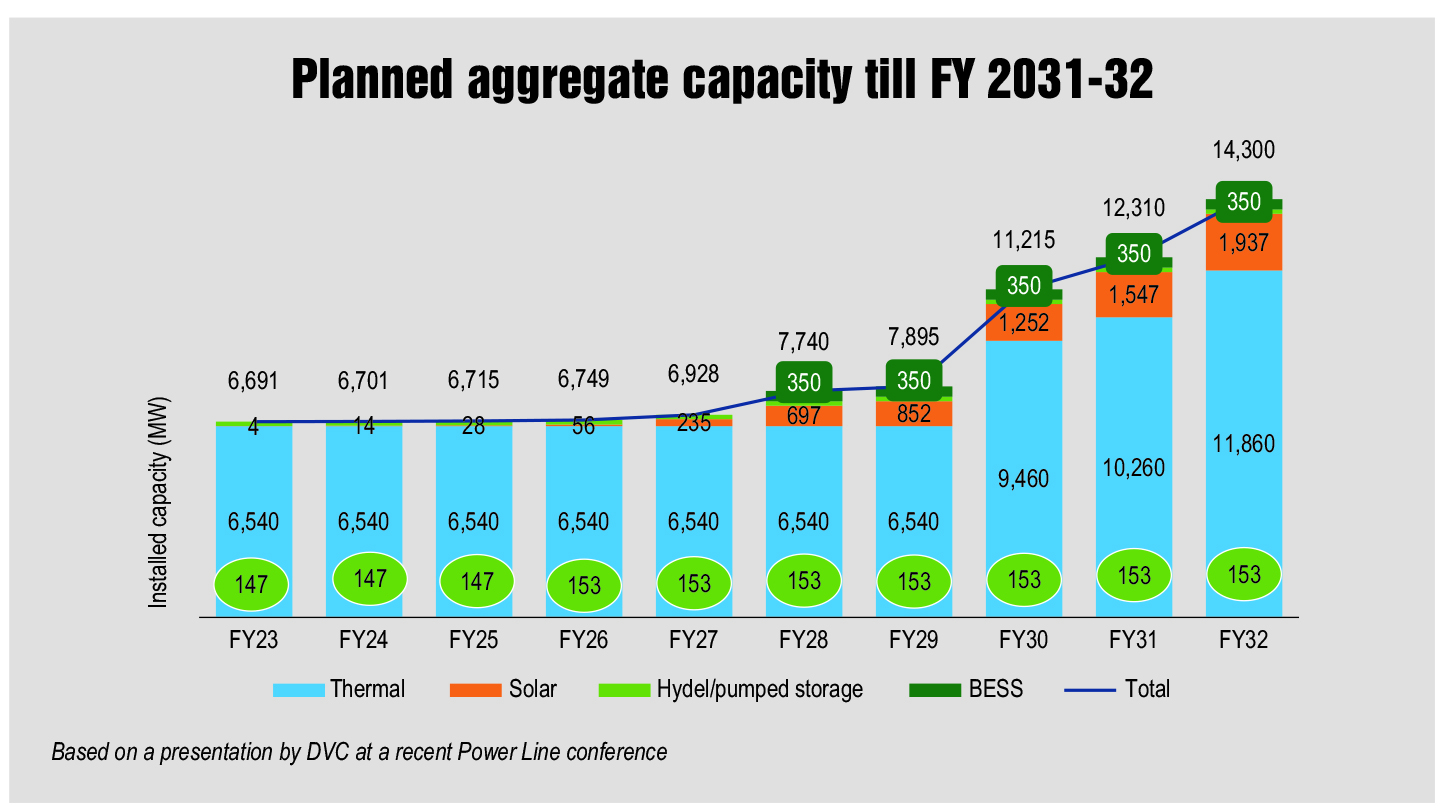
DVC has outlined an ambitious energy roadmap for 2032, focused on a diversified mix of thermal power, renewable energy and battery energy storage systems (BESSs). The corporation plans to increase its total installed capacity from around 6,715 MW in FY 2024-25 to 14,300 MW by FY 2031-32, largely through new and cleaner thermal projects. Thermal power capacity is projected to rise from 6,540 MW to 11,860 MW.
As part of its decarbonisation strategy, DVC aims to scale up solar capacity significantly from 28 MW to 1,937 MW by 2032 through ground-mounted and floating solar installations. This includes a 755 MW solar park being developed through a joint venture with NTPC Green Energy Limited, of which 310 MW has already been contracted. Recently, in March 2026, DVC also awarded an engineering, procurement and construction contract to TrueRE Oriana Power for a 234 MW grid-connected floating solar project at the Maithon dam reservoir in Jharkhand. The project is expected to become the largest floating solar installation in the state.
To address renewable energy intermittency, DVC plans to deploy 350 MW of BESS by 2032, including 250 MW/500 MWh at Maithon and 100 MW/400 MWh at Konar. Additionally, pumped storage projects of 1,500 MW at Lugupahar and 1,000 MW at Panchet Hill are under consideration. DVC has also initiated feasibility studies for green hydrogen and carbon capture to explore decarbonisation pathways for its existing thermal assets. In addition, EV charging infrastructure has been installed at six field stations to support e-mobility.
Through this balanced portfolio, DVC aims to support India’s energy transition, while ensuring long-term reliability and grid stability.