
Transformers remain critical assets in the power transmission network, and their failure continues to pose a serious risk to grid reliability and operational efficiency. Such failures often lead to forced outages, extended downtime, equipment damage and significant financial losses for utilities. The increasing incidence of failures highlights persistent issues related to ageing assets, operational stresses, insulation degradation, design limitations and gaps in maintenance practices.
Recent cases indicate that transformer failures are typically driven by a combination of internal and external factors. These include insulation and bushing failures, mechanical and electrical stresses arising from system faults, and the inability of equipment to withstand transient overvoltages. External disturbances such as feeder faults, lightning strikes and resonance conditions further aggravate equipment stress, often triggering internal faults. In addition, instances of winding failures, interturn short circuits and manufacturing defects continue to cause transformer outages, underscoring the need for improved asset management and monitoring practices.
Failure trends
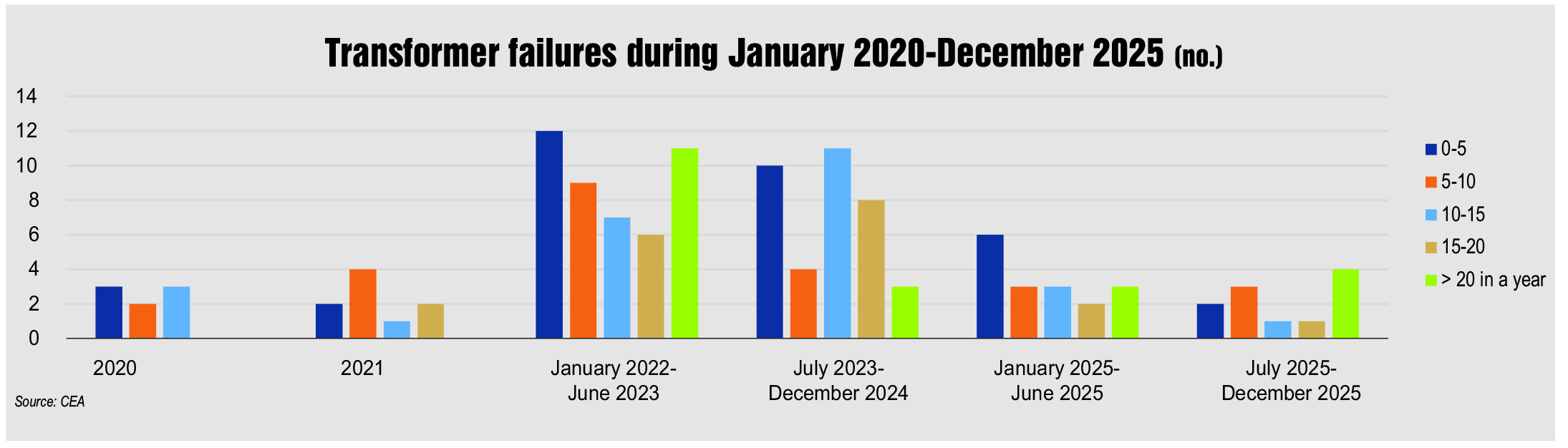
According to the report by the Standing Committee of Experts constituted by the Central Electricity Authority (CEA), a total of 17 transformer failure incidents were reported to the authority by eight utilities, namely, Delhi Transco Limited (DTL), the Damodar Valley Corporation, Gujarat Energy Transmission Corporation Limited (GETCO), Maharashtra State Electricity Transmission Company Limited, NLC India Limited, NTPC Limited, Punjab State Transmission Corporation Limited and Uttar Pradesh Power Transmission Corporation Limited during the period from January 2025 to June 2025. Of the total failures reported, six pertained to the 220 kV class and 11 to the 400 kV class, with no failures reported in the 765 kV class. In terms of operational life, six transformers failed within five years of service, three within 5-10 years, five during 10-20 years of operation, and three after more than 20 years in service.
Subsequently, during the period from July 1, 2025 to December 31, 2025, a total of 11 transformer failures in the 220 kV and above voltage class were reported by eight utilities, namely, DTL, GETCO, Haryana Vidyut Prasaran Nigam Limited, NHPC Limited, Odisha Power Transmission Corporation Limited, Rajasthan Rajya Vidyut Prasaran Nigam Limited, THDC India Limited and Tamil Nadu Transmission Corporation Limited. Of these, eight failures were in the 220 kV class and three in the 400 kV class, with none reported in the 765 kV category. With respect to age profile, two transformers failed within five years of operation, three in the 5-10-year range, two during 10-20 years, and four after more than 20 years of service.
 Observations and recommendations
Asset monitoring
To address the recurring failures of transformers and reactors, the CEA has emphasised the need for a shift towards proactive and technology-driven asset management practices. A key recommendation is the implementation of a centralised asset monitoring system covering medium voltage and high voltage equipment such as transformers, reactors, circuit breakers, cables and switchgear. Such a system should integrate condition-based monitoring, online sensors and inspection records, while maintaining a comprehensive database of factory acceptance tests, site acceptance tests and periodic testing data. Advanced analytics-based health indices, aligned with IEEE, IEC and CIGRE standards, along with features such as dissolved gas analysis, partial discharge monitoring and bushing diagnostics, are expected to significantly improve early fault detection and asset reliability.
Condition-based maintenance
The authority has also stressed the importance of adopting condition-based maintenance practices in place of conventional time-based maintenance, with a greater focus on trend analysis of test results rather than absolute values. Utilities have been advised to undertake regular operations and maintenance (O&M) of substation equipment, strengthen manpower for O&M activities, and share best practices across utilities. Timely reporting of failures to original equipment manufacturers (OEMs), even beyond the warranty period, has been highlighted as critical for enabling design improvements and reducing future failures.
Life cycle management
Utilities are encouraged to enhance life cycle management practices by maintaining detailed equipment histories, including testing records, maintenance logs and operational performance data, to support informed run-refurbish-replace decisions. Close monitoring of ageing assets, periodic testing prior to warranty expiry, and prompt repair or replacement upon detection of abnormalities are essential measures.

Design and safety
The recommendations also underline the importance of proper handling, storage, transportation and installation of equipment, in line with OEM guidelines, to prevent premature failures. Measures such as periodic testing of spare equipment, avoiding prolonged storage under unsuitable conditions, and ensuring timely commissioning have been emphasised. Design-related interventions, including minimising the use of on-load tap changers and tertiary windings where feasible, along with ensuring compliance with short-circuit withstand requirements, have also been suggested.
In addition, utilities are advised to adopt improved safety and monitoring practices, such as installation of CCTVs in substations, use of RTV coating in pollution-prone areas and regular cleaning of equipment to prevent flashovers. Detailed failure investigations, including internal inspections in coordination with OEMs and submission of reports to the Standing Committee, have been recommended to build a shared knowledge base across utilities.
Overall, the focus remains on strengthening monitoring systems, improving maintenance practices, enhancing coordination with OEMs, and leveraging data-driven decision-making to reduce the incidence of transformer failures and improve grid reliability.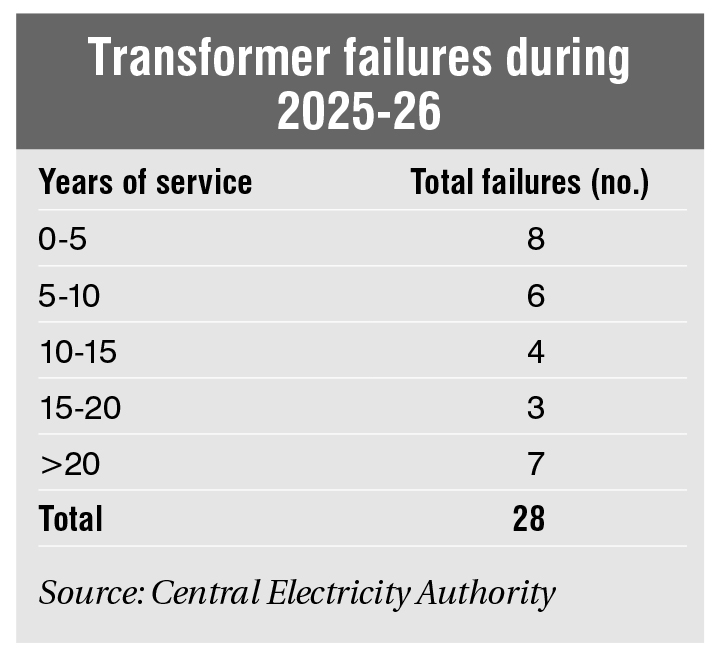
Conclusion
Transformer failures cannot be completely avoided, but they can be reduced through better design, maintenance and advanced monitoring. The rising number of failures, especially in ageing and heavily loaded assets, highlights the need for a more proactive and data-driven approach to asset management. Stronger coordination between utilities, OEMs and system operators is essential for timely feedback, design improvements and effective failure reduction.
Going forward, the focus should be on condition-based maintenance, digital monitoring and timely replacement of ageing assets. A structured approach to failure analysis, along with knowledge sharing and standard practices, will be key to improving transformer reliability and overall grid resilience.
Aastha Sharma