

India’s power grid is expanding to keep pace with rising electricity demand propelled by rapid urbanisation, industrialisation and renewable energy integration. A reliable electricity transmission system requires robust infrastructure to balance power generation, transmission and demand in real time. This also underscores the critical role of transmission assets such as substations and switchgear, which enable efficient power delivery to load centres and manage flows across a much larger and more interconnected system. Indian utilities are undertaking several initiatives to upgrade their substations and switchgear with the aim of improving power reliability, reducing maintenance requirements and enhancing operational efficiency to facilitate seamless power transmission.
Power Line takes a look at the key trends, demand drivers and the outlook for the substation and switchgear industry…
Market overview
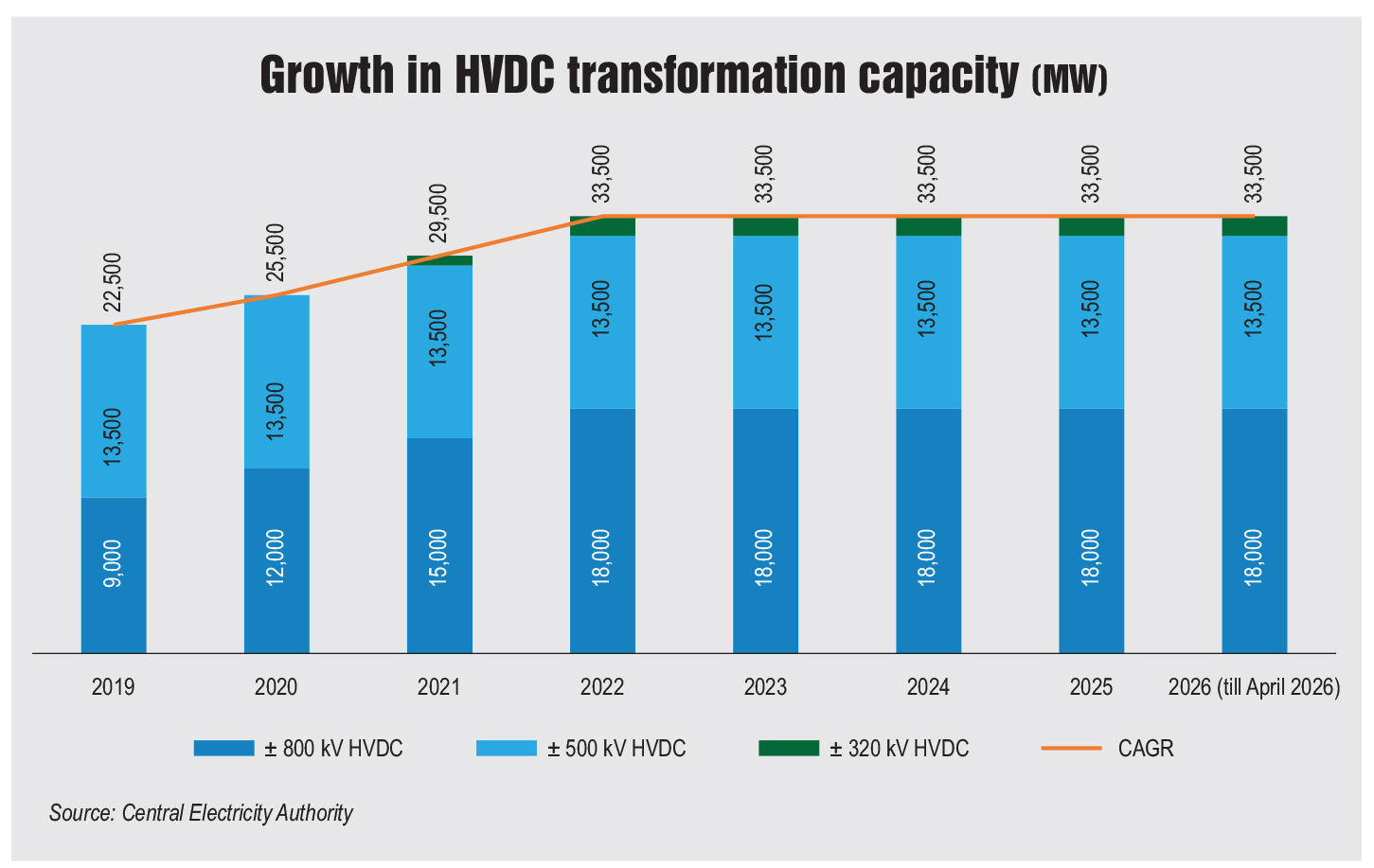
India is on the verge of building the largest high voltage direct current (HVDC) transmission networks to support its growing power infrastructure needs. The HVDC substations in India operate at various voltage levels, with the ±800 kV being the most prominent for major transmission corridors to ±500 kV and ±320 kV levels. Likewise, the alternating current (AC) substation network includes multiple standard voltage levels, with 765 kV, 400 kV and 220 kV substations serving as the primary backbone of the electricity grid infrastructure. As per the Central Electricity Authority (CEA), the AC substation capacity stood at 1,428 GVA as of April 2026. Between 2019 and 2026, the AC substation capacity has grown at a CAGR of 7.21 per cent. The HVDC substation capacity stood at 33,500 MW, having grown at a CAGR of 5.85 per cent between 2019 and 2026. The switchgear and substation market in India is experiencing growth driven by a number of factors including investments and modernisation of the power T&D network.
Demand drivers
Electricity demand
Factors such as rapid industrialisation, urbanisation and prolonged summers in India have driven electricity demand in recent years. On May 25, 2026, India witnessed an all-time-high peak demand of 268 GW. The peak demand was met by large-scale available and optimal scheduling and despatch of power generation capacities, supported by effective utilisation of transmission corridors. According to the CEA, the per capita electricity consumption in FY 2023-24 stood at 1,400 kWh, an increase of 18.54 per cent from that in the previous year. The expansion of electricity transmission infrastructure to cater to the rising electricity demand is likely to accelerate deployment of substations and switchgear in the coming years.
 Transmission network expansion
The tariff-based competitive bidding (TBCB) framework has supported swift implementation of transmission projects in India by making lowest-bid tariff discovery. The framework has pushed developers to optimise capital cost, financing, and operations & maintenance of transmission projects, along with merits such as reduction in time and cost overruns of transmission projects, increase in private investments and renewable energy integration as compared to the cost-plus regime.
In February 2026, the National Committee on Transmission declared approval for two transmission schemes under the TBCB framework, with a cumulative cost of Rs 99.8 billion to support interregional power transfers. This includes the eastern corridor: ERES-47 scheme; and the western scheme: pumped storage and new SR-WR corridor. Both these schemes include the development of 765/400/220 kV substations. Likewise, in February 2026, Power Grid Corporation of India Limited (POWERGRID) won an intra-state transmission project named Network Expansion Scheme in Maharashtra for the Removal of Transmission Constraints in Pune Region-I under the TBCB framework, which includes development work for the establishment of a 765 kV/400 kV air-insulated substation in Ahilyanagar district, bay extension works at existing substations as well as the construction of transmission lines. As of April 2026, under the TBCB route, a total of 84 transmission projects were in the construction phase, with a cumulative cost of Rs 2.34 trillion.
Renewable energy integration
Renewable energy projects are driving significant demand for substations and switchgear in India by requiring new grid evacuation infrastructure and power quality solutions to utilise variable generation. As per the CEA’s transmission plan for the integration of over 900 GW of non-fossil fuel capacity by 2035-36, the total substation capacity planned under the inter-state and intra-state to accommodate wind and solar capacity during 2026-27 to 2035-36 is envisaged at 827,600 MVA, along with 137,500 ckt km of transmission lines at an anticipated cost of Rs 7.93 trillion.
Renewable energy integration, supported by the green energy corridor (GEC) scheme and similar initiatives, is adding to the growth of interstate and intra-state substations, and switchgears. For instance, the GEC-II initiative is expected to integrate 20 GW of renewable energy capacity in the intra-state transmission that would witness the addition of 24,488 MVA of transformation capacity, with 7,929 ckt km in the electricity grid. Likewise, under the proposed GEC-III scheme, which is expected to evacuate renewable energy capacity of 134.7 GW, transformation capacity of 228,903 MVA, along with 51,126 ckt km of transmission lines, is likely to ensure clean energy transmission to load centres. Such a scenario is expected to favour the growth in the installation of substations and switchgears in the country.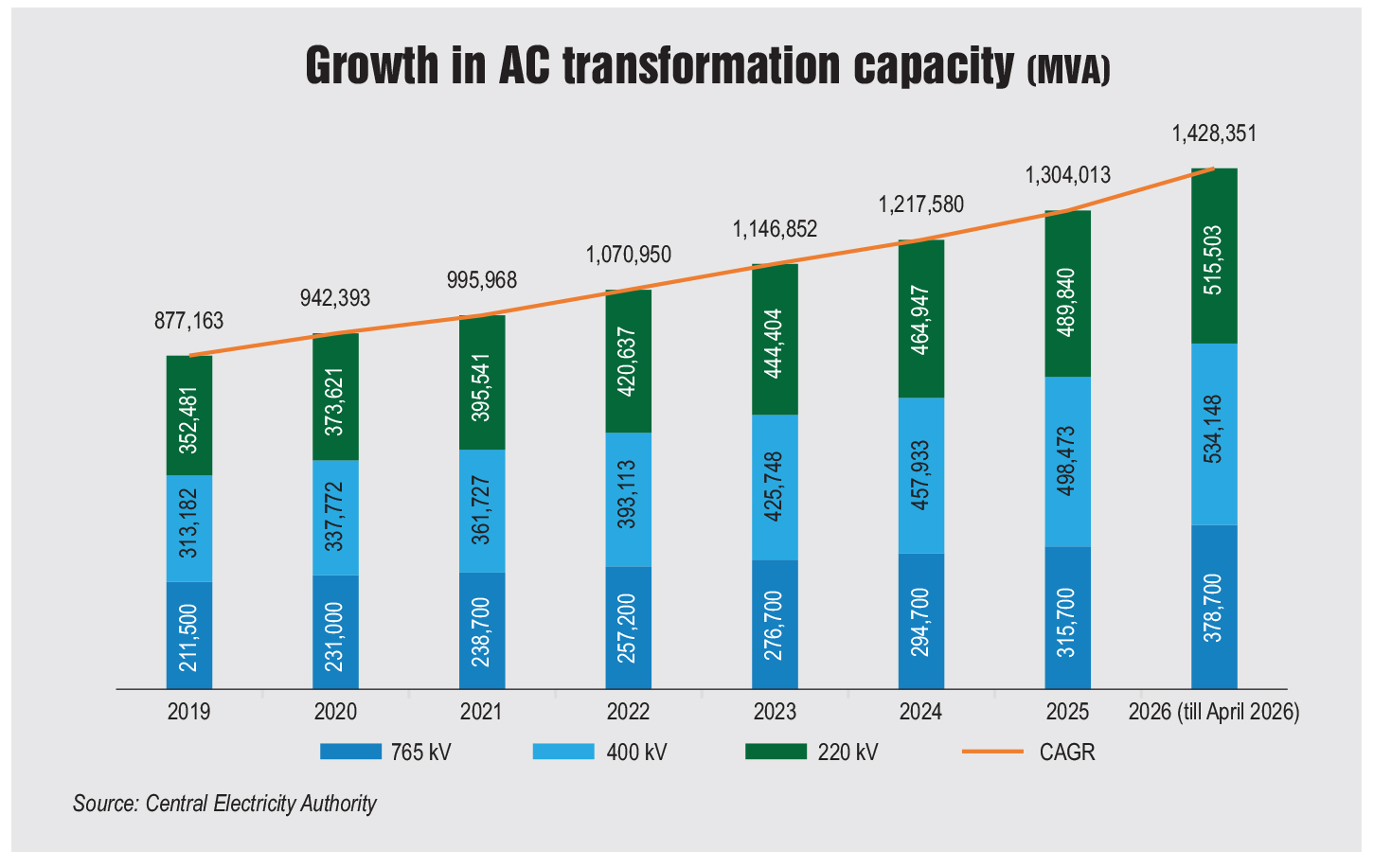
Distribution network strengthening under the RDSS
The Revamped Distribution Sector Scheme (RDSS), launched in July 2021 with a budgetary outlay of Rs 3.03 trillion to strengthen the electricity distribution network, both in terms of financial and operational aspects, focuses on loss reduction infrastructure works and smart metering works. As a part of the same, the works sanctioned under the RDSS primarily include the establishment of new substations and gas-insulated substations (GISs), upgradation of substations, replacement of old conductors, etc. As of January 2026, the estimated cost of distribution infrastructure work was Rs 212 billion, while the sanctioned central gross budgetary support for the same was Rs 127 billion. Hence, the forthcoming loss reduction works under the RDSS are likely to drive the substation and switchgear market in the country.
Technology trends
The sector is witnessing a shift in installation of GISs for several plausible reasons that address issues related to efficiency, reliability, space and environmental considerations. Urbanisation and industrial expansion have driven the need for compact substations. An indoor GIS curtails the environmental impact on switchgear too, which further reduces maintenance needs and extends its lifespan. In April 2026, Odisha Power Transmission Corporation Limited (OPTCL) won major grid infrastructure projects that include the establishment of three GISs to ensure uninterrupted and reliable power supply in Bhubaneswar. Likewise, in January 2026, Salasar Techno Engineering won a 110/22 kV GIS project worth Rs 686.7 million from POWERGRID to be established at Lawspet, Puducherry. Further, in January 2026, POWERGRID issued a tender to establish a 400 kV GIS, as part of the transmission system planned for upcoming green hydrogen and green ammonia projects in Andhra Pradesh. The establishment of GISs in the forthcoming projects could benefit the substation and switchgear market in India.
Substations are evolving from traditional, fixed infrastructure to tailored, flexible solutions that address specific grid needs. Smart substations are an advancement over traditional substations, where digital technology, automated control systems and advanced communication systems are integrated to monitor and operate electrical power systems on a real-time basis with greater efficiency and dependability.
In February 2026, the Indian Institute of Technology Bhubaneswar, developed and commissioned an advanced digital substation, equipped with a centralised monitoring and protection system. An indigenous digital substation utilises intelligent merging units unlike intelligent electronic devices and gives headway for the distributed energy resource management system as well.
Further, modern substations, such as prefabricated power solutions, mobile substations and micro substations, are novel entrants in the industry. A prefabricated substation is an electrical substation that is manufactured, assembled and pretested and is delivered as a “plug-and-play” unit. It is pre-equipped with transformers, switchgear, relays and control systems. Likewise, a mobile substation is mounted on a trailer that delivers grid-level voltage transformation in temporary, emergency or remote areas. Similarly, a micro-substation is a compact set-up that converts high voltage power directly from transmission lines to low voltage power suitable for residential consumers, thereby supplying 50-100 households per substation.
With respect to switchgear technology, the industry’s focus is shifting away from traditional switchgear and moving towards smart switchgear to enable swift response and remote operability. Smart switchgear encompass features such as real-time monitoring, data analytics and automation. This enables the quick identification of faults and supports robust energy management. A smart switchgear monitors power loads and provides balanced load distribution to optimise energy usage. Further, its ability to remotely monitor and control indicates minimal downtime. This makes smart switchgear a crucial part of sustainable energy infrastructure.
Way forward
Maintenance, repair and overhaul of switchgear and substations is likely to become a critical aspect in ensuring operational readiness, safety and cost-effectiveness. Strategies such as scheduled maintenance, repair after failure, predictive maintenance and condition-based overhaul of equipment are necessary to avoid unexpected faults, reduce outages, maximise efficiency and ensure regulatory compliance.
Considering the environmental impact that the power equipment possesses, green GIS has emerged as an alternative to conventional GIS. A recent CEA report supports utilisation of green GIS technology in the Indian grid. Green GISs not only have similar performance reliability in comparison to conventional substations but also signifies potential environmental benefits. However, the establishment of green GISs can help performance at lower voltage levels till 132 kV, but their massive scale implementation might require concentrated measures in terms of testing, standardisation and development of favourable infrastructure. Pilot project installations are likely to support the implementation of green GIS on a large scale, followed by monitoring and operation feedback. Hence, perceiving the performance reliability through such measures is expected to bring confidence among T&D utilities for the adoption of green GIS technology.
Indigenisation of switchgear and substations is important because India relies heavily on imported advanced components for its T&D sector. In December 2025, the CEA identified a list of 73 critical items that are currently imported and highlighted the need for localisation. As these items are the foundation of switchgear and substation equipment, greater emphasis on setting up domestic substation and switchgear manufacturing capabilities in India is likely to reduce the country’s dependence on imports. This will improve the availability of the equipment and also lower its cost in the market.
Switchgear and substations are indispensable to the power sector, but their evolution through technological intervention is critical to meet modernisation challenges. The power industry is shifting away from traditional electromechanical components to intelligent switchgear with internet of things connectivity, AI-driven predictive maintenance and supervisory control and data acquisition integration, while substations are evolving into smart substations with digital monitoring, real-time control and automated fault isolation. On the flip side, technological advancements often come with a cost.
Hence, the affordability of switchgear and substations remains equally crucial. They must be accessible at reasonable costs through indigenisation, production-linked incentive schemes and other cost-effective solutions.
Mohnish Makwana