India’s electricity demand has expanded significantly over the past few years, reflecting the country’s economic growth, rising electrification levels and increasing energy consumption across sectors. A major milestone was achieved on May 21, 2026, when India successfully met its highest-ever peak electricity demand of 270.8 GW. The demand was met through a diversified generation mix comprising thermal, hydro, nuclear and renewable energy resources. Renewable energy, particularly solar power, played an important role in supporting the grid during peak periods, while hydro and other flexible resources contributed to balancing system requirements.
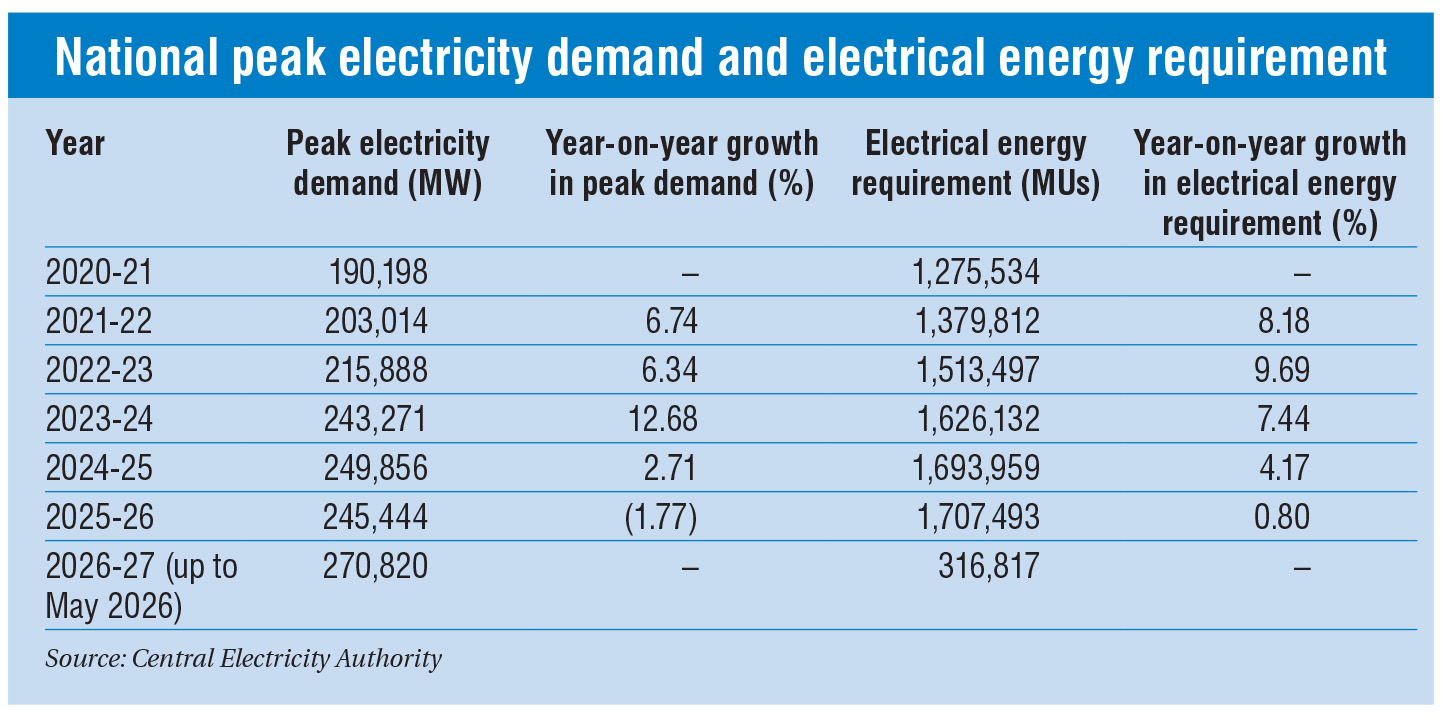
Peak electricity demand increased from about 190 GW in 2020-21 to nearly 250 GW in 2024-25, recording a compound annual growth rate (CAGR) of 7.06 per cent. Meanwhile, electrical energy requirement rose from about 1,276 billion units (BUs) in 2020-21 to around 1,694 BUs in 2024-25, registering a CAGR of 7.35 per cent. This sustained growth highlights increasing consumption trends across households, industries, agriculture and commercial establishments. India has largely been able to meet the rising demand through the expansion of generation capacity and improved grid management.
Recent trends
In 2025-26, maximum peak demand was recorded during the summer months, that is, from April to June, reaching approximately 235-240 GW in June due to increased cooling requirements. Demand moderated during the monsoon period. In September, solar and non-solar peak demand were nearly identical at around 225 GW. During the winter months, non-solar demand declined sharply to 190-210 GW, while solar-hour demand remained significantly higher, reaching 240-245 GW during December and January. October acted as a transition period when both demand levels were almost equal.
India’s power generation companies have significantly increased their purchases of natural gas through the domestic gas exchange to meet the sharp rise in electricity demand driven by the intense summer heat. According to data from the Indian Gas Exchange, power producers purchased 4.5 trillion British thermal units of gas between April 1 and May 26, 2026. This represents an almost 350 per cent increase compared to the corresponding period last year, highlighting the growing reliance on gas-based generation to address peak power demand during the summer months. Notably, during high-demand summer months, about 10 GW of gas-based power was used during non-solar hours. However, at present, challenges related to the availability and price volatility of natural gas due to the ongoing Middle Eastern crisis constrain its adoption. To address this issue, generators are exploring alternative sources.
On May 21, despatchable generation capacity, which can be ramped up or down to meet fluctuations in electricity demand, reached a peak output of 90 per cent of its available capacity. This indicates that the power system is operating with limited reserve margins, leaving little spare capacity to respond to unexpected demand surges or unplanned power plant outages. Notably, demand growth is not uniform across the country and varies significantly across states and regions. A notable example is Uttar Pradesh, which established a new national benchmark by successfully meeting a peak power demand of 32,673 MW on June 24, 2026. The state has surpassed major industrial states, including Maharashtra, Gujarat, Tamil Nadu and Karnataka, in meeting electricity demand.
 Factors driving demand growth
One of the most important drivers of recent demand growth has been the occurrence of severe heatwaves across India. Rising temperatures have led to a greater use of air conditioners, coolers and refrigeration equipment, resulting in substantial increases in electricity consumption. Cooling demand has emerged as a key determinant of peak load growth, particularly during the summer months when temperatures reach extreme levels across several parts of the country.
Agriculture has also contributed significantly to demand growth. Increased power consumption for irrigation, particularly during periods of inadequate rainfall, has raised electricity requirements in rural areas. The expansion of agricultural activities and greater access to electric pumping systems have strengthened demand from the sector. At the same time, rapid urbanisation has led to greater electricity consumption in residential and commercial establishments, while expanding industrial activity has increased the power requirements of manufacturing and processing industries.
 Government initiatives to meet future power demand
To ensure reliable power supply and meet the anticipated peak electricity demand during the summer months (April–June 2026), the government has taken several measures. It has issued directions under Section 11 of the Electricity Act, 2003, for the operation of Tata Power’s Coastal Gujarat Power Limited 4,000 MW plant from April 1, 2026, to enhance power availability for Gujarat, Maharashtra, Rajasthan, Haryana and Punjab. The progress of thermal and hydropower projects targeted for commissioning by June 2026 is being closely monitored, while approvals for renewable energy projects, particularly wind power plants and battery energy storage systems, are being expedited. Planned maintenance of thermal power plants has been deferred, making an additional 10,000 MW of generation capacity available during the summer period. Coal availability has also been strengthened, with coal-based power plants holding around 58.2 million tonnes of coal stock as of March 22, 2026, sufficient for approximately 19 days of operation at 85 per cent plant load factor. Further, Coal India Limited has been advised to conduct coal auctions under Windows I and II of the Revised SHAKTI Policy, 2025, while domestic coal transportation has been ramped up, with average rake loading increasing to 465 rakes per day. To further improve fuel supply, CIL, Singareni Collieries Company Limited, captive coal mine operators and generation companies have been directed to enhance rake loading, with progress being regularly monitored by the Ministry of Coal. Further, the Electricity (Amendment) Rules, 2026, have been notified to promote captive power generation by industries. Hydropower generation is being optimally scheduled to conserve water to meet peak demand, and all generation companies, including independent power producers and central generating stations, have been advised to maintain maximum generation availability, except during planned maintenance or forced outages.
Demand outlook
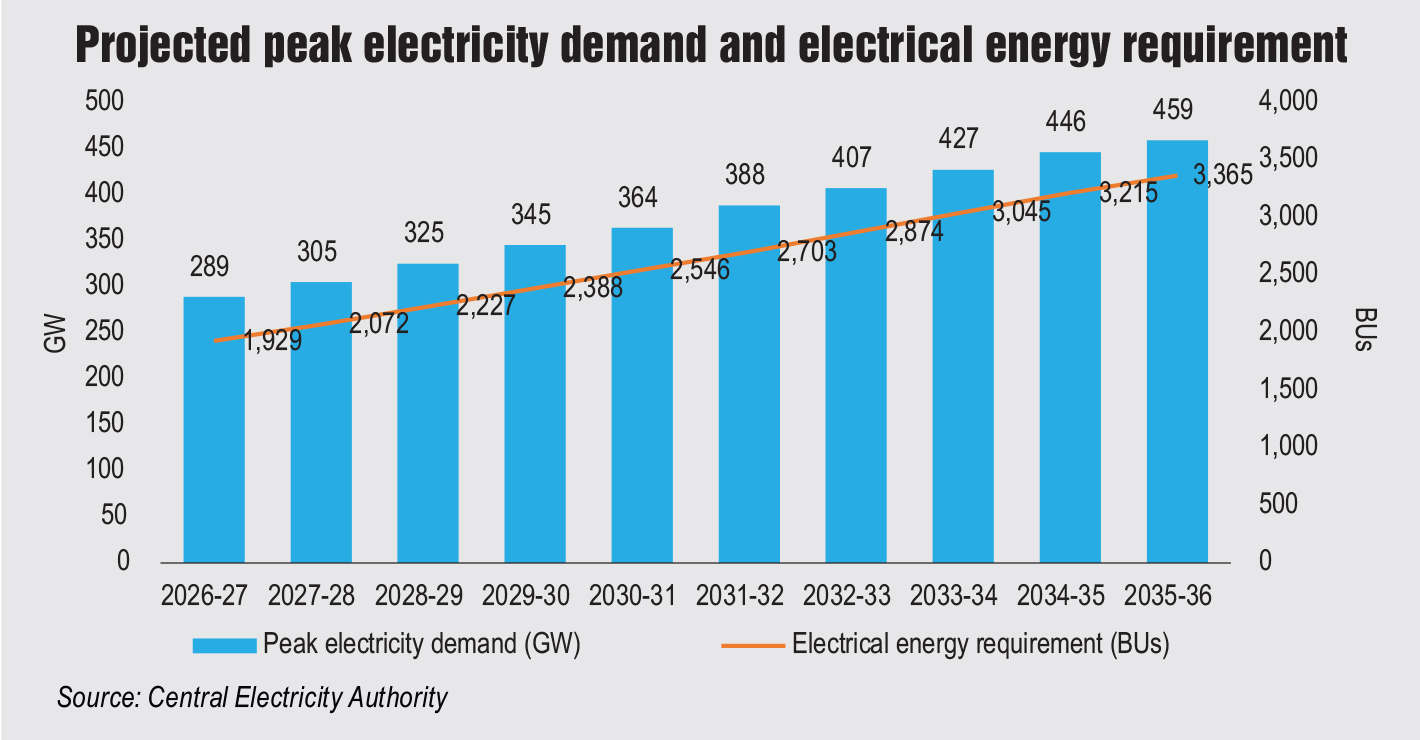
Under the National Electricity Plan, installed generation capacity is projected to reach 874 GW by 2031-32. The long-term outlook points towards continued growth in electricity demand. According to the mid-term review of the 20th Electric Power Survey, peak electricity demand is expected to grow at a CAGR of 5.58 per cent between 2024-25 and 2035-36. During the same period, the electrical energy requirement is projected to increase at a CAGR of 6.41 per cent. By 2035-36, peak demand is expected to reach 459 GW, while electrical energy requirement is projected to touch 3,365 BUs.
The peak demand projection for 2026-27 stands at 289 GW. While the projected peak demand for 2025-26 was 270 GW, the actual peak demand during the year was around 245 GW. This difference illustrates the impact of weather conditions and other external factors on actual electricity consumption. Nevertheless, the long-term trend remains firmly upward, necessitating continuous investment in generation, storage and transmission infrastructure.
Challenges and the way forward
Ensuring adequate power generation capacity during periods of peak demand is emerging as a critical electricity security challenge, particularly during night-time hours when electricity demand for cooling continues to rise and solar PV generation is unavailable. While India’s summer peak is typically reached during the day, demand rises sharply again at night as people turn on their air conditioners.
India’s electricity demand is undergoing a period of sustained expansion driven by economic growth, urbanisation, industrial development, agricultural requirements and rising cooling needs. Seasonal variations, particularly the influence of summer temperatures and monsoon conditions, continue to shape short-term demand patterns. At the same time, long-term projections indicate substantial increases in both peak demand and energy consumption. Meeting these requirements will depend on continued investments in generation capacity, renewable energy, energy storage and transmission infrastructure, along with effective planning and coordination across the power sector.
Akanksha Chandrakar