

The power transmission segment in the country has witnessed steady growth over the past few years, driven mainly by the increasing power demand and generation capacity, especially in the renewables segment. A key driver for further expansion of the grid is the evacuation of power from the upcoming renewable energy projects. Projects such as green energy corridors and a transmission system for renewable energy zones are already under way to facilitate the integration of renewable energy into the grid. On the technology front, high voltage direct current (HVDC) is gaining traction as it helps transmit electricity over long distances with minimal losses. Further, gas-insulated switchgear (GIS) substations and hybrid substations are gaining prominence to address right-of-way (RoW) issues. Transmission utilities are transitioning to newer tower designs and structures such as monopoles and multicircuit towers, and adopting various digital and online tools for asset management and monitoring.
Size and growth
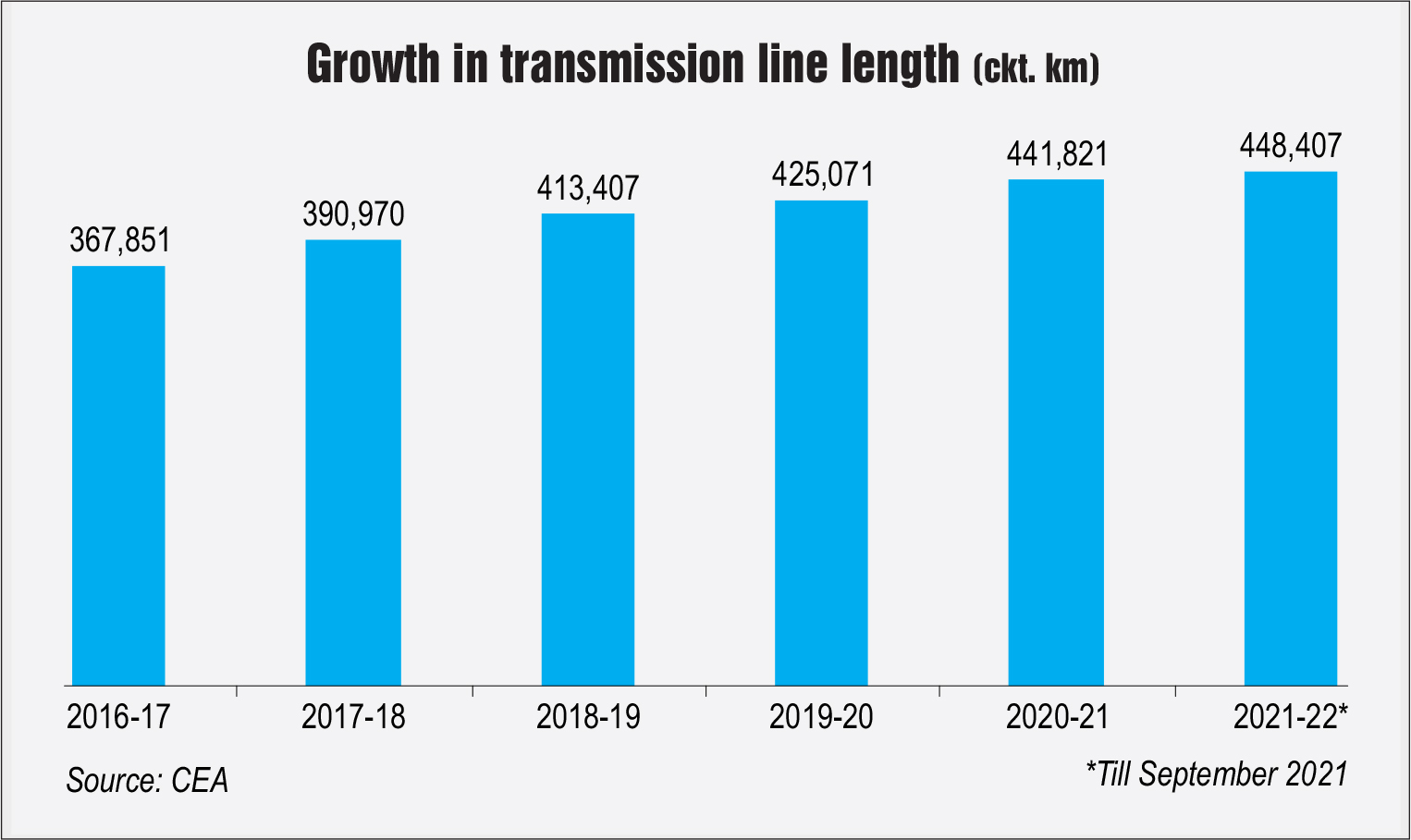
The country’s transmission infrastructure has grown rapidly over the past few years. As of March 2021, the total transmission line length (at 220 kV and above) stood at 441,821 ckt. km. Meanwhile, the alternating current (AC) substation capacity stood at 995,968 MVA, and the HVDC substation capacity at 29,500 MW. Between 2013-14 and 2020-21, the transmission line length grew at a compound annual growth rate (CAGR) of 6.13 per cent; and the AC and HVDC substation capacity grew at 9.8 per cent and 11.8 per cent respectively. The interregional transfer capacity more than trebled from 33,950 MW in March 2014 to 105,050 MW in March 2021, recording a CAGR of 17.5 per cent. During 2021-22 (till September 2021), the transmission line length stood at 448,407 ckt. km, and AC and HVDC substation capacity at 1,027,391 MVA and 32,000 MW respectively. Further, the interregional transfer capacity stood at 110,750 MW.
Power Grid Corporation of India Limited (Powergrid) continues to dominate the country’s transmission sector with 170,724 ckt. km of lines and 451,351 MVA of substation capacity (as of September 2021). In recent years, private participation in the transmission segment has increased significantly. The share of private players in terms of total line length increased from 3.3 per cent in 2011-12 to 7.6 per cent in 2020-21. Meanwhile, their share in terms of substation capacity increased from 0.5 per cent to 4.2 per cent.
In order to fast-track the development of the country’s transmission network, tariff-based competitive bidding (TBCB) was introduced in 2006. As of September 2021, 55 transmission projects (excluding cancelled and under-litigation projects) were awarded under TBCB. Of these, 36 projects have been commissioned while the remaining 19 are under construction. Further, of the awarded projects, 35 were secured by private players, while 20 were won by Powergrid. The key private players in the transmission segment include Sterlite Power Transmission Limited and Adani Transmission Limited.
Growth drivers
The transmission segment is set to grow in the coming years, driven mainly by the need to evacuate power from large-scale renewable energy projects. With the government’s target of setting up 175 GW of renewables by 2022 and 450 GW by 2030, transmission systems will require significant expansion and strengthening. Besides the changing energy generation mix, consumers are turning into prosumers as they are both consuming and producing electricity; and decentralised generation of energy is becoming popular. Together, they make the grid even more complex as it becomes the centre of both generation and consumption. In times to come, there will be a need to manage bidirectional flows and multiple feeding points. This makes green grids and green energy corridors (GECs) much more important.
In September 2021, the central government announced plans to offer 44 new transmission projects worth Rs 414 billion under the GEC programme through the TBCB bidding process. These projects will evacuate about 38 GW of renewable energy from the western and northern regions. The projects are a part of the central government’s flagship GEC programme, which aims to connect renewable energy zones (REZs) with the national grid. The major projects include the Rajasthan REZ, Gujarat (Khavda), system strengthening in north, system strengthening in south, Gujarat (Dholera), Rajasthan (Neemuch), and Bhatapara augmentation.
Another growth driver for transmission infrastructure is the government’s focus on creating a regional power grid to utilise resources in the South Asian region in an optimal manner and stabilising the Indian grid in the wake of the increasing share of renewables. To realise the vision of a South Asian grid, there is a need to build new transmission networks and strengthen existing ones. The One Sun One World One Grid initiative envisions connecting all countries with solar energy supply across the Tropic of Cancer. India plans to take a major leap towards building an intercontinental renewable energy transmission network.
The growing power demand also creates the need for transmission network expansion. The per capita electricity consumption in India stood at 1,208 units in 2019-20, which is expected to reach 2,984 units by 2040. Further, the new forms of load, such as the charging of a large number of electric vehicles, data centres and Indian Railways, which is undertaking an electrification drive, will be some of the other key drivers for the expansion of the transmission network.
The demand will also come from the renovation and modernisation of sub-transmission networks. As per a Ministry of Power’s recent order, all 33 kV systems, which are currently maintained by state distribution companies, will be brought under the state transmission utilities in a phased manner for better planning, loss reduction and increased supply reliability.
Technology focus
Owing to factors such as increasing urbanisation, limited space availability and the need to quickly scale up the transmission infrastructure, developers are looking at towers that require minimum RoW approvals, can be installed faster and provide cost benefits. Therefore, utilities now prefer monopoles or narrow-base lattice towers to conventional lattice-type towers. Moreover, transcos are increasingly deploying emergency restoration system (ERS) towers following natural disasters.
Powergrid has been installing monopoles since 2008-09 to save space and avoid the felling of trees. The utility recently commissioned the ±320 kV Pugalur (Tamil Nadu)-Thrissur (Kerala) voltage source converter-based high voltage direct current system with monopoles. Sterlite Power has used monopoles for uprating the Mallapuram-Manjeri line from a 66 kV single-circuit to a 110 kV D/C for the Kerala State Electricity Board. The Gurgaon Palwal Transmission project of the India Grid Trust has deployed multicircuit monopole towers for transmission lines for space optimisation. As of 2020-21, Adani Transmission Limited had two ERS sets in the central part and one ERS set in the western part of the country. More recently, during the 2021 Taukte cyclone, Powergrid used the ERS to set up 11 towers and constructed 10 new towers for restoring the 220 kV Timbdi-Dhokadva line, feeding power to the Union Territory of Diu.
Owing to time and space constraints, new and emerging technology solutions are being deployed for the construction and operation of transmission projects. Project developers are deploying LiDAR technology, drones and air cranes for the construction of transmission lines, and thermovision cameras and Android-based applications for operations and maintenance. In order to enhance the availability of the transmission network, utilities are deploying online asset monitoring tools. The state utilities are also making arrangements for remote inspection and maintenance. For immediate fault detection and faster rectification, MAHATRANSCO has started using drones to carry out inspection and maintenance assessment of power lines in the state.
Issues and challenges
Several challenges need to be addressed to ensure that the grid expansion plans are on track. Due to the lack of harmonisation of policies and regulations across states, developers face issues in project development, particularly in securing RoW and obtaining environmental and forest clearances. While developers have taken steps to overcome RoW challenges by deploying advanced design and technology options for towers and transmission lines, advanced technological options cannot be deployed across all projects. Apart from this, there are challenges related to the short gestation period of renewable energy plants vis-à-vis that of transmission projects.
To meet the future peak load and integrate huge renewable energy projects going forward, huge investments will be required to strengthen and ramp up the country’s transmission infrastructure. The National Infrastructure Pipeline has estimated a capital expenditure of about Rs 3,040 billion for the power transmission segment between 2020 and 2025. State utilities are expected to lead the transmission segment with a projected capex of Rs 1,900 billion. Hence, India must shift its priority to strengthening its transmission infrastructure in order to ensure a smooth green energy transition.
Nikita Gupta