

The operational performance of power utilities has improved during the past year, with an increase in economic activities post-Covid. Power demand has increased, which is also reflected in the rising utilisation levels, measured by the plant load factor (PLF) of thermal power plants (TPPs). The majority of the state transmission utilities fared well in the past year, reporting a decline in transmission losses. The aggregate technical and commercial (AT&C) losses of discoms have also reduced, although they are still above the targeted level of 15 per cent in most states.
Power Line presents an overview of the performance of utilities across the power sector during the past year…
Generation
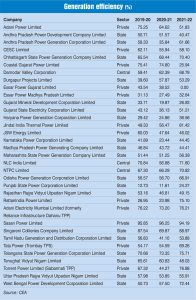
The national PLF of TPPs stood at 58.87 per cent during 2021-22, an increase of 4.3 percentage points from the 54.57 per cent recorded during 2020-21. Meanwhile, the PLF for the April-August 2022 period stood at 65.26 per cent (tentative).
Of the 34 utilities tracked by Power Line Research during 2021-22, 26 utilities reported an increase in PLF over the previous year. The highest PLF (at 94.19 per cent) was reported by Sasan Power Limited, which operates the 3,960 MW Sasan ultra mega power project in Madhya Pradesh, followed by Singareni Collieries Company Limited (SCCL) with a PLF of 88.97 per cent. SCCL operates the 1,200 MW Singareni TPP in Telangana.
Sector-wise, the central sector recorded the highest PLF during 2021-22. The average PLF of central sector-owned plants stood at 69.71 per cent, higher than the 63.47 per cent recorded in the previous year. In the state sector, the PLF was recorded at 54.5 per cent during 2021-22, much higher than the 46.23 per cent recorded a year ago. In the private sector, PLFs decreased from 54.66 per cent during 2020-21 to 53.62 per cent during 2021-22 .
Among central utilities, NTPC Limited recorded a PLF of 70.82 per cent during 2021-22, about 4.54 percentage points higher than its previous year’s record of 66.29 per cent. NTPC’s best performing plant during 2021-22 was the Korba super thermal power station (STPS) in Chhattisgarh, which recorded a PLF of 93.28 per cent, whereas its lowest PLF was recorded at its Kudgi STPS in Karnataka at 31.91 per cent. Among other central sector utilities, the Damodar Valley Corporation recorded an increase of 6.4 percentage points in its PLF, from 62.39 per cent during 2020-21 to 68.79 per cent during 2021-22, whereas the PLF of NLC India Limited increased from 56.88 per cent to 71.60 per cent during 2021-22.
At the state level, SCCL was the best performing utility with 88.97 per cent PLF during 2021-22, which is well above the average state sector PLF of 54.5 per cent as well as the national average. Telangana State Power Generation Corporation Limited was the second-best performing state utility with a PLF of 75.71 per cent, followed by West Bengal Power Development Corporation Limited with a PLF of over 72.44 per cent and Chhattisgarh State Power Generation Company Limited with a PLF of 70.4 per cent during 2021-22. Only three state utilities – Andhra Pradesh Power Development Company Limited, Durgapur Projects Limited and Tenughat Vidyut Nigam Limited – recorded a decline in PLF during 2021-22 vis-à-vis 2020-21 and the rest reported an increase as compared to the previous year’s level. The biggest increase in PLF was reported by Andhra Pradesh Power Generation Corporation Limited (APGenco) and Karnataka Power Corporation Limited (KPCL). The PLF increased by 25.82 percentage points from 35.84 per cent during 2020-21 to 61.66 per cent during 2021-22 in the case of APGenco. Meanwhile, KPCL recorded an increase of 21.01 percentage points from 23.44 per cent during 2020-21 to 44.45 per cent during 2021-22.
In the private sector, PLFs varied widely from 25.94 per cent to 94.19 per cent. CESC Limited, Essar Power Madhya Pradesh Limited, Jindal India Thermal Private Limited (JITPL), RattanIndia Power Limited, Adani Electricity Mumbai Limited (AEML) (Dahanu TPP), Tata Power (Trombay TPS) and Torrent Power Limited (Sabarmati TPP) witnessed an increase in PLFs during the review period. All other private sector utilities registered a decline in their PLFs. Six private utilities reported PLFs higher than the national average. These were JITPL, RattanIndia, AEML, Sasan Power Limited, Tata Power (Trombay TPS) and Torrent Power Limited (Sabarmati TPP). The highest year-on-year decline in PLF was reported by Coastal Gujarat Power Limited, which saw its PLF go down from 74.8 per cent during 2020-21 to 25.94 per cent during 2021-22.
Meanwhile, the highest year-on-year increase in PLF was reported by RattanIndia Power Limited, which saw its PLF go up from 23.98 per cent during 2020-21 to 75.1 per cent during 2021-22. Meanwhile, Essar Power Gujarat Limited did not register any generation during 2021-22.
Transmission
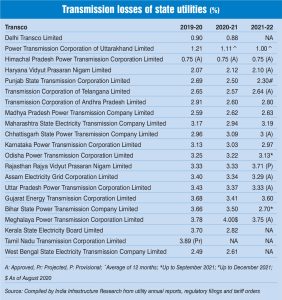
The performance of state transmission utilities improved during 2021-22 and utilities tracked by Power Line Research reported transmission losses in the range of 0.75 per cent (Himachal Pradesh Power Transmission Corporation Limited [HPPTCL]) to 3.75 per cent (Meghalaya Power Transmission Corporation Limited) during 2021-22.
Of the 17 utilities for which data is available for 2021-22, 10 utilities registered a decline in their transmission losses during 2021-22 over the previous year, while six registered an increase (Transmission Corporation of Telangana Limited, Transmission Corporation of Andhra Pradesh Limited, Madhya Pradesh Power Transmission Company Limited, Maharashtra State Electricity Transmission Company Limited, Rajasthan Rajya Vidyut Prasaran Nigam Limited, and Gujarat Energy Transmission Corporation Limited) and one utility HPPTCL did not register any change.
Among the utilities tracked, HPPTCL reported the least transmission losses at 0.75 per cent, followed by Power Transmission Corporation of Uttarakhand Limited with 1 per cent transmission loss. Meanwhile, Punjab State Transmission Corporation Limited, Madhya Pradesh Power Transmission Corporation Limited, Karnataka Power Transmission Corporation Limited, Transmission Corporation of Telangana Limited, Transmission Corporation of Andhra Pradesh, Haryana Vidyut Prasaran Nigam Limited and Bihar State Power Transmission Company Limited are other state utilities that recorded losses of 2-3 per cent during 2021-22. The rest of the state transcos reported losses in the range of 3-3.75 per cent, including state utilities of Meghalaya, Gujarat, Uttar Pradesh, Assam, Rajasthan, Chhattisgarh, Odisha and Maharashtra. The transco with the highest loss of 3.75 per cent was the Meghalaya Power Transmission Corporation.
Distribution
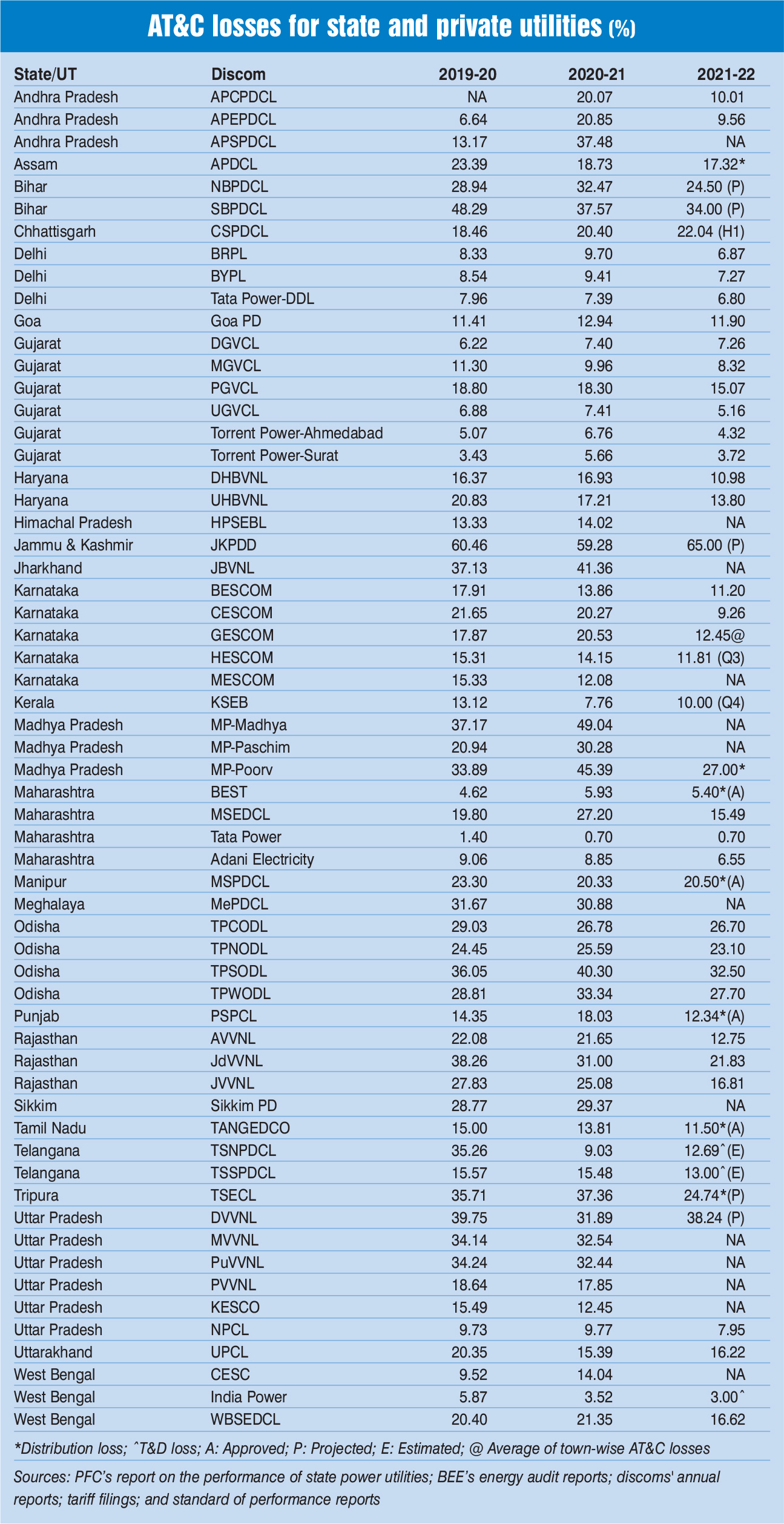
Data was collated by Power Line Research for 60 discoms (46 state-owned distribution utilities and 14 private utilities) from tariff orders, BEE energy audit report and company reports. It is observed that among state utilities, AT&C losses ranged from as low as 5.16 per cent for Uttar Gujarat Vij Company Limited (UGVCL) to as high as 65 per cent for the Jammu & Kashmir Power Development Department (JKPDD) during 2021-22. Overall, most of the state utilties have reported a decline in AT&C losses during 2021-22 vis-à-vis 2020-21. The most significant improvements were reported by Andhra Pradesh Eastern Power Distribution Company Limited (APEPDCL), Andhra Pradesh Central Power Distribution Company Limited (APCPDCL), Chamundeshwari Electricity Supply Company Limited (CESCOM), and Maharashtra State Electricity Distribution Company Limited (MSEDCL), which reported a decline of over 10 percentage points in AT&C losses.
Among state utilities, UGVCL was the best performer with AT&C losses of 5.16 per cent during 2021-22. In addition, 12 state-owned utilities reported/estimated AT&C losses of less than 15 per cent during 2021-22. These are UGVCL, APEPDCL, APCPDCL, the Goa Power Department, Dakshin Gujarat Vij Company Limited (DGVCL), Madhya Gujarat Vij Company Limited (MGVCL), Dakshin Haryana Bijli Vitran Nigam Limited (DHBVNL), Uttar Haryana Bijli Vitran Nigam Limited (UHBVNL), Chamundeshwari Electricity Supply Company Limited (CESCOM), Gulbarga Electricity Supply Company Limited (GESCOM), Bangalore Electricity Supply Company Limited (BESCOM), and Ajmer Vidyut Vitran Nigam Limited (AVVNL).
The worst performing state-owned utilities during 2021-22 were JKPDD, Dakshinanchal Vidyut Vitran Nigam Limited (DVVNL) and South Bihar Power Distribution Company Limited (SBPDCL) with AT&C losses of 65 per cent, 38.24 per cent and 34 per cent respectively. Meanwhile, private sector discoms continued to report a steady performance with losses of less than 10 per cent over the past couple of years. Only the four Odisha discoms, which were acquired by Tata Power during 2019-20 and 2020-21, have losses of 23 per cent-33 per cent. Tata Power Mumbai’s AT&C losses during 2021-22 were less than 1 per cent.
Meanwhile, Adani Electricity Mumbai Limited reported AT&C loss of 6.55 per cent during 2021-22. Among Delhi discoms, BSES Yamuna Power Limited (BYPL), BSES Rajdhani Power Limited (BRPL) and Tata Power Delhi Distribution Limited recorded AT&C losses of 7.27 per cent, 6.87 per cent and 6.8 per cent respectively. In Gujarat, AT&C losses of Torrent Power-Surat and Torrent Power-Ahmedabad stood at 3.72 per cent and 4.32 per cent respectively. Meanwhile, Noida Power Company Limited’s (NPCL) AT&C loss was recorded at 7.95 per cent. Other private discoms (which reported T&D losses during the review period) also improved their performance. The T&D loss for India Power in West Bengal was recorded at 3 per cent.
Conclusion
Overall, power utilities have seen a recovery in their operational performance post-Covid-19. The thermal power generation segment was reeling with declining PLFs, which has improved with the resumption of economic activities and increase in power consumption. The electricity distribution segment has seen some improvement in its operational performance. However, the government’s recently launched Revamped Distribution Sector Scheme is expected to strengthen the distribution network and improve the operational and financial performance of utilities. Additionally, the late payment surcharge rules will allow discoms to clear their past dues in equated monthly installments. This will improve the financial position of the segment, which has so far remained the weakest link in the electricity value chain.