

 Manish Kumar Srivastava, Executive Director (Engineering), and Pankaj Kumar Gupta, General Manager (Energy Transition & Policy Research), NTPC Limited
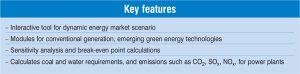
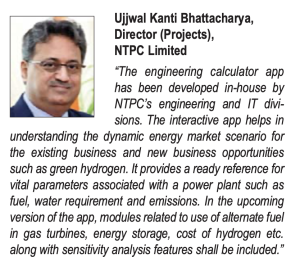
As part of its digitalisation initiative, NTPC, the country’s largest power generating utility, has launched an interactive engineering calculator app on the Google Play Store and iOS. The app has been developed in-house by the engineering and corporate IT departments of NTPC. Considering NTPC’s existing portfolio and ambitious targets for new business opportunities, the app has been designed for use cases ranging from conventional power generation to upcoming technologies associated with hydrogen, energy storage, etc. The app is an excellent tool for the basic thumb-rule calculations used in the day-to-day engineering activities of the power sector.
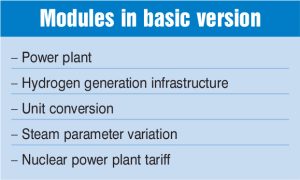
The basic version of the app provides access to five modules – power plant parameters, hydrogen generation infrastructure, unit conversions, techno-commercial impact of steam parameters on a thermal power plant (TPP), and nuclear power plant tariffs. Based on user input, various output parameters such as energy charge rate (ECR); coal and water requirements; CO2, SOx and NOx emissions in TPPs; and a basic idea of hydrogen infrastructure requirements for different hydrogen generation processes are calculated via these modules. The app also has a unique feature for the conversion of input and output parameters to different units based on the user’s requirement.
 Power plant parameters
Specifically designed for engineers and professionals in the energy sector, the power plant module includes the basic requirements for planning and operating a TPP. The module allows users to calculate power generation, coal consumption, ECR, water requirements, etc. based on inputs such as plant capacity and heat rate. Further, it provides users with the flexibility to change the input parameters and choose the TPP configuration (ultra-supercritical/advanced supercritical boilers, water-cooled or air-cooled condensers, etc.), to visualise the impact of these on various output parameters.
Options to modify fuel content parameters such as ash, fixed carbon and sulphur are also included in the app. Additionally, features related to emissions from power plants (such as CO2, SOx, NOx, ash and other pollutants) are available, providing users with a comprehensive tool to assess the environmental impact of power generation. Further, the ability to change the unit of measurement for the input/output parameters facilitates understanding as per user requirements. For example, SOx emissions can be displayed in units ranging from mg per second to kg per year. The sensitivity analysis feature enables users to enhance their decision-making through in-depth analysis of input/output parameters.
 Steam parameter variation
The steam parameter variation tab of the app is a valuable tool for engineers and professionals in the energy sector, providing a high level of customisation and insight into the impact of steam parameter variations on critical performance parameters.
With this module, users can easily input various steam parameters such as main steam (MS) pressure, MS temperature, reheater temperature and condenser pressure to assess their impact on the performance of a power plant. Further, it provides users with the flexibility to choose between subcritical and supercritical unit types, allowing for more accurate modeling of different scenarios. Users can also vary the heat rate, plant capacity, plant load factor, coal price and gross calorific value, thereby providing a high level of customisation to model-specific scenarios. The module provides insights into critical performance parameters, such as the impact of steam parameter variations on the heat rate of a plant, coal savings/requirements, cost savings and additional costs, and can help stakeholders optimise their plant designs for maximum efficiency and cost effectiveness.
 Hydrogen generation infrastructure
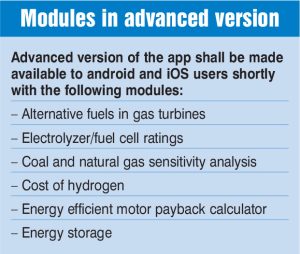
Considering the National Green Hydrogen Mission targets specified by the Government of India, the hydrogen generation infrastructure module has been designed to aid understanding of the infrastructure requirements for the generation of hydrogen. This module gives a broad idea of the water, area and renewable power requirements, and associated hydrogen generation costs. Further, a comparison of infrastructure requirements and emissions for different hydrogen production processes such as water electrolysis, steam methane reforming and coal gasification is included in this module. In the advanced version, modules related to electrolyser/fuel cell ratings, hydrogen co-firing in gas turbines (to check the hydrogen quantity required for blending, ECR, CO2 reductions, etc.), hydrogen generation costs, etc., are available.
Unit conversion
The unit conversion module provided in the basic version of the app is a useful tool for enabling quick conversion from one unit of measurement to another. We use different units for different kinds of measurement, such as pressure, temperature, length, water flow, volume and weight. This module provides users with an easy interface for all such unit conversions with just one click.
Nuclear plant tariff
The nuclear power plant tariff module estimates the completed project cost, loan repayment period, discount factor and internal rate of return based on the inputs provided by the user, in line with the tariff notification of the Department of Atomic Energy.