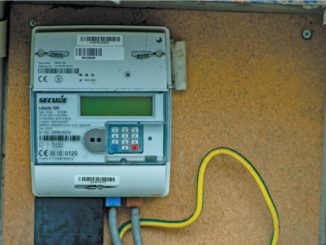
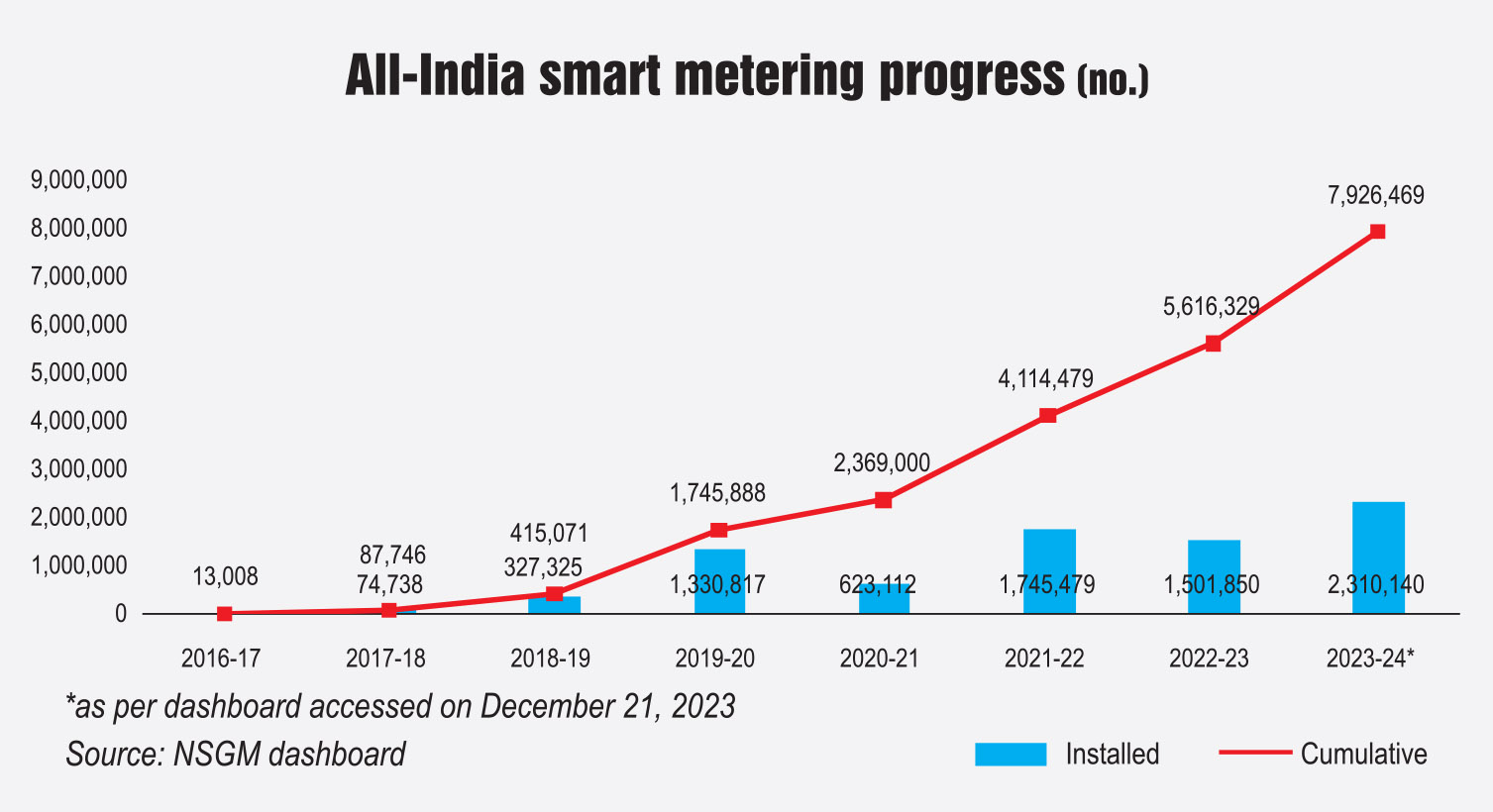
 In recent years, discoms have prioritised the modernisation of metering infrastructure through the widespread adoption of smart meters. This is aimed at enhancing the operational and financial performance of discoms. Smart meters offer several advantages, including the automatic generation of bills, the ability to prevent delayed payments through remote disconnection features and the reduction of aggregate technical and commercial (AT&C) losses. As of December 19, 2022, a total of 222 million smart meters have been sanctioned nationwide, with 7.9 million already installed, according to the National Smart Grid Mission (NSGM) dashboard. Additionally, the installation of 214 million smart meters is currently under way.
Within the framework of the Revamped Distribution Sector Scheme (RDSS), prepaid smart metering is slated for implementation, with an estimated budget of Rs 1,500 billion and gross budgetary support of about Rs 230 billion. The primary goal is to deploy 250 million prepaid smart meters over the course of the scheme. Apart from prepaid smart metering for consumers, the initiative includes the development of system metering at the feeder and distribution transformer levels. These meters will be equipped with communication features, integrated with advanced metering infrastructure (AMI) and incorporated into a unified billing system. This comprehensive approach enables discoms to automatically measure energy flows at various levels, conduct energy accounting and perform audits without the need for human intervention.
Smart metering initiatives under RDSS
Launched in 2022, the Ministry of Power’s flagship RDSS initiative aims to improve the operational efficiency and financial sustainability of discoms. With an outlay of Rs 3.03 billion for a period of five years (2021-22 to 2025-26), the scheme aims to provide financial assistance to discoms for the modernisation and strengthening of distribution infrastructure, as well as for improvements in reliability and quality of supply to end-consumers. The main objectives of the RDSS are to reduce AT&C losses to 12-15 per cent, lower the average cost of supply-average revenue realised gap to zero by financial year 2024-25 and improve the quality, reliability and affordability of power supply to consumers by creating a financially sustainable and operationally efficient distribution sector. The scheme incorporates all current projects sanctioned under programmes such as the Integrated Power Development Scheme, the Deendayal Upadhyay Gram Jyoti Yojana and the Prime Minister’s Development Package 2015.
The RDSS is divided into two key components: Part A, which aims to provide financial support for prepaid smart metering, system metering and distribution infrastructure upgrades; and Part B, focused on training, capacity building and other enabling and supporting activities. The sanctioned outlay for smart metering amounts to approximately Rs 1,349.86 billion, while for loss reduction works, it is Rs 1,191.34 billion. Under the scheme, prepaid smart metering is a critical aspect, envisaged with an estimated outlay of Rs 1,500 billion and a gross budgetary support of about Rs 230 billion, with the aim of installing 250 million prepaid smart meters during the scheme period. Further, there are plans to implement system metering at the feeder and distribution transformer levels with communication features and associated AMI, thereby facilitating the automatic measurement of energy flows at all levels for energy accounting and auditing without human intervention.
The roll-out of smart meters will be carried out via public-private partnerships in the total expenditure (totex) mode so that service-level agreements can be enforced for proper energy accounting, in turn facilitating the identification of defaulting consumers and meter tampering. Under the totex mode, due to the implementation of prepaid metering, it is expected that discoms will be able to fund monthly costs through the enhanced revenue generated from improvements in billing and collection.
Smart metering progress so far
So far, 7.9 million smart meters have been installed out of the 222 million sanctioned under the NSGM. Under the smart grid pilot projects, as of November 2023, 24,214 smart meters have been installed by the Chandigarh Electricity Division in Subdivision 5 and Jaipur Vidyut Vitran Nigam Limited has installed 145,116 smart meters to cater to 0.15 million consumers. The project entails the deployment of smart meters, AMI, distribution transformer monitoring units (DTMUs) and supervisory control and data acquisition (SCADA) systems.
The progress in the implementation of smart grid initiatives reflects significant strides in enhancing the efficiency and reliability of the power distribution system. Building on the successful completion of 11 smart grid pilots under the Restructured Accelerated Power Development and Reforms Programme (R-APDRP), these projects have tested and validated a range of advanced technologies. The pilots, encompassing smart metering, radio frequency/power line communication/GPRS communication, peak load management, DTMU, net metering, outage management systems and rooftop solar integration, showcase a holistic approach to grid modernisation. The integration of the metering, billing and collection system with AMI/smart metering underscores the seamless synergy between billing systems and cutting-edge metering technologies. The release of Rs 1.19 billion as part of the gross budgetary support further demonstrates the financial commitment to these transformative endeavours under the R-APDRP. Notably, nine new projects with a total cost exceeding Rs 12 billion have been sanctioned across seven states, namely, Chandigarh, Rajasthan, Maharashtra, Uttar Pradesh, Kerala, Odisha and Jharkhand.
Success factor for smart meter project roll-out
The successful implementation of a smart metering project relies on meticulous planning and execution. The timely commencement of the project is vital, involving the prompt signing of the contract agreement, the establishment of a special purpose vehicle and the implementation of a payment security mechanism as per the standard bidding document. Additionally, ensuring efficient material supply is critical, necessitating the issuance of purchase orders to original equipment manufacturers and the formulation of a supply schedule. The establishment of a dedicated smart metering wing within the utility, comprising members from IT, technical and commercial wings, ensures a holistic approach to project management. Further, for project execution, it is crucial to finalise a detailed Level 2 plan and develop standard operating procedures (SOPs) with clearly defined responsibility centres. These SOPs should address key field issues such as the meter change process, verification of the last meter reading, meter dismantling and installation, sealing, old meter disposal or return and delta updates of consumers through an application. Moreover, the definition of an escalation matrix for resolving right-of-way issues will add a layer of efficiency to project execution.
IT integration is a crucial component, emphasising the seamless integration of meter data management with other utility systems and the integration of advanced metering infrastructure service providers’ (AMISP) customer interface app with the utility’s customer information system or enterprise resource planning system for routine master data updates. The proactive inclusion of regular cybersecurity audits aligns with the stipulations of the request for proposal. Enabling prepaid connections involves revisiting the tariff structure to collaboratively devise prepaid-friendly tariffs with the utility and the state electricity regulatory Commission. Implementing rebate mechanisms encourages consumer adoption of prepaid metering, and a user-friendly application with multiple recharge options enhances the overall customer experience.
Challenges in smart meter project roll-out
The challenges inherent in rolling out a smart meter project are diverse and require careful consideration to ensure successful implementation. In terms of IT system integration, complexities arise from the intricate connection between the utility IT system and meter data management systems, leading to delays and increased costs. The standardisation of key elements in the AMI value chain, clear integration touchpoints/ data flow diagrams during the tendering stage and the joint identification of the responsible, accountable, consulted, informed matrix with existing utility system integrators and AMISP offer viable solutions. Communication network challenges, including fast-evolving technology and unreliable networks, can be mitigated through the adoption of international/national standards, dedicated communication bandwidth for smart metering and cost optimisation with large-scale operations.
Consumer engagement presents its own set of challenges, such as hesitation during the transition to smart metering, misinformation, lack of awareness and difficulties in engaging those less familiar with technology. Addressing these issues requires comprehensive awareness campaigns, the provision of offline recharge centres for non-tech-savvy consumers and the development of a user-friendly app. Regulatory and tariff challenges involve the need for tariff restructuring, standardisation of components, rebates and adjustments to security deposits for prepaid connections. Solutions include adapting tariffs to the prepaid system, standardising deduction mechanisms and ensuring consistent rebates across states.
Data security challenges encompass unauthorised access, consumer concerns about data usage and potential vulnerabilities in smart meters. Implementing strong security measures, educating consumers, having transparent data privacy policies and offering opt-in/opt-out choices for data sharing with third parties are essential solutions. Supply chain challenges, such as shortages and limited manufacturing capacity, can be addressed by increasing local content, reusing healthy static meters and having predefined SOPs for phased meter installations. Finally, the handling of removed meters necessitates SOPs to ensure effective resource utilisation, utilising healthy static meters until the smart meter roll-out and engaging vendors for scrap handling before project commencement to manage environmental hazards and manufacturing limitations.
Outlook
The smart distribution roadmap under the NSGM outlines a comprehensive plan for the evolution of distribution infrastructure, incorporating key milestones by 2023, 2026 and 2030. By 2023, the focus is on deploying prepaid smart meters, targeting all consumers (excluding agricultural consumers) in specific electrical divisions with over 50 per cent urban consumers and AT&C losses exceeding 15 per cent in 2019-20, to be accomplished by December 2023. The roadmap emphasises the formulation of policies and standards for smart charging stations and smart inverters, and the exploration of small pilots, as demonstrated by Tata Power Delhi Distribution Limited, for smart energy storage systems. Moving forward to 2026, the plan envisions the extension of prepaid smart meters to all consumers in areas with prepaid smart meters by March 2025, covering the remaining distribution transformers. It also aims to integrate real-time data acquisition system across 3,800 towns by 2026, accompanied by consumer indexing and asset mapping on GIS maps after the installation of smart meters. Pilot programmes up to 2025-26 will explore demand response, vehicle-to-grid technologies, smart microgrids and smart homes.
Looking ahead to 2030, the roadmap anticipates leveraging smart meter data for various use cases, including loss reduction, demand forecasting, asset management, time-of-day (ToD) tariffs, renewable energy integration, network management and consumer analytics. GIS mapping is projected to extend to the 11 kV distribution transformer level by 2030. The integration of SCADA, distribution management systems, outage management systems and GIS is envisaged to empower utilities to optimise operational advantages by 2030, facilitating replication in other towns and areas based on their experiences. Peer-to-peer trading of rooftop solar on blockchain platforms by utilities with high solar rooftop installations and the prioritisation of grid-interactive net zero buildings underscore the roadmap’s commitment to advancing a smart, sustainable and efficient distribution network.
To conclude, as the country’s energy consumption continues to rise and is anticipated to surge in the years to come, the adoption of new technologies will unquestionably offer significant advantages to utilities. Looking ahead, the integration of emerging technologies will be pivotal in constructing a robust smart grid for the future.
Based on a presentation by Atul Bali, Director, NSGM, at a recent Powerline conference