

The US is focusing on modernising its electric grid through dedicated funding under the Infrastructure Investment and Jobs Act (also known as the Bipartisan Infrastructure Law [BIL]) and the Inflation Reduction Act (IRA). Independent estimates project a 60 per cent expansion in transmission systems by 2030, potentially tripling by 2050, to meet clean electricity and resiliency demands. The US Department of Energy (DOE), which is the nodal agency for the disbursement of BIL and IRA funds for clean energy programmes, is implementing several strategies to help reduce siting and permitting delays in the construction of new transmission projects. It aims to ensure reliability, reduce consumer costs and enable the addition of new clean energy resources. Initiatives include the Transmission Siting and Economic Development (TSED) grant programme (established under the IRA); the Coordinated Interagency Transmission Authorisations and Permits Programme to improve the efficiency of federal permitting processes; and the National Interest Electric Transmission Corridors to unlock additional federal funding, and siting and permitting tools.
The IRA provides $760 million in TSED grants to support states and local communities in the siting and permitting of interstate and offshore electricity transmission lines (Section 50152) and an additional $100 million to support the planning, modelling, analysis and convening of stakeholders (Section 50153). In line with this, on August 29, 2023, the DOE announced a $300 million funding opportunity as the first tranche of the programme. Going forward, two additional application phases will be available in the summer of 2024 and the fall of 2025.
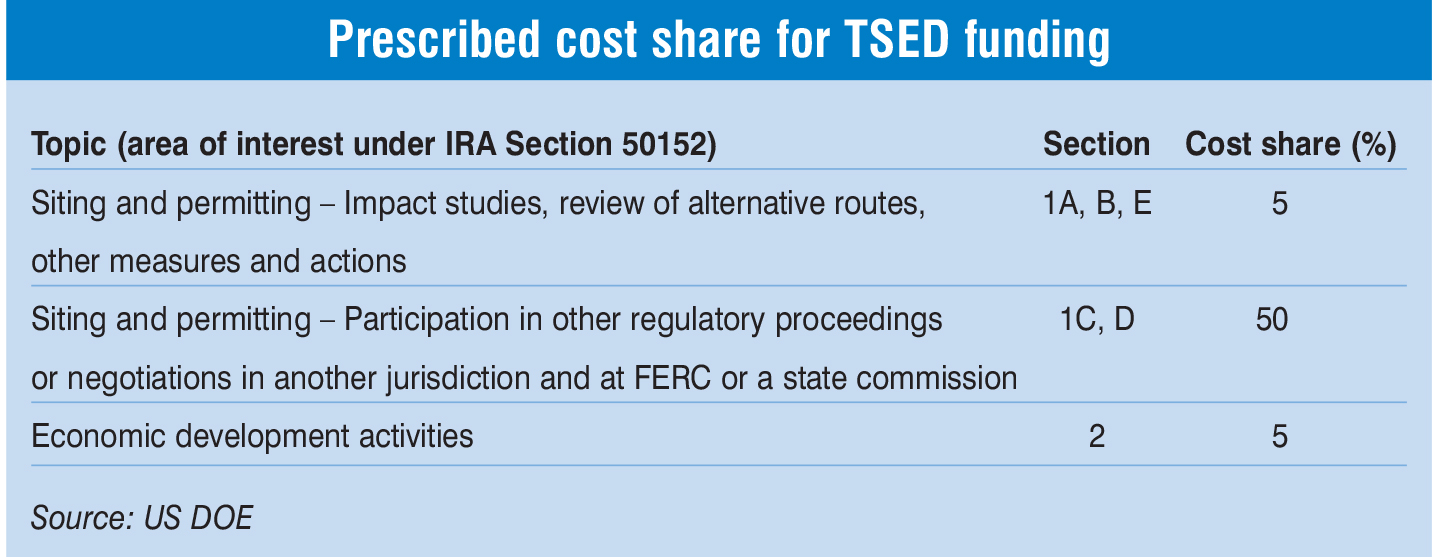
Administered by the DOE’s Grid Deployment Office (GDO), the TSED grant programme will support states, tribes and local governments in strengthening and accelerating the siting and permitting processes of qualifying or covered projects, as well as the economic development in communities affected by the construction and operation of such projects. Qualifying or covered transmission projects include high voltage interstate or offshore transmission lines (alternating current or direct current) proposed for construction and operation at a minimum level of 275 kV (for onshore) or 200 kV (for offshore) by an entity that has applied or informed a siting authority of its intent to apply for regulatory approval. All awardees are required by law to share a minimum of 5 per cent of the costs with the DOE.
Siting and permitting activities
Activities eligible for funding include studies and analysis of the impacts of qualifying projects, examination of up to three alternative siting corridors for covered projects, participation by the siting authority in regulatory proceedings or negotiations in another jurisdiction or proceedings at the Federal Energy Regulatory Commission (FFRC) or a state regulatory commission (subject to a 50 per cent cost share), and other actions that may improve and shorten the processes for approval by the siting authority. These other actions include increasing human resources capacity, such as staff or consultants; coordination within the state or with other state, tribal or federal jurisdictions; and robust engagement and communication with stakeholders, including impacted communities. All activities, except regulatory proceedings, involve a cost share of 5 per cent.
Authorities receiving funding for siting activities must agree to reach a final decision on an application within two years of the grant being disbursed, unless the DOE extends the timeline. Unutilised funds must be returned to the DOE.
 Economic development activities
Eligible TSED award recipients for economic development activities include siting authorities and other state, tribal or local government entities working with communities, and they can partner with community organisations such as non-profits. The DOE could consider projects such as sub-grant programmes enabling communities to propose local activities; investments in local energy resilience, such as microgrids or solar; affordable and sustainable housing; community infrastructure such as broadband, public safety facilities, community centres, green spaces or species habitats; job training and apprenticeship programmes; and low-income energy funds to reduce costs for qualifying community members. The DOE is flexible and urges communities to propose projects tailored to meet local needs.
Under this, the DOE can award economic development activities but cannot disburse the funds until certain milestones are achieved in the transmission project development, such as obtaining permits or commencement of construction. Further, awardees are required to contribute 5 per cent of the total costs.
The way forward
Applicants must prepare and submit a four-to six-page concept paper or a brief, expressing a high-level interest. It should include seven key elements: the basis of eligibility; a description of the proposal and objectives; identification of two to three high-level risks and challenges and possible risk mitigation strategies; schedule for the project, including start dates for spending grant funds; identification of the transmission project; identification of qualification, experience and resources of the applicant to ensure project completion; and requirement of partners if applicable. The deadline for the submission of concept papers was November 17, 2023, and the DOE is expected to respond in early 2024. The complete application deadline is April 5, 2024, with the final selection notification expected in the summer of 2024. The DOE aims to allocate approximately $200 million for economic development activities and $100 million for siting and permitting for up to 40 projects under each category. The period of performance may vary from 24 to 28 months.
In October 2023, the GDO announced that there would be two additional application phases in summer 2024 and fall 2025. The DOE intends to accept a second round of concept papers in August 2024, with full applications due in winter 2024-25; and a third round of concept papers in fall 2025, with full applications due in winter 2025-26.
Notably, while transmission developers are ineligible for TSED grants, the DOE encourages their collaboration to identify innovative solutions that enhance coordination across jurisdictions, streamline permitting processes and resolve bottlenecks. The latest financial aid is expected to support studies, modelling, environmental planning and analysis to expedite decision-making and reduce processing times for applications. This is crucial to address the existing challenges posed by lengthy siting and permitting processes, expediting the construction of transmission infrastructure to achieve the country’s clean energy goals.