

 A dominant player across the power generation segment, NTPC Limited has a large installed capacity fuelled primarily by coal. The company is, however, diversifying its portfolio and is aiming for 60 GW of capacity through renewable sources by 2032. Alongside, the company is focusing on efficient ash management and emissions reduction, and is adopting measures for decarbonisation and sustainability to meet the country’s growing energy needs. At a recent Power Line conference, K. Shanmugha Sundaram, Director (Projects), NTPC Limited, provided insights into the company’s growth, its proactive measures to address environmental concerns and its future energy initiatives. Edited excerpts…
NTPC Limited, India’s largest energy conglomerate has an installed capacity of around 74 GW with coal being the predominant fuel in its energy portfolio. NTPC was established in 1975 to accelerate power development in India and since then, it has established itself as the dominant power major with a presence across the value chain of the power generation business.
Its power generation journey began modestly with a 200 MW coal-based unit at Singrauli in Uttar Pradesh way back in 1982. NTPC became a Maharatna company in May 2010 and is ranked as the No. 2 Independent Power Producer (IPP) in Platts Top 250 Global Energy Company rankings.
In order to strengthen its core business, NTPC has diversified its portfolio across various sectors, including coal mining, hydro, renewables, consultancy, power trading, and green hydrogen mobility, thus emerging as an integrated energy player.
Some of the company’s noteworthy milestones include the commissioning of its first supercritical thermal plant in 2011, the commissioning of the Koldam hydro project in 2015, the commissioning of its first ultra supercritical unit in 2019 and the commissioning of India’s first air-cooled condenser (ACC) for the supercritical plant in North Karanpura in 2023.
NTPC has ventured into overseas projects with a 1,320 MW supercritical coal plant in Bangladesh. It has recently commissioned India’s largest floating solar PV project of 100 MW at Ramagundam, Telangana.
NTPC has been operating its plants in an efficient way, resulting in higher plant availability. As of March 31, 2023, the company accounted for about 17 per cent of the total national capacity and contributed around 25 per cent of India’s total power generation. NTPC is taking several steps to make its energy portfolio greener by adding significant capacities of renewable energy. By 2032, the company plans to have 60 GW of capacity through renewable sources.
There have been several notable achievements for providing clean power from coal power plants. These include a reduction in specific water consumption with the implementation of technologies such as air-cooled condensers; efforts to mitigate emissions of sulphur dioxide (SO2), nitrogen oxides (NOx), and particulate matter (PM); and improvements in fly ash management with the implementation of dry bottom ash handling systems, as exemplified at the Patratu plant. Flue gas desulphurisation (FGD) systems have been awarded for over 65 GW. Around 7 GW has been commissioned and the rest is at various stages of construction. For controlling NOx, around 35 GW of capacity has in-built NOx control systems from the design stage itself and combustion modification has been awarded for the remaining 20 GW, of which 19 GW has already been commissioned.
India has one of the highest rates of growth in renewable energy capacity addition globally since 2016. However, the power demand is increasing at a very rapid rate in India due to ever-increasing GDP growth and, therefore, the addition of renewable energy capacity alone will not be sufficient to meet the power demand requirements. Despite the promising growth of renewable energy, it faces various challenges, including intermittency and variability, low-capacity utilisation factor, reliance on seasonal variations, import dependency for solar modules, non-availability of commercially viable large-scale storage solutions, grid stability issues, land requirement for setting up renewables and limited availability of affordable solar systems.
Additionally, challenges associated with the development of nuclear and hydro power plants such as long gestation periods and environmental challenges further signify the importance of coal power plants in India’s generation mix. Further, as per the Central Electricity Authority (CEA), peak power demand is expected to reach 366 GW by 2031-32. Therefore, coal-based power plants will remain indispensable for providing baseload power to the nation.
For meeting the above demand, as per the CEA, around 80 GW of coal-based capacity addition will be required by 2031-32. Accordingly, NTPC has planned to add 5,600 GW of coal-based capacity in Phase I. The projects in Phase I include Singrauli III (2×800 MW), Sipat III (1×800 MW), Darlipali II (1×800 MW), and Meja II (3×800 MW). An additional six projects, aggregating 11,200 MW, have been identified for implementation under Phase II. This is in addition to around 10 GW capacity that is under construction. All the new capacity additions have been planned only as brownfield projects, using high-efficiency and low-emission technologies.
Key issues and challenges in thermal power generation
Thermal power plants face various challenges, which include conventional and transitional challenges. The transitional challenges include the imperative of decarbonisation, running below critical technical minimum load, ensuring flexible operation, which is in addition to conventional challenges such as 100 per cent ash utilisation, reduction in water consumption and compliance with stringent environmental regulations. The flexible operation of thermal plants will significantly impact both boilers and turbines, leading to a reduction in the residual life and an increase in forced outages, and hence reduced reliability and availability of the plant, heat rate degradation, and increased auxiliary power consumption (APC).
NTPC has taken various initiatives to address these challenges. For ash management, various avenues for ash utilisation, including cement, bricks, paver tiles and blocks, are being explored. Within a thermal plant, ash utilisation is effective through dyke raising and buttressing. The National Highways Authority of India has been a major customer of ash generated from power plants. As a direct-use material, ash is used for road embankments, filling of low-lying areas, bottom ash mine stowing, and bottom ash sand replacement. Additionally, new technological tools that are being experimented with include mobile applications for ash management, digital piezometers, drone surveys for dyke management, as well as the use of ash in eco-dredging and watershed technology. Environmental challenges in thermal power generation include the generation of greenhouse gas, SO2 and NOx emissions, water pollution, leaching, and disposal of by-products such as ash and gypsum.
To mitigate the environmental challenges, NTPC is taking various initiatives including installing FGD systems and combustion modification systems, and undertaking ESP renovation and modernisation (R&M). On the water conservation side, NTPC has taken several initiatives such as the introducing ACCs, utilising sewage treatment plant water and ensuring zero liquid discharge (ZLD), which has resulted in a reduction in specific water consumption to 2.69 litres per kWh against the norm of 3 litres per kWh.
Further, NTPC has taken several initiatives to decarbonise its thermal power plants. These include co-firing of biomass and adoption of state-of-the-art ultra supercritical technology, etc. NTPC has already fired 125,000 tonnes of biomass at various stations. Additionally, the company has pursued R&M initiatives to improve the efficiency of existing plants. Notably, at the Ramagundam unit, R&M-focused efforts for turbine systems have led to significant improvements in heat rates, reflecting NTPC’s commitment to continuous improvement and technological advancement. NTPC is also carrying out significant R&D works for reducing carbon emissions through carbon capture from flue gases. It has successfully commissioned a 20 tpd carbon capture plant (from flue gas) at NTPC Vindhyachal. This is a first-of-its kind initiative in India. Along with the carbon capture plant, a 2 tpd hydrogen plant is being set up for the synthesis of 10 tpd of methanol from the captured CO2. NTPC is also setting up a CO2 to Generation 4 Ethanol plant at NTPC Lara. Also, R&D works are being carried out to study the techno-commercial viability of co-firing methanol in coal-based power plants for reducing CO2 emissions. These low-carbon fuels can replace the HFO/LDO being used in power plants and can significantly reduce imports.
Further, all NTPC plants are being operated with a technical minimum load of 55 per cent. NTPC has also conducted pilot tests for limited hours for a technical minimum load of 40 per cent, which may require additional system and support/compensation .
The way forward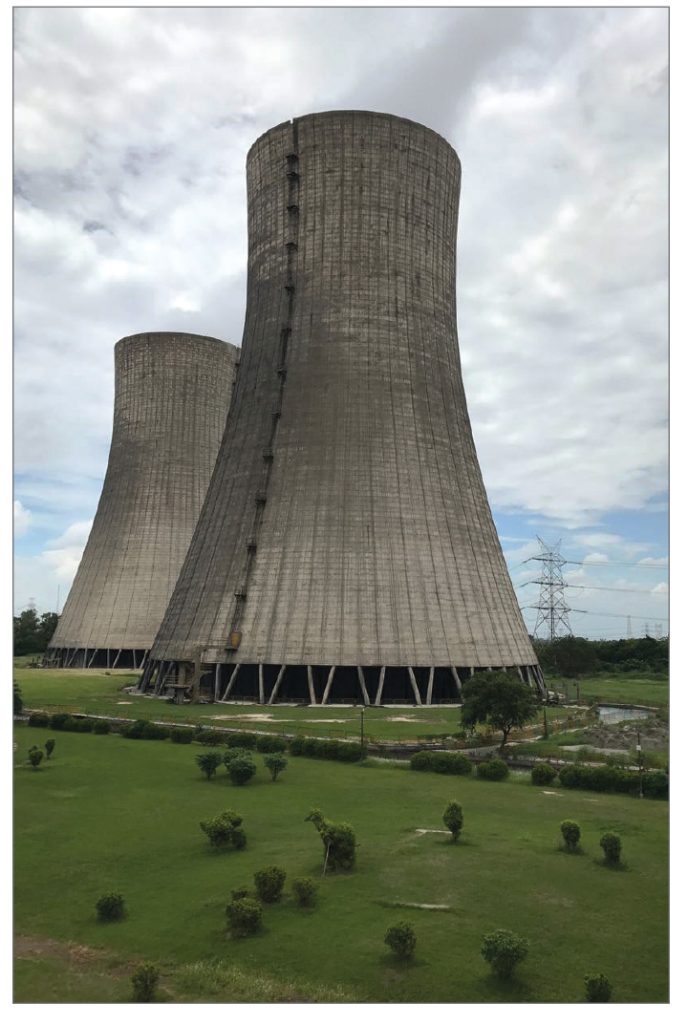
Energy transition and decarbonisation are the need of the hour to meet global climate targets. However, for a country like India, where per capita energy consumption is a fraction of the global average, ensuring energy security, sustainability and affordability is an equally important aspect. Meeting the energy needs of underserved populations and ensuring safe and sustainable energy access for the poorest and most vulnerable groups are the foremost considerations in India. The electricity requirement in India is expected to grow in tandem with its GDP growth and, as per the CEA, the per capita consumption is expected to rise to 3,000 kWh by 2040.
In view of the above and considering the challenges of the Indian scenario, renewables capacity addition alone will not be enough for ensuring reliability, sustainability and affordability in the future. Therefore, coal-based power plants are expected to remain an integral part of the energy mix in the future and decarbonising these plants will be essential for achieving the COP26 commitments and meeting Indian electricity demand in the future.
A comprehensive roadmap, along with a strong regulatory/policy framework, is required for achieving India’s net-zero emissions target in a graded manner, following a transition path with a focus on the challenges in the Indian scenario. The roadmap should include strategic utilisation of inefficient plants, increased torrefied biomass co-firing in existing plants, co-firing of low-carbon fuels, and the use of high-efficiency low-emission ultra supercritical technologies with biomass firing and carbon capture utilisation technologies in new plants.
This can bring CO2 emissions to the level of a gas power plant, thereby providing a path for future transition to net-zero emission targets. This would create a win-win situation, that is, the cheapest solution for decarbonisation, facilitating the integration of variable renewable energy into the grid, providing an opportunity for utilising coal resources, and ensuring reliable, affordable and sustainable power along with socio-economic security.
For the development of nuclear power plants in India, a joint venture has been formed between NTPC and Nuclear Power Corporation of India Limited, and we are currently working on two nuclear projects – Mahi Banswara in Rajasthan and Chutka in Madhya Pradesh.
Apart from this, NTPC has been focusing on pumped storage projects (PSPs). PSPs can be more advantageous as they can facilitate round-the-clock energy supply. NTPC’s green energy arm has recently signed an MoU with the Maharashtra government for setting up a PSP. We are currently in discussions with the Tamil Nadu and Meghalaya governments for installing PSPs. Also, NTPC has been taking initiatives in the green hydrogen space, for which the company has signed an MoU with the Andhra Pradesh government for setting up a green hydrogen hub. NTPC is also running a pilot for green hydrogen mobility in Leh and Delhi. It is also trying to establish a hydrogen-based microgrid for the Indian Army. Additionally, initiatives for harnessing energy from green ammonia, green methanol, and hydrogen in power plants and vehicles as fuels are under way.
Overall, NTPC believes that coal power plants will continue to play a significant role in future power generation in India, but with a focus on decarbonisation and emission reduction through the deployment of high-efficiency and low-emission coal technologies, co-firing of carbon-neutral/low-carbon fuels, use of carbon capture and utilisation, etc. Therefore, in addition to the installation of renewable and nuclear energy, the decarbonisation of coal power plants will play an equally important role in achieving the net-zero emission targets as well as ensuring the availability of reliable, sustainable and affordable power.