

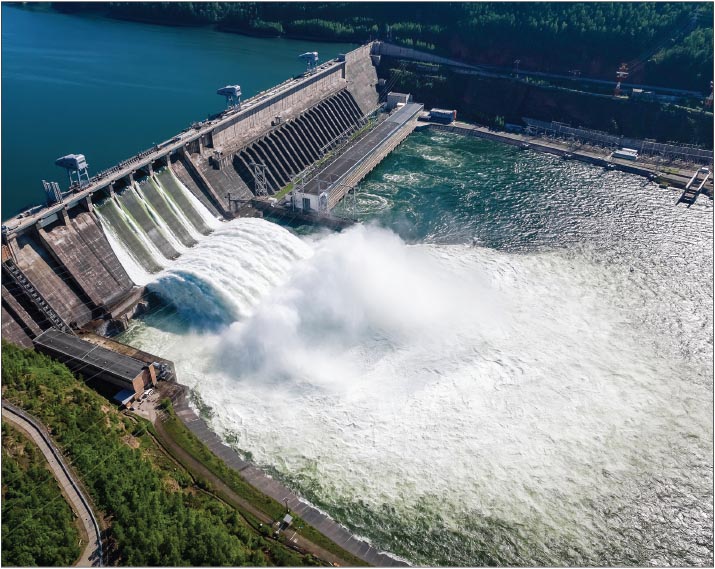
 The renovation and modernisation (R&M) of hydroelectric power plants (HEPs) presents a cost-effective strategy to address declining production levels. Instead of constructing entirely new facilities, R&M offers a more expedient approach, typically yielding positive results within a three- to four-year timeframe. HEPs typically have a standard operational lifespan of 30-35 years. Beyond this period, life extension through renovation becomes necessary to maintain optimal functionality. HEPs, despite their longevity, eventually require maintenance and upgrades to maintain optimal performance.
Approaches to R&M
Renovation projects for HEPs present an opportunity to incorporate new technological advancements. Replacing outdated materials with modern alternatives, such as epoxy insulation for generator windings instead of bitumen, and SF6 switchgear in place of conventional switchgear, can enhance efficiency and safety. Additionally, turbine upgrades can be implemented to modify flow passages and runner profiles, potentially leading to increased power output. While this approach increases the availability of the generating unit and potentially extends its lifespan, it does not necessarily improve efficiency or output.
However, advancements in materials and engineering present exciting possibilities. Strategic upgrades can involve replacing outdated components with redesigned ones utilising state-of-the-art materials. This approach, particularly applicable to older equipment, can lead to significant gains in output and efficiency. The use of these advanced materials and methods often translates to a longer overall lifespan for the equipment.
Modernisation extends beyond physical upgrades and should be considered an ongoing process. Integrating advanced equipment such as static excitation systems, microprocessor-based governors, numerical relays and data recorders offers significant benefits. These advancements improve plant performance and reliability by enabling real-time monitoring of factors such as vibration, silt content in water and overall system health.
The most impactful strategy is through uprating programmes. These involve a comprehensive evaluation of the prime mover (turbine) and its surrounding systems. Along with that, it evaluates factors such as water availability, operating margin and technological advancements. This assessment considers various factors such as hydraulic data, electrical capacity and economic feasibility to determine the optimal uprating strategy. For a successful uprating programme, providing detailed technical data to contractors or bidders is crucial. This data should include hydraulic data, relevant civil structure drawings, water conductor system details, major breakdown history (if applicable) and information on retained or old equipment. By implementing these uprating programmes, it is possible to achieve a 10-30 per cent increase in the generating capacity of existing hydroelectric units. This approach maximises the potential of existing infrastructure while offering substantial gains in power generation.
By strategically planning renovations, modernisations and uprating programmes with techno-economic considerations in mind, HEPs can achieve optimal performance and maximise their long-term value.
Strategies for R&M
HEPs operating in environments with high silt content face unique challenges during maintenance and repair. In some instances, the required remedial measures are so extensive that they fall outside the scope of routine operation and maintenance (O&M) activities. These power stations require additional resources to implement specialised renovation efforts.
R&D-based solutions for silt management: To address the imbalance between the needs of high-silt and standard HEPs, several research and development (R&D)-based solutions have been proposed, such as applying advanced coatings like plasma, high-velocity oxy fuel or high-velocity air fuel on underwater turbine parts. It can potentially improve protection against silt erosion. Replacing conventional admiralty brass tubes in coolers with cupronickel tubes offers a more durable solution against silt damage. Brass tubes are susceptible to puncturing and require frequent plugging, rendering the entire cooling system ineffective over time. Integrating cyclone separators into the cooling water system enhances filtration efficiency. These separators leverage centrifugal force to remove fine silt particles (as small as 20 microns) that can pass through traditional strainers and damage cooler tubes. In high-silt environments, closed-loop cooling systems may be a viable alternative to explore, especially for power plants with heat exchangers located near the tailrace. When replacing runners, opting for profiles specifically designed for silt-laden flows can improve performance and efficiency. These designs may involve reduced blade curvature, relocated maximum curvature points, minimised angles of incidence and increased blade length with fewer blades. A modular approach to repairs can significantly reduce downtime. By stocking critical components such as runners, guide vanes, liners and seals as pre-fabricated modules, replacements can be performed swiftly.
Uprating considerations for high-silt plants: Uprating (increasing generation capacity) can be an objective during major renovations. Uprating often involves replacing the runner with a modified profile for a higher specific speed. This might necessitate new guide vanes as well. Upgrading stator winding insulation from Class B to Class F insulation can improve efficiency. While uprating might lead to a slight increase in silt erosion velocity, the potential benefits of efficiency gains and technological advancements in materials and design outweigh this drawback. A well-planned, step-by-step upgrade strategy can be highly beneficial. Uprating high-silt plants necessitates meticulous condition monitoring. Modern instruments such as laser and photo-electric silt meters, along with video probes, can be employed to assess silt levels and internal component damage without dismantling the generating unit.
Modernisation for improved O&M: Implementing digital control systems such as numerical relays, supervisory control and data acquisition systems, digital voltage regulators and digital governors can significantly enhance plant O&M efficiency. Replacing traditional hardwiring with digital signal transmission using optical fibres and remote terminal units offers improved reliability and communication. Upgrading from conventional servo valve-based governing systems to more modern options can enhance overall plant control. Utilising self-lubricating, non-metallic bearings can further reduce maintenance requirements.
Progress and plans
Under the Central Electricity Authority’s R&M programme for HEPs, R&M works at 118 HEPs with a total installed capacity of 22,634.7 MW were completed by the end of 2017-22 and a total benefit of 4,016 MW was accrued through life extension, uprating and restoration. Of these, 26 plants belong to the centre and the remaining 92 to various states. During 2017-22, renovation, modernisation, uprating and life extension (RMU&LE) works at 14 HEPs (five central sector and nine state sector) with an aggregate capacity of 2,023.20 MW were completed, yielding a cumulative benefit of 848.68 MW. During 2021-22, RM&LE work was completed on Odisha Hydro Power Corporation Limited’s Hirakud HEP (2×37.5 MW), Gujarat State Electricity Corporation Limited’s Ukai HEP (3×75 MW), NHPC Limited’s Baira Siul HEP (3×60 MW), the Bhakra Beas Management Board’s Dehar Power House (165 MW) and Jammu & Kashmir State Power Development Corporation’s Ganderbal HEP (4.5 MW) and the Chenani HEP (5×4.66 MW).
During 2022-27, RMU&LE work at 64 HEPs with an aggregate capacity of 11,718 MW is planned for completion, which is expected to yield a cumulative benefit of 9,323.3 MW. Of these 64 projects, nine projects, with a total installed capacity of 2,249 MW, have been completed as of September 2023. Meanwhile, during 2027-32, RMU&LE work at 21 HEPs (three central sector and 18 state sector) with an aggregate capacity of 2,879.2 MW at an estimated cost of Rs 6.83 billion is planned for completion.
Conclusion
The R&M of HEPs offer a compelling strategy to address several key challenges such as declining production levels, extending lifespan, technological advancements and silt management. The government’s ongoing R&M programme for HEPs demonstrates a clear commitment to maximising the potential of existing hydropower infrastructure. Continued investment in R&M is essential to ensure the long-term viability and efficiency of India’s hydropower sector. Ongoing research and development in areas such as advanced materials, digital control systems and silt management solutions will be crucial for further optimising HEP performance. A judicious balance needs to be struck between maximising efficiency gains and uprating capacity while considering potential drawbacks like silt erosion. By implementing a comprehensive R&M strategy that incorporates these considerations, its hydropower plants in India can continue to be a reliable and sustainable source of clean energy for years to come.