

This paper is intended to be written from the perspective of how we often react when faced with post-implementation challenges after technical changes have occurred. As a consequence, we impulsively try to improve the situation, leading to further mistakes and hindering the attainment of optimal benefits right from the beginning, during implementation and even post-implementation. Such reactive behaviour also demotivates the team as they are unable to achieve the desired outcomes.
The purpose of this paper is to provide suggestions and assistance to discoms in preparing a proactive plan to convert opportunities into tangible results. It aims to address all upcoming threats (challenges) in a timely manner by equipping the team with the necessary knowledge and creating a conducive environment. Additionally, it emphasises the importance of implementing changes required in the system to counter these potential threats, such as implementing anti-theft measures and making effective use of data. It also stresses the need to establish a proficient in-house IT team to leverage data effectively, with design processes based on actual field requirements, and address security and system upgradation issues promptly.
The additional features shown in the figure highlight the importance of data collection at specified intervals (for instance, minutes, hours, days, or months) with time-stamped accuracy. Moreover, these features allow for the upgrade of metrology-related software and the fixing of bugs through firmware updates. These enhancements enable the smart meters to function in various modes such as prepaid, post-paid and net metering without the need for implementing a separate prepaid tariff within the meter.
Smart metering (advanced metering infrastructure [AMI]) improves consumer supply effectively, minimising complaints, changing audit scenarios and definitions, increasing the effectiveness of anti-theft measures, etc. In the future, new challenges related to anti-theft measures and security issues may arise. In this paper, we will elaborate on the three Cs (chance [opportunities]), upcoming challenges and expected changes) as, in my view, this will involve the reengineering of the whole business process of the discom, especially the commercial one. Moreover, the available data will provide information to correct the supply scenario.
Chances (opportunity): There are numerous opportunities (chances) provided by smart prepaid metering to discoms:
- Collection is always more than the assessment, and all billing receivables are paid by consumers in advance. However, there are challenges in the old bill recovery mechanism framed by discoms, as well as in the timely charging of meters and implementing antitheft measures.
- The most significant challenge lies in effectively indexing and tagging consumers in every distribution
- transformer (DT). We can achieve nearly 100 per cent accurate tagging by implementing the following approach:
- To start, we can initiate a power outage in the specific DT, feeder or substation, resulting in a loss of power for connected consumers. The smart meter associated with the particular DT, feeder or substation will transmit the “gasp” signal, and all meters connected to it will also send the gasp signal.
- To identify the relevant consumers, we will prioritise those whose outage occurrence time is closest to the time of the power outage at the DT, feeder or substation. We will calculate the time difference between the outage time at the DT, feeder or substation and the outage time for each consumer. Consumers with a time difference falling within the threshold limit will be highlighted in green. Those with a time difference exceeding the threshold time but less than the threshold time + 15 minutes will be displayed in yellow. If the time difference exceeds the threshold time + 15 minutes, the consumers will be indicated in red.
- The same process will be followed when the power supply is restored, and both the DT, feeder or substation meter and the consumer meters send the “first breath” signal. A comprehensive dashboard will be available to display the results of both processes.
- Every consumer meter and DT/feeder meter records the on/off duration of supply. A few minutes of planned supply interruption will provide quality consumer indexing (tagging) for every DT and feeder. During this duration, no meter will function in the net metering mode or record grid supply, which will be monitored from the database. However, this requires complete coverage of the area with 100 per cent smart meters. Since collection efficiency is now obsolete, line losses are equal to aggregate technical and commercial (AT&C) losses, or only line loss will be monitored, a change in the business process is necessary.
- With time-stamped energy data of all consumers tagged with DT, along with DT energy data, an energy audit time-stamped curve is available. Correct measurement is key to improvement. As we know, if we cannot measure accurately, we will not be able to improve. Teams may conduct raids when losses are highest in terms of energy in units or percentages. Additionally, if loss-free areas and technical losses are quite high, teams may assess lines and perform augmentation, and tighten or replace jumpers if there is overheating. This approach will help improve technical losses and the overall quality of supply in the area.
With the availability of every consumer’s voltage profile at 15-minute intervals, it provides a complete scanner of the voltage distribution graph, spanning from DT to the end consumer. Using this data with artificial intelligence (AI) will help identify individual consumer supply issues and low voltage area supply issues. It can assist in analysing voltage drops from the source to end consumers with load profile data, providing the following AI modelling capabilities:
- Identifying overloading/under-capacity transformer information
- Separating technical losses and commercial losses from line losses.
iii. Facilitating augmentation plans
- Improving the quality of supply without consumer complaints, thereby increasing consumer satisfaction
- Identifying forced voltage disruptions caused by meter tampering, which would require immediate attention
The available 15-minute time-stamped meter reading data, including events and on/off durations on a daily basis, will help provide additional information for targeted raids at the appropriate intervals through effective data analysis. Creating historical data for effective AI modelling based on various raid case studies and meter reading data studies can further enhance the efficacy of these raids. If the above-mentioned studies are effectively utilised, they can help improve assessment by reducing losses, increase consumer satisfaction by enhancing the supply based on the obtained information and deter consumers from resorting to wrongful practices.
Challenges: Every opportunity (chances) may not always result in immediate cash gains or timely conversions; it can also present various threats (challenges), depending on the approach taken (proactive/reactive). One approach may lead to gains without significant costs, while another may involve substantial additional costs with unrecoverable losses. In our view, the following are some challenges during and after the implementation of smart prepaid metering:
A major challenge is the recovery of old arrears during and after the implementation of smart prepaid metering. This will require a properly managed online scheme with government and regulator intervention. Some potential solutions include offering one-time settlements with benefits for consumers who opt for smart prepaid metering, implementing software mechanisms to enable consumers to pay old arrears in instalments along with current recharging and ensuring that the duration of the recovery scheme is optimised based on available resources and their timely reach to every consumer—this will be particularly crucial for discoms facing substantial arrears and low annual consumer turnout.
Line losses may remain a challenge, similar to the past, and could even increase due to the persistence of non-payment practices, potentially leading to theft.
Energy losses due to theft can be classified into two types: hooking and meter tampering.
Hooking: This can be restricted or stopped through techno-administrative solutions, effective field raid teams with administrative support and technical interventions such as aerial bundle cables and armoured service cables, particularly in sensitive areas.
Meter tampering: Since the metrology is the same as in all electronic meters, tampering practices similar to those seen in normal electronic meters may still exist. Addressing this will require field raids, data analysis based on meter reading instrument studies of tampered meter readings, and timely raids by professional teams to effectively pinpoint theft cases.
In the future, tampering practices should evolve, or remote hacking attempts may become more prevalent. To address these possibilities, well-trained expert teams will be required to proactively tackle these challenges.
Developing AI models for better utilisation of data poses significant challenges. Therefore, it requires:
- Studying various cases of anti-theft measures and creating effective models
- Creating models for implementing effective tariff structures
iii. Developing models to study consumer behaviour
- Building models for improved load forecasting
- Developing models to proactively address consumer supply issues
Lastly, identifying metrology exceptions, blocking information to billing and analysing data at the meter data management (MDM) level are crucial. Upgrading firmware to address potential exceptions in the future is a fundamental requirement for ensuring the success of the project from the very beginning.
To address the above challenges, a dedicated team will be needed to collect data from the field, analyse related information and proactively address any potential threats to the project. This will help ensure the desired benefits of India’s biggest metering project, that is, the smart prepaid metering programme.
Changes: Since there will be changes in processes after implementing smart metering in the prepaid mode, several opportunities and threats may arise. By proactively administering the required changes, we can easily address challenges, mitigate threats and capitalise on cash opportunities (chances). The key changes in practices that we envision are:
Capacity building: The current training courses for smart metering and AMI solutions are insufficient. We need to 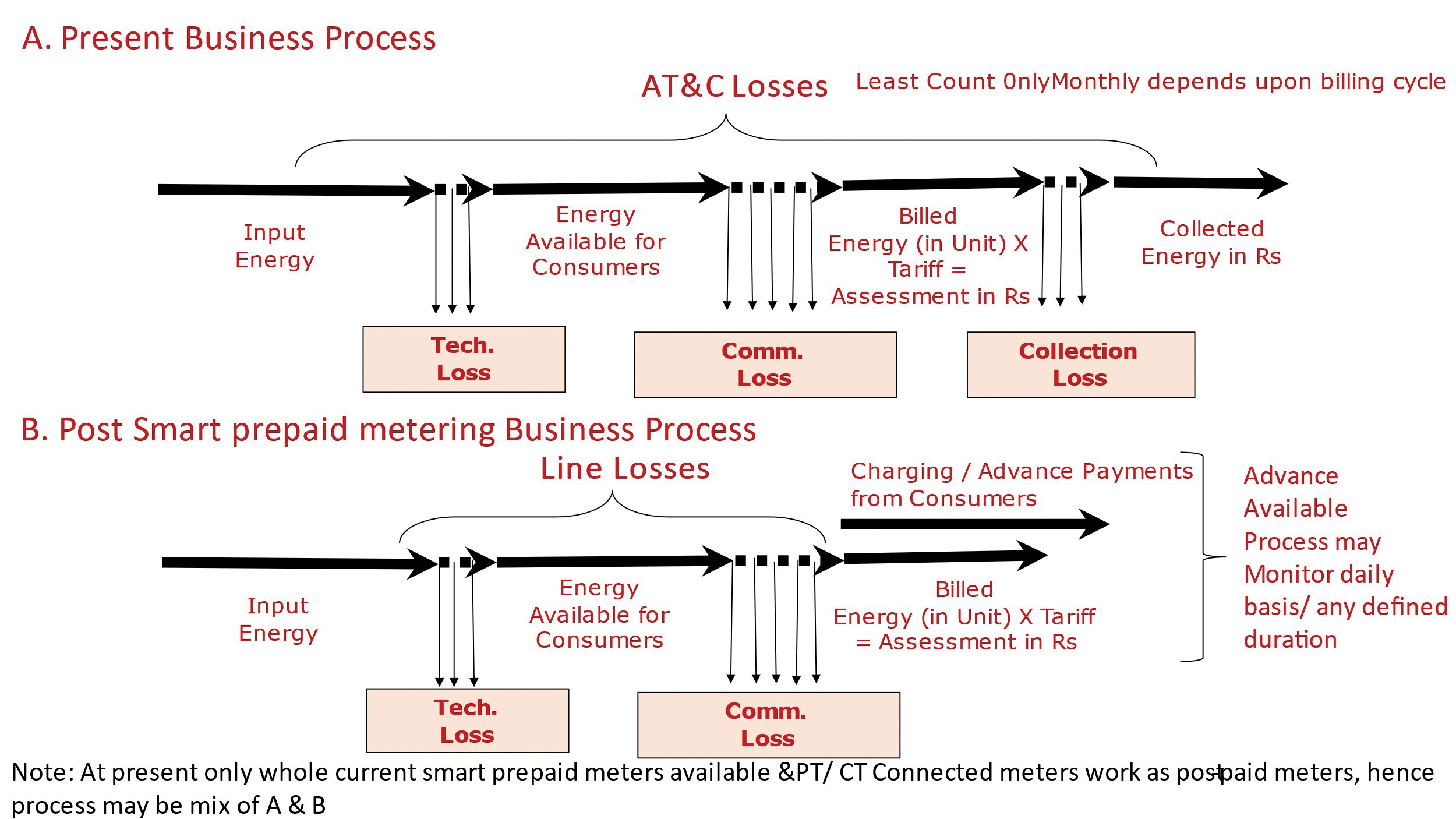 provide expert training during capacity building in various areas, including metrology, raids, data understanding and conversion, modelling techniques, security and IT-based processes with related monitorable dashboards.
Change in organisation: With billing issues becoming rare post-smart prepaid metering, only a few high-load CT/PT-connected consumers may remain on postpaid metering. Thus, activity-wise responsibilities need to be established at the district level.
Benefits: Smart prepaid metering supports the simplification of tariffs and implementation of time-of-use metering, enabling discoms to better manage loads and flatten peak hours. This will also help address the demand-supply gap resulting from post-solar supply and net metering.
Dashboard-based monitoring system: Dashboard systems need to be updated to include the monitoring of payments from high-value post-paid consumers, arrear realisations, disconnected smart prepaid meters, government realisations, low consumption cases, duration-based low-value consumers, raid hit rate, executed list of raids, meter testing, high loss DTs (urban vs. rural), etc. The timely creation of accurate dashboards will significantly contribute to the success of smart prepaid metering from the outset.
Metering installation practices for smart prepaid meters: To ensure the effective functioning of smart meters in the prepaid mode, where data is collected daily from meters to the MDM system, and to prevent meter tampering from the outset, the following practices need improvement:
- Proper installation of meters on a board with a miniature circuit breaker/fuse unit.
- Vertical installation of meters without bearing the load of service cables.
iii. Spacers between meters and boards should be used to prevent tampering and enable a 360-degree view of the meter.
- Meters should be installed in locations with strong communication signals, avoiding basements or inside premises.
- All meters should be installed approximately 5 feet high, near the consumer’s gate.
Following these quality meter installation practices ensures continuous communication, easy inspection/testing of meters and faster meter reading and billing during emergencies.
Elaborating on every point in detail is not possible in this context, but we have attempted to cover the most crucial points to help discoms achieve success with smart prepaid metering from the outset. By effectively addressing the 3Cs, we can improve consumer satisfaction, create commercially viable discoms and potentially support future tariff reductions as desired by the government and regulators.