

 Sudipa Majumdar, Director, and Navpreet Saini, Senior Research Analyst, IRADe
The goal of the Paris Agreement 2015 was to pursue efforts “to limit the temperature increase to 1.5 °C above pre-industrial levels”, signalling the end of the fossil fuel era and promoting the transition from coal, oil and gas to clean energy sources. Thereafter, during the Glasgow Climate Pact (COP26), India committed to enhancing its renewable energy capacity to 500 GW by generating 50 per cent of its power from renewable resources by 2030 and achieving net zero emissions by 2070. India has been working to reduce its dependence on fossil fuels by shifting to renewable energy sources in line with its net zero targets.
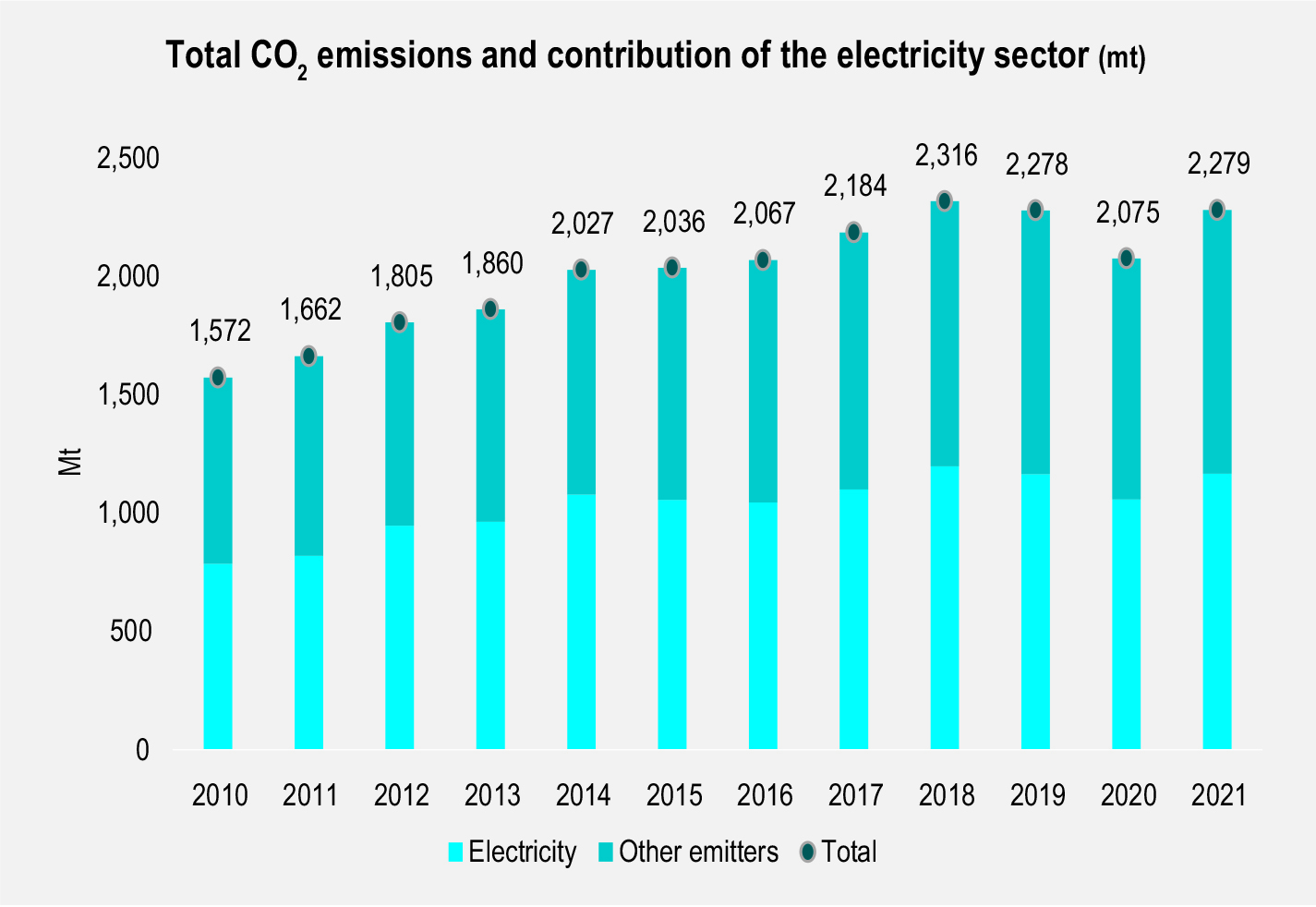
In India, the electricity sector remains the biggest consumer of raw coal and is also the largest CO2 emitter, contributing to 51.2 per cent of total emissions in 2021 (see Figure). The share of coal consumption in electricity went up from 60.7 per cent in 2013-14 to 70.4 per cent in 2022-23 (see Table). As per the Central Electricity Authority’s projections, the share of coal consumption in electricity is likely to remain as high as 55 per cent in 2029-30, indicating that India will not be able to move away from coal in the short term. Therefore, achieving net zero targets is a huge challenge for a coal-dependent emerging nation since coal is one of the most affordable and available energy sources in India, with substantial reserves of 361.41 billion tonnes as of April 1, 2022.
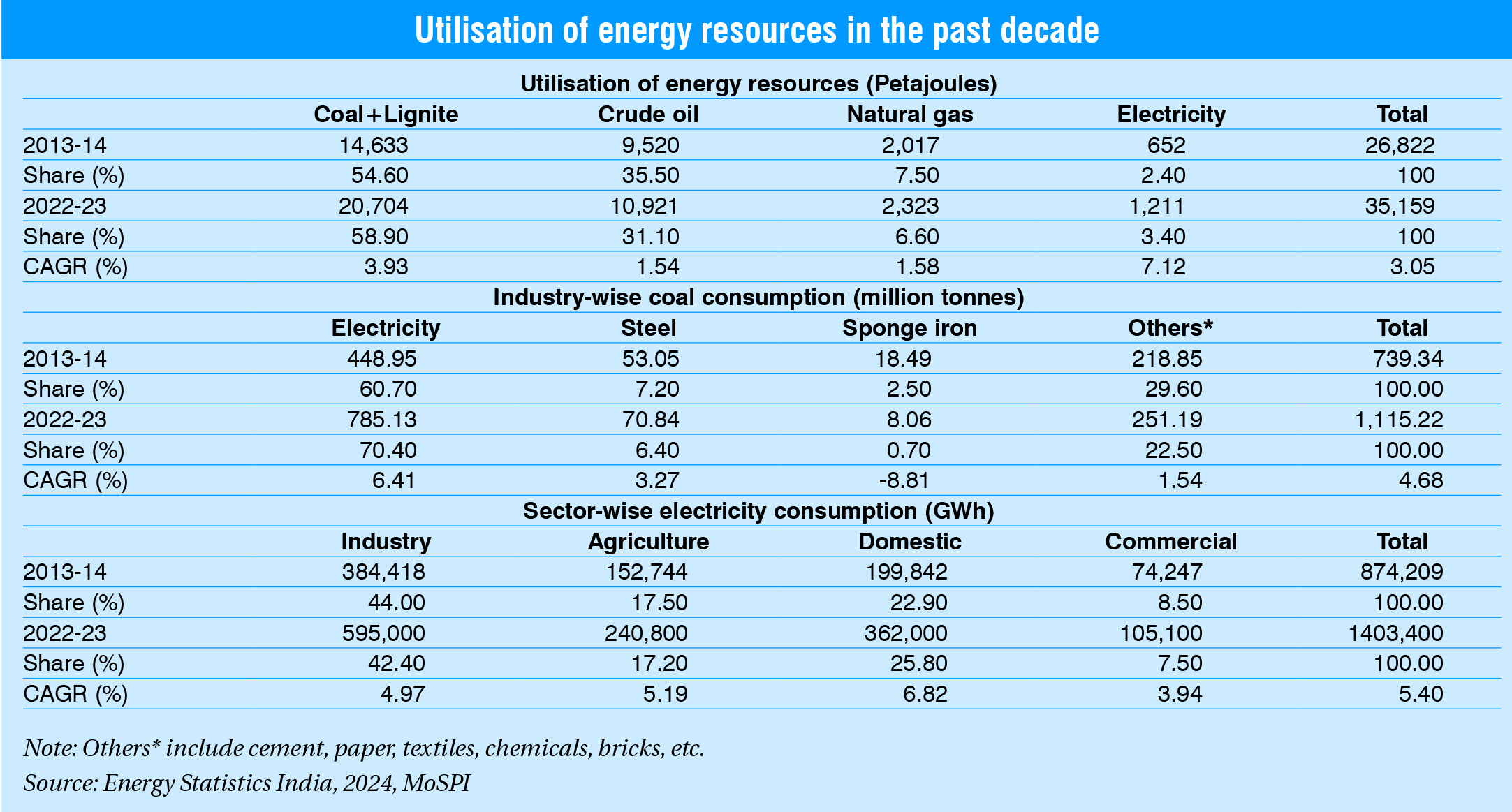 India is one of the largest producers and consumers of coal in the world and the trajectory has continued to grow upwards over the past decade. During this time, coal and lignite accounted for 59 per cent of total energy resources in India while industry was the highest consumer of electricity. The residential sector witnessed the maximum growth in consumption of electricity in the past decade (see Table).
While the share of coal decreased from 67 per cent in 2015-16 to 51 per cent in 2022-23, the share of renewables in the total installed capacity increased significantly during the same period. In 2023, India ranked fourth in the world in renewable energy capacity installations, after China, the US and Germany. It is evident that India has been taking conscious steps towards energy transition, with the installed capacity from renewable sources (solar, wind, biomass and small hydro) projected to reach 435 GW by 2029-30, accounting for over 60 per cent of the total installed capacity. The average emission factor (measured as kg CO2 per net kWh) from the total generation is estimated to reduce to 0.477 by 2029-30 from 0.658 in 2020-21.
In order to increase the share of clean energy, the Government of India introduced the PM Suryoday Yojana in January 2024, with a target of installing rooftop solar on 10 million houses for low- and middle-income individuals. This is expected to reduce electricity bills and make India self-reliant for its electricity needs by harnessing solar power. India has also made significant strides with the National Green Hydrogen Mission, aiming for 5 million tonnes per annum of green hydrogen production by 2030.
 Despite these steps towards a Green India by 2030, the government continues to support and rely on coal to meet the growing electricity demand, especially during peak demand due to summer heat waves. Climate change and the resulting increase in temperature will create additional demand for electricity for cooling, and this must be met through sustainable energy sources in the future.
India needs a comprehensive approach towards renewable energy since its dependence on fossil fuels has been increasing. To align with the COP commitments, India must phase out coal use in the power sector by 2030. The government should reinforce policies supporting renewable energy by offering incentives and benefits to attract investments. Investment should be directed towards technological innovation and advancements in solar PV technology to introduce efficient solar cells and cost-effective manufacturing processes. Similar investments are also required for improvements in wind turbine design and offshore wind technology. Energy security and stable supply need to be addressed through storage technologies, including batteries and pumped hydro storage. Long-term planning is crucial, which involves prioritising the transition from fossil fuels to a cleaner greener future.