
By S.K. Soonee, Former and Founder CEO, POSOCO; Dr Deb Chattopadhyay, Senior Energy Specialist, The World Bank; Debasis De, Former Executive Director, NLDC Grid-India; and K.V.N. Pawan Kumar, Deputy General Manager, and Abishek R.S., Manager, Grid-India
India’s energy sector has been undergoing a significant transformation over the past decade, driven by economic growth, population expansion and the increasing demand for electricity. To meet this demand, India has set ambitious targets for renewable energy integration, aiming to become one of the largest producers of clean energy globally. A key element of this transformation is ensuring the adequacy of the transmission network – that is, the ability of the grid to transfer electricity from generation sources to consumers in a reliable, efficient and sustainable manner. Transmission adequacy plays a critical role in maintaining the stability of the grid, reducing bottlenecks and ensuring that energy from diverse sources, including renewables, can reach all parts of the country. The challenges and opportunities associated with the Indian power grid, marked by its diverse intra-state systems and massive geographical spread, are key to integrating renewable energy, enhancing market operations and improving overall grid resilience.
This article provides an in-depth look at transmission adequacy and possible interconnection capacity planning strategies for India…
Transmission planning and the role of key agencies
Transmission planning in India is a multi-tiered process that involves various stakeholders at both the national and state levels. India’s National Electricity Plan outlines a clear strategy for both generation and transmission. It incorporates short-term and perspective plans, ensuring that state-level planning aligns with the country’s overall energy needs. Transmission planning criteria laid out by the Central Electricity Authority help streamline processes, offering a clear path for coordination between central and state entities.
One of the most significant factors in this transition is the role of policy and regulatory interventions. Central Transmission Utility of India Limited (CTUIL) and the state transmission utilities (STUs) are pivotal in ensuring efficient transmission planning and execution. The principles guiding long-term power purchase agreements and bulk electricity markets have undergone reform, driving innovation in transmission access, siting, grid operations, technology and cost allocation.
Mechanisms such as Point of Connection charges and General Network Access (GNA) are increasingly becoming the backbone of India’s transmission infrastructure. These frameworks help ensure that transmission pricing and access remain aligned with market needs, fostering a competitive environment while ensuring reliability.
 Development of interstate and intra-state transmission networks
The development of robust interstate and intra-state transmission networks is essential for ensuring that electricity can be transferred between regions and states in a reliable and efficient manner. A well-connected transmission network plays a crucial role in balancing supply and demand across the country by enabling the transfer of electricity from regions with diurnal/seasonal surplus generation to regions with deficit. This is particularly important in a country as large and diverse as India, where electricity demand and generation capacity vary significantly between different states and regions across diurnal/seasonal time frames.
 Adequate transmission connectivity is required to take care of the variability of renewables within a state, which can import the balancing power from neighbouring states/regions, maintaining the security and reliability of the grid. Energy storage is also a form of transmission asset, as it can move electricity in time, thus reducing congestion and curtailment of renewable energy sources.
One of the key challenges is the need for significant and timely financial investments in upgrading existing transmission infrastructure and building new transmission lines.
Another challenge is the need to ensure that the transmission network is resilient to natural disasters and other disruptions dependent on outage conditions. Ensuring the resilience of the interstate and intra-state transmission networks requires investments in climate-resistant infrastructure, as well as the implementation of advanced technologies such as smart grids and real-time monitoring systems.
It is essential that the performance of the existing network is evaluated based on certain urgency indicators/key performance indicators (KPIs), and that future planning is done in order to achieve the interconnection targets set in advance.
Setting interconnection targets
Lessons from the European Union
The European Union’s (EU) experience in setting minimum interconnection targets offers valuable lessons for India. In the EU, minimum trading capacities, or minRAMs, are essential to ensuring efficient electricity trade. For India, adopting a similar framework could encourage states to improve their interconnection capacities, ensuring better integration of renewable energy and enhancing grid stability.
 Interconnection target for India
One of the key strategies for ensuring transmission adequacy in India could be increasing the power import capability of each state to at least 50-60 per cent of its peak demand. This target is essential for ensuring that states with limited generation capacity can meet their electricity needs by importing power from other regions and neighbouring states. Achieving this target requires significant investment in both interstate and intra-state transmission networks, as well as improved coordination between CTUIL and STUs.
Urgency indicators: A need for timely investments
As India’s renewable energy capacity grows, it is critical to address the imbalance between increasing generation potential and limited interconnection capabilities. To stimulate timely investments, the introduction of urgency indicators/KPIs in transmission planning is crucial. These indicators would monitor:
- Price differentials in the wholesale market
- The total transfer capability (TTC) of interconnections compared to peak load and installed renewable generation capacity
- The alignment of GNA with demand and generation projections.
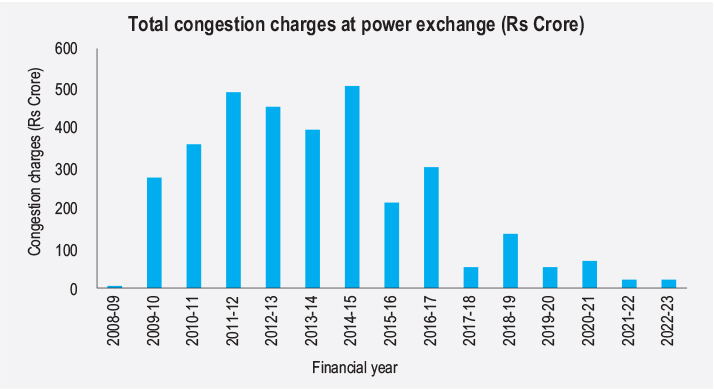
Urgency indicator 1: Cost of congestion
One of the critical economic justifications for expanding transmission infrastructure is the potential to reduce congestion costs. In India’s dynamic energy market, wholesale electricity prices exhibit significant geographic variations. Transmission infrastructure that reduces price disparities can provide substantial economic value by enabling lower-cost generators to meet the country’s energy demands.
Timely expansion/upgradation is essential, otherwise network congestion would rise again. However, rigorous techno-economic analysis of each line is a must, before any investment decision is taken.
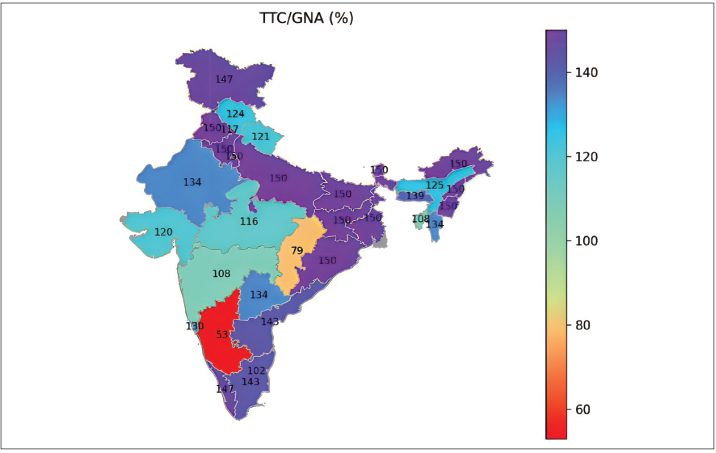
Urgency indicator 2: TTC/GNA
It is evident that the TTC for a state should be higher than their GNA requirement to transfer the power for which access has been obtained without affecting security. Hence, this ratio should be always greater than 100 per cent, and can be used as one of the indicators for evaluating access performance and planning future expansion/upgradation.
Urgency indicator 3: TTC/Demand
This ratio will provide information on how close the existing network is performing to achieve the target set for interconnection. The difference will show the gap and possible future congestion in case of very low internal generation, specifically from renewables due to extreme weather conditions. It also shows the flexibility of the network in meeting demand from outside the network. This could be another indicator to assess the investment requirement for achieving the target.
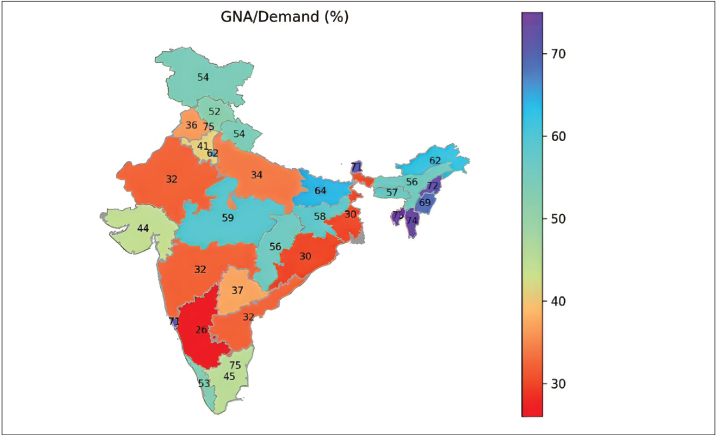
Urgency indicator 4: GNA/Demand
The ratio of GNA/Demand provides information on the requirement of access to meet the demand depending on the available internal generation. Individual states may decide the percentage. A very low value could signal the requirement for network expansion or upgradations.
Challenges of integrating renewable energy into the grid
India’s renewable energy sector has grown rapidly in recent years, with the country setting ambitious targets to achieve 500 GW of installed renewable energy capacity by 2030. However, the renewable-rich states, particularly those with huge wind and solar power capacity, will need to further enhance their intra-state transmission networks to facilitate energy export to other regions.
Barriers to achieving transmission targets
Despite the clear benefits, several barriers exist in India’s path towards achieving its ambitious transmission targets. These challenges mirror those faced by other regions such as the EU. The barriers include:
- Suboptimal bidding zone configurations
- The lack of mechanisms for sharing redespatching costs
- A lack of visibility on critical network elements beyond the primary limiting factors.
There is also an urgent need for calculating the Locational Marginal Price to capture the congestion in the inter-state and intra-state networks.
 A decarbonised future by 2070
India has set a long-term goal to achieve net-zero emissions by 2070. This transition will require more than just the addition of renewable energy capacity – it will necessitate a fundamental transformation of the country’s transmission infrastructure.
The need for transmission capacity is progressively raised by several factors, starting with (a) economics, followed by (b) reliability, (c) resilience, and (d) emissions and environmental concerns. While regulatory mechanisms have primarily focused on reliability, they have not yet fully addressed the other factors. The reliability standards for generation adequacy are well defined, with policy targets such as loss of load probability. However, in the case of transmission adequacy, the standards are more qualitative and less specific, depending heavily on various factors such as the planner’s mindset and the scenarios considered. There is a growing need for system-level urgency indicators to guide transmission adequacy planning. Furthermore, inter-connection and resilience standards must evolve to encompass a broader range of extreme weather events, such as heatwaves and droughts, and consider the impacts of renewable energy variability events. Transmission has a resource adequacy value when it is the least cost solution to meeting resource adequacy needs.
Conclusion
Capturing the benefits and trade-offs of transmission for resource adequacy requires integrated planning of generation and transmission, along with building a linkage between portfolio planning tools and resource adequacy analysis. Transmission adequacy is a critical component of India’s energy transition, as it ensures the reliable and efficient transfer of electricity from generation sources to consumers across the country. By developing both inter-state and intra-state transmission networks and cross-border interconnections, setting clear interconnection targets, and addressing the transmission bottlenecks, India can pave the way for a resilient, reliable and decarbonised power grid.