
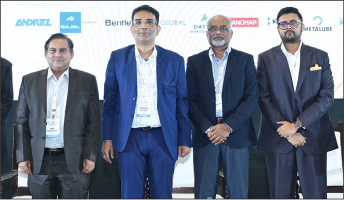
At TransTech India 2024, the panel discussion titled “Focus on Renewable Energy Evacuation” explored key areas related to renewable energy evacuation, including the needs of developers, progress in improving grid connectivity, current issues and possible solutions. The panellists were Purnendu Chaubey, Senior Vice President, ReNew; Varchasvi Gagal, Chief Executive Officer (CEO), Datta Power Infra; Sarit Maheshwari, CEO, NTPC REL; and Mahesh Vipradas, Vice President, Sembcorp India. Edited excerpts…
Current scenario
India has achieved 200 GW of renewable energy capacity, with an additional 300 GW targeted by 2030. Of the transmission capacity, 270 GW has already been planned, with several projects under way. This would require approximately 50,000 ckt km of transmission lines and 400,000 MVA of transformation capacity by 2030. There is a significant difference in the commissioning timelines of renewable energy generation plants and the required transmission systems. While transmission systems typically have a gestation timeline of 36-48 months, renewable energy plants can be set up within 15-18 months. This has been partly addressed through proactive planning. Over the past couple of years, the planning and connectivity processes have been streamlined to a large extent, giving renewable energy projects easier access to the market. Improvements in the planning of the interstate transmission system (ISTS) have facilitated the growth of renewables and encouraged investments.
Developers frequently enquire about grid connectivity schedules, seeking specific commissioning dates for renewable energy parks. This requires a thorough analysis of radiation levels and wind resource assessments. While renewable energy zones are being established in certain states, there is a significant gap in the connectivity schedule, extending until 2030. There is also a significant gap between the energy generation output of renewable energy-rich states such as Rajasthan and Gujarat, and that of other states. Moreover, the development costs incurred are higher in non-renewable energy-rich states. Further, there are concerns about the tariff structures in these states.
The transition to the general network access phase has been a positive for the sector as it offers more flexibility in siting renewable energy projects. However, it is crucial to set up such projects across the country to reduce grid management challenges in states that have significant renewable energy projects coming up. Energy storage solutions are expected to help address this congestion further. To this end, recent tender mechanisms are shifting from vanilla solar and wind projects to round-the-clock, and firm and despatchable renewable energy, allowing for more efficient use of transmission assets. The green energy corridors have been successful in evacuating significant power capacities from renewable energy-rich states. Additionally, there is a major focus on the creation of renewable energy zones and the development of solar parks, including massive ones at Bhadla, Khavda and Leh. Further, key public sector companies such as Oil and Natural Gas Corporation Limited, Indian Oil Limited, SJVN Limited, NTPC Limited and NHPC Limited are targeting 2-6 GW of renewable energy capacity annually.
Notably, the ISTS waiver is set to end in June 2025, which will significantly change the power evacuation landscape for renewable energy. Consequently, more projects are expected to come up on intra-state networks, as developers may want to avoid transmission charges. Intra-state transmission network growth is now expected to accelerate. Developers will need to weigh the advantages of planning projects in renewable energy-rich states against the increased transmission costs.
Outlook
Various new models are expected to emerge to address connectivity challenges, including the use of grid connectivity post-solar power hours. The planned renewable energy bidding trajectory provides ample opportunities for project development. However, a dynamic planning strategy is needed for renewable energy developers. Factors such as market strategy, power pricing and other variables necessitate continual adaptation. To address connectivity issues, more streamlined planning of substations with greater developer involvement is required. The current “follow-up” model is not sustainable as developers rush to secure connectivity wherever it is available, driving up land prices in those areas due to the scarcity of grid connectivity. The future of the energy industry lies in continuous, reliable power supply and flexible renewable energy sources, particularly as storage technologies become more affordable. These advancements will lead to more efficient use of the transmission network.