
Despite the urgent need for clean power to meet the nation’s 500 GW non-fossil fuel capacity goal by 2030, one significant obstacle remains – a transmission infrastructure that can meet this upcoming demand. India’s ability to meet its renewable energy and electrification targets is increasingly constrained by bottlenecks in the transmission network.
Reconductoring, which involves replacing the existing conductors with high-capacity alternatives such as high temperature low sag (HTLS) conductors, is emerging as a solution for delivering more power through existing corridors and overcoming the numerous right-of-way (RoW) issues that construction of new lines face.
Demand factors
Simply put, reconductoring involves replacing or upgrading the conductors on the existing transmission or distribution lines to increase their capacity to carry electricity. This cost-effective and efficient method optimises the existing infrastructure to increase transmission capacity.
Hence, by enhancing capacity without the need for additional land acquisition or long lead times, reconductoring presents a practical and sustainable alternative to the conventional approach of building new transmission lines. It is also a much more practical alternative to constructing new lines, particularly in urban areas and regions facing RoW constraints.
While planning for reconductoring, utilities must consider the choice of technology. As per the Central Electricity Authority’s (CEA) 2019 guidelines on the rationalised use of high performance conductors, such conductors can be considered for reconductoring of existing lines. High performance conductors should be considered in those corridors where power transfer over the transmission line is constrained due to the thermal loading of conductors. In the intra-state transmission system, the requirement of such conductors is needed at the 220 kV, 132 kV and 66 kV levels. However, application of high performance conductors may not be cost-effective for HVDC systems at the 765 kV voltage level.
The most commonly used advanced conductors in India include high-temperature low-sag HTLS conductors, high-temperature superconductors, aluminium conductor steel-reinforced cables, and composite core conductors. These designs operate at higher temperatures, reduce heat loss, and allow for greater power transfer.
 Challenges and considerations in reconductoring
To highlight the various aspects of reconductoring, the CEA, in 2023, had released a draft paper on the reconductoring of ISTS lines. One challenge that the paper highlighted was that the process must address several key technical aspects such as acceptable sag parameters, maximum allowable conductor temperatures, and the structural health of transmission towers. Special attention is needed for long spans to prevent excessive tension on towers and their foundations. In cases where the load-bearing capacity of the existing towers is insufficient,reinforcements, or even complete replacements, may be required.
Reconductoring multivoltage or multicircuit lines adds another layer of complexity, especially when adjacent circuits must remain operational during the process. Also, reconductoring with advanced conductors may not always be economically feasible. Hence, utilities must carefully assess these factors to determine whether reconductoring with advanced conductors aligns with their technical and financial goals.
Reconductoring has pros and cons under both regulated tariff mechanisms (RTMs) and tariff-based competitive bidding (TBCB). RTM ensures single ownership, streamlined operations and lower costs with faster execution. TBCB, on the other hand, promotes cost efficiency through competitive bidding.
The structural integrity of transmission towers must be assessed for mechanical stress and potential reinforcements. Reconductoring with advanced conductors may expose vulnerabilities in terminal equipment, requiring upgrades to switches, protection systems, and FACTS controllers. Multivoltage lines add complexity, demanding careful planning when adjacent circuits
remain operational.
Conclusion
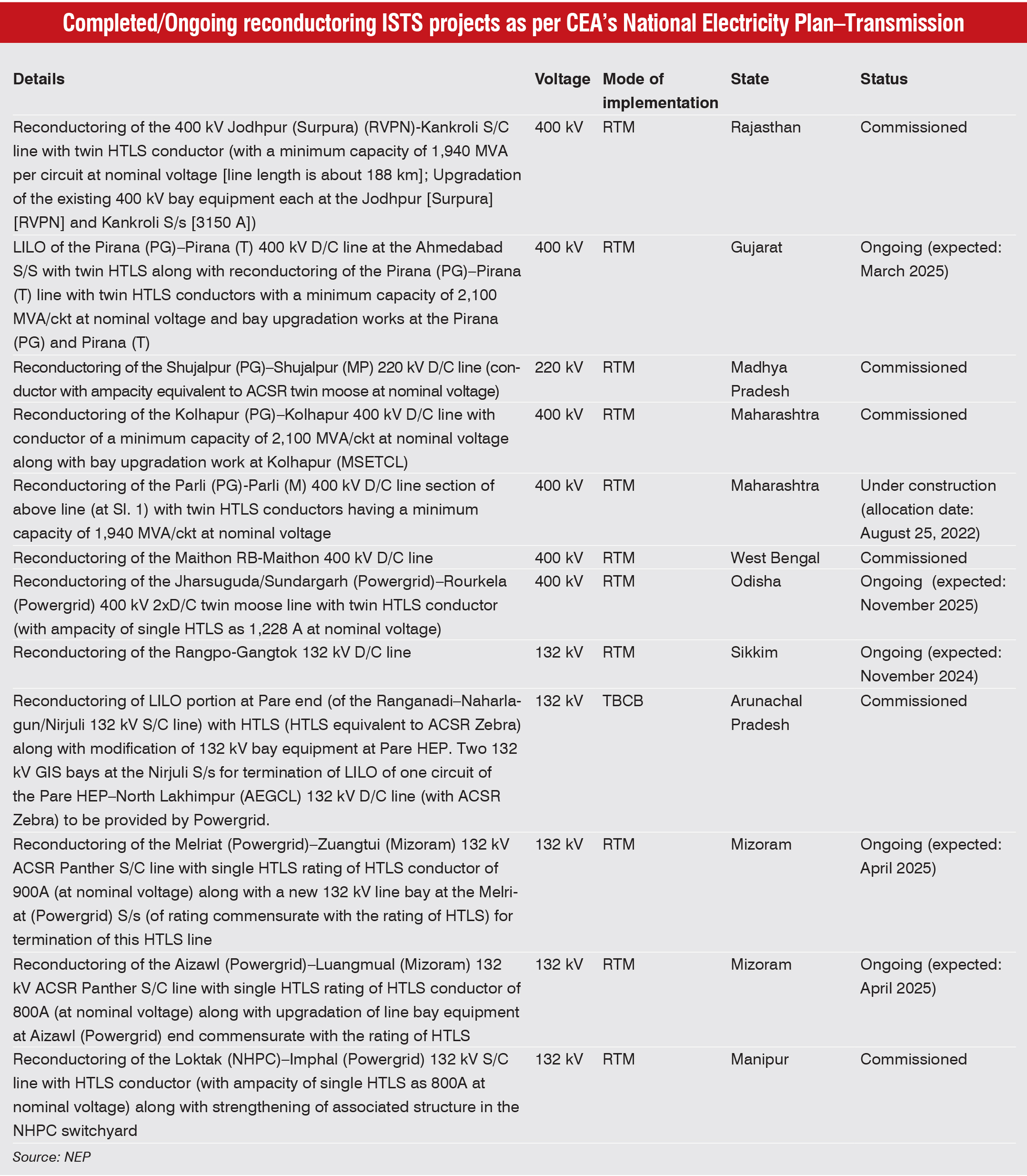
The newly released National Electricity Plan (Volume II, Transmission) has identified important reconductoring projects, some of which have been completed while others are at the implementation stage (see table).
The country operates a vast transmission network, which is bound to grow even more with the increasing demand for power. With careful planning, adherence to the CEA’s guidelines and the prudent use of advanced conductors, reconductoring can overcome these obstacles and play a pivotal role in creating a resilient transmission network in the country.