
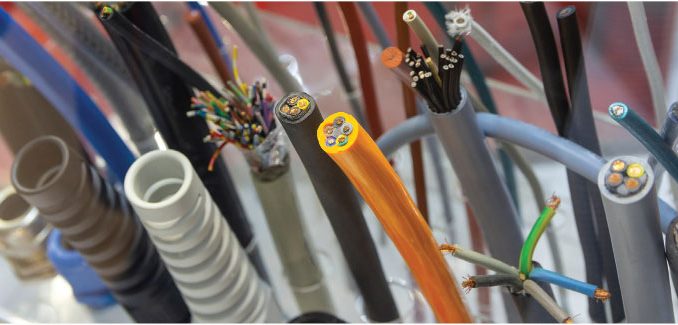
The cables and conductors segment is experiencing strong demand, driven by a significant pipeline of transmission and distribution projects, supported by significant funding under government initiatives such as the Revamped Distribution Sector Scheme (RDSS) and the Green Energy Corridor (GEC) project. The power generation and transmission sector is undergoing rapid expansion and transformation, due to increasing power demand and the shift towards renewable energy sources.
With the government’s focus on renewable energy, the industry is expanding its supply of cables to the solar and wind power sectors, in addition to serving industries such as data centres, oil and gas, railways, defence and other specialised applications. Further, government initiatives in underground cables and electrification are driving strong demand for cables and conductors. Growth in the telecommunications, residential and commercial sectors further boosts this demand, supporting the market’s expansion.
Drivers
RDSS and other schemes
The RDSS, launched by the central government, is driving significant demand for cables and conductors in the power sector as utilities ramp up their network additions.
With a budget of Rs 3,037.58 billion allocated for five years (2021-22 to 2025-26), the scheme aims to provide financial assistance to discoms for modernising and strengthening distribution infrastructure, while improving the reliability and quality of supply to end-consumers.
As per the Central Electricity Authority’s (CEA) Distribution Perspective Plan 2030, utilities are expected to develop significant infrastructure for the 2022-25 period, with approvals already sanctioned under the RDSS. The plan estimates that about Rs 4,280 billion will be required for the upgradation of distribution infrastructure during 2022-27, of which around 44 per cent has already been sanctioned up to 2027 under the RDSS and other schemes.
In terms of network additions, the total addition during the 2022-25 period for high tension (HT) feeders is expected to be 505,681 ckt km, with 273,581 ckt km already approved under the RDSS. Additionally, 669,630 ckt km of low tension (LT) feeders will be added, with 5,446,195 ckt km already approved. Till 2025, the targeted addition is 5,462 new substations (66/33/22 kV), with 409 substations already approved under the RDSS. For distribution transformers (11/0.433 kV), 1,788,309 units are planned, of which 459,718 units have been approved, and their total capacity will increase by 84,478 MVA, with 26,609 MVA already approved.
Additionally, ongoing projects under schemes such as the Integrated Power Development Scheme and the Deendayal Upadhyaya Gram Jyoti Yojana have been incorporated into the RDSS. To support states in achieving the objective of providing uninterrupted power supply to all households, projects worth Rs 1,850 billion have been executed (as of August 2024) for strengthening the distribution system across states, which includes works such as the new development/upgradation of substations, and HT and LT lines, agricultural feeder segregation; aerial bunched cable and underground cabling.
National Electricity Plan – Transmission
In October 2024, the CEA unveiled the National Electricity Plan – Transmission, detailing the transmission network requirements through 2031-32. According to the plan, between 2022 and 27, a total of 114,687 ckt km of transmission lines and 776,330 MVA of transformation capacity will be added at an investment of Rs 4,252.22 billion. In the following period (2027-32), the addition of 76,787 ckt km of transmission lines and 497,855 MVA of transformation capacity is expected at an investment of Rs 4,909.2 billion.
By the end of 2031-32, the total transmission line length is estimated to reach 648,190 ckt km, with a transformation capacity of 2,345,135 MVA. Furthermore, high voltage direct current (HVDC) bipole capacity, including back-to-back systems, is expected to increase to 66,750 MW by the end of 2031-32. Several interregional transmission corridors are planned for the 2027-32 period, with 24,600 MW of interregional transmission capacity expected to be added. This expansion will increase the total interregional transmission capacity to approximately 167,540 MW by the end of 2031-32.
GEC
The GEC project aims to synchronise electricity produced from renewable sources, such as solar and wind, with conventional power stations in the grid. GEC comprises both the interstate transmission system (ISTS) and intra-state transmission system (InSTS), along with the setting up of renewable energy management centres and control infrastructure, such as reactive compensation and storage systems.
ISTS GEC Phase I, aimed at establishing 3,200 ckt km of ISTS lines and 17,000 MVA substations, was commissioned in March 2020 by PowerGrid Corporation of India Limited. The project was implemented to evacuate approximately 6 GW of renewable power.
The InSTS GEC scheme, with a total target of 9,700 ckt km of InSTS lines and 22,600 MVA of substations, was approved by the Cabinet Committee on Economic Affairs (CCEA) in 2015. The InSTS GEC scheme is currently under implementation by the state transmission utilities (STUs) of eight renewables-rich states. These projects are being set up for the evacuation of about 24 GW of renewable energy power, of which about 18.72 GW has been commissioned and connected to the grid.
As of June 30, 2024, 9,135 ckt km of transmission lines have been constructed and 21,313 MVA substations have been charged. Out of the eight states, four have completed all projects, namely, Rajasthan, Madhya Pradesh, Karnataka and Tamil Nadu. Of the remaining four, three – Andhra Pradesh, Himachal Pradesh and Maharashtra – have been granted extension up to December 31, 2024, while Gujarat has till
March 31, 2025.
The InSTS GEC II scheme, with a total target of 10,750 ckt km of InSTS lines and 27,500 MVA of substations, was approved by the CCEA in January 2022. The transmission schemes will be implemented by the STUs of seven states – Gujarat, Himachal Pradesh, Karnataka, Kerala, Rajasthan, Tamil Nadu and Uttar Pradesh – for the evacuation of approximately 20 GW of renewable energy power in these states. Currently, the STUs are preparing the packages and are in the process of issuing tenders for project implementation. The scheduled commissioning timeline for the projects under this scheme is March 2026.
The central government has also sanctioned the implementation of ISTS to support a 13 GW renewable energy project in Ladakh under GEC II. The project involves the construction of approximately 713 km of transmission lines, covering 1,268 ckt km, and the installation of two 5 GW HVDC terminals in Ladakh (Pang) and Kaital (Haryana). The infrastructure will facilitate the transmission of electricity generated from renewable energy projects totalling 13 GW of capacity, along with a 12 GWh battery energy storage system in Ladakh.
FAME II
The government’s Faster Adoption and Manufacturing of Hybrid and Electric Vehicles (FAME II) initiative offers various incentives aimed at lowering the cost of electric vehicles (EVs) and developing the required infrastructure. The growth of the EV market is expected to spur developments in related infrastructure, such as charging stations, requiring durable and efficient electrical installations.
Outlook
India is witnessing significant growth in demand for wires and cables, driven by the country’s ambitious renewable energy targets, particularly in solar and wind power. The expansion of solar power plants, especially photovoltaic projects, requires high quality cabling systems to ensure minimal energy loss and efficient power transmission. For instance, a 1 MW solar project typically uses around 50 km of solar cable.
Further, there is an increasing need for cables capable of efficiently transmitting power from remote renewable sites to the grid. Manufacturers are responding by developing high-voltage cables with advanced insulation and greater transmission capacities. With the government’s target of 140 GW of wind energy by 2030 and 500 GW of total renewable energy, the demand for specialised cables, such as medium voltage elastomer, nacelle, converter and generator cables, is on the rise.
Further, transmission systems for evacuating 10 GW of offshore wind energy from Gujarat and Tamil Nadu, at an estimated cost of Rs 280 billion, are also being planned. The offshore wind cable market is expected to experience substantial growth in the coming years, with forecasts predicting a notable surge in cable demand compared to previous levels. There is also a growing demand for submarine power cables to connect offshore wind farms to the mainland, particularly in states such as Gujarat and Tamil Nadu, which have the highest potential for offshore wind generation. This is creating a significant market opportunity for cable manufacturers and installation services.
Conclusion
Policy support measures such as Atmanirbhar Bharat and the China+1 strategy are expected to establish India as a hub for manufacturing, design and innovation. With its vast pool of skilled labour and rapidly improving manufacturing infrastructure, India has emerged as a compelling alternative.
Overall, the market is poised for growth, supported by several incentives and programmes offered by the government. This positions the sector for continued expansion, in line with technological advancements and the changing energy landscape.
Aastha Sharma