
 By Hitesh Chaniyara, Partner, PricewaterhouseCoopers Private Limited
Imagine a future where every home and business in India runs on renewable energy, with solar panels and wind turbines dotting both countryside villages and city skylines. This ambitious vision is not a distant dream but a concrete aim set by India to reach 500 GW of non-fossil energy capacity by 2030, a significant increase from the current 193 GW. Moreover, India aims to achieve net zero emissions by 2070. The Government of India and several other stakeholders are already working towards achieving this ambitious-yet-achievable goal.
The transmission system is a vital bridge in the power sector value chain, seamlessly linking energy sources to their consumers. As we move towards an economy increasingly reliant on electrification, especially with renewable energy sources, the significance of transmission infrastructure is growing. The current cumulative transmission infrastructure, which illuminates India, stands at approximately 485,000 ckt km with a transformation capacity of around 1,257,000 MVA. Now, the biggest question everyone is trying to answer is: Is today’s transmission system fit for
the future?
Let us dive in and seek an answer to this question.
Energy transition often grabs the headlines but it is the transmission infrastructure that will ultimately determine the success of a country’s energy transition aspirations. According to Bloomberg New Energy Finance (BNEF), the world needs a whopping 152 million ckt km of power lines to hit the net zero goal by 2050. That is twice the length of today’s transmission network and long enough to reach the sun from Earth! This highlights just how crucial investing in transmission infrastructure is. India’s draft National Electricity Plan (up to 2031-32), as outlined by the Central Electricity Authority (CEA), aims to add approximately 124,000 ckt km of transmission lines and increase transformation capacity by approximately 710,000 MVA at 220 kV and higher voltage from 2022 to 2027. Targets for the 2027-2032 period include adding around 105,000 ckt km of transmission lines and boosting transformation capacity by 595,000 MVA. The plan also covers strengthening of interregional corridors and cross-border transmission links.
We all know that bringing variable renewable energy (specifically solar and wind generating plants) into the grid without compromising its stability can be challenging due to the variability and intermittency associated with renewables, resulting in operational uncertainties in the power system. This necessitates upgrading the transmission system to ensure it remains reliable, safe and future-ready. However, there is no universal “one-size-fit-all” solution. In India, we need to work out our own localised solution consisting of multiple implementable and economical elements.
We can tackle this problem with a five-pillar strategy – building resilient transmission infrastructure, deploying cutting-edge grid technologies, linking power markets via interconnectors, leveraging advanced digital tools, and creating a supportive policy and regulatory environment. Effective design and implementation of these elements can help build a transmission system that is fit for the future, which in turn can help address India’s energy trilemma (energy security, energy sustainability and energy affordability).
Building resilient transmission infrastructure
India initiated the Green Energy Corridors (GEC) programme to strengthen its transmission infrastructure for the evacuation of renewable energy. This initiative encompasses both the interstate transmission system (ISTS)
and the intra-state transmission system (InSTS).
Phase I of the ISTS was rolled out in March 2020. This initial phase involved establishing a 3,200 ckt km ISTS network with 17,000 MVA of transformation capacity. This milestone facilitated the evacuation of 6 GW of renewable energy. The GECs under InSTS are under development in eight renewable energy-rich states − Andhra Pradesh, Gujarat, Himachal Pradesh, Karnataka, Madhya Pradesh, Maharashtra, Rajasthan and Tamil Nadu. It aims to evacuate about 24 GW of renewable energy, with 18.72 GW already commissioned and connected to the grid through these projects. Phase II is set to construct 11,000 ckt km of the ISTS network and 28,000 MVA of transformation capacity, with a goal of enabling the transfer of 20 GW of renewable energy across seven states by March 2026.
Deploying cutting-edge grid technologies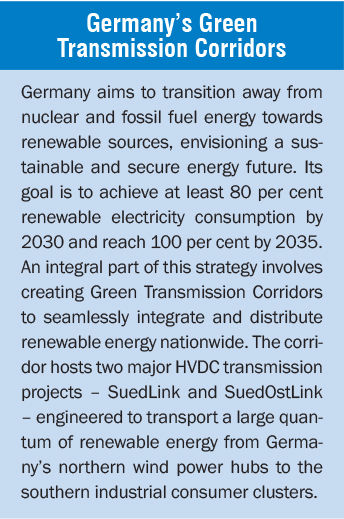
Advanced grid technologies like grid- scale energy storage systems, flexible alternating current transmission systems and advanced HVDC systems can offer much-needed flexibility and controllability to the grid operator, which enables the smooth integration of variable renewable energy.
According to the CEA’s Optimal Generation Mix 2030 report, India is projected to require 60 GW of energy storage capacity by 2030. This comprises 42 GW of battery energy storage systems (BESS).
A few years ago, Powergrid implemented a 1 MW/0.5 MWh BESS pilot project in Puducherry, blending advanced lead-acid and li-ion (LFP) technologies. Now, the country is moving towards grid-scale BESS implementation. For example, NTPC, the country’s largest state-owned electricity producer, is setting-up a 1,000 MWh grid-scale battery storage system.
India is also exploring harnessing its pumped storage potential of 108 GW for various purposes including grid management and ancillary services. While its current capacity is close to 5 GW, India aims to set up 18 GW of pumped hydro storage capacity by 2032.
Linking power markets via interconnectors
Transmission interconnectors help expand the capacity of electricity markets to engage with other markets, enhancing the flexibility of the power system and offering significant benefits for decarbonisation. They not only help align average electricity prices across markets but also effectively reduce the increasing fluctuations in electricity supply and pricing. As renewable energy introduces more variability and intermittency into the system, a large electrical control area over a wide geographical region is needed to maintain
grid stability.
More than seven decades ago, India started its journey to develop interconnectors with its neighbouring countries to promote cross-border electricity transactions. It all began with the Koshi and Gandak agreements between India and Nepal. India and Bhutan collaborate on hydroelectric power, exporting 2,070 MW via multiple interconnectors including the ±800 kV Biswanath Chariali-Agra HVDC link. India and Bangladesh facilitate 1,160 MW of power exchange via interconnectors. India and Myanmar are exploring a 500 MW HVDC interconnection between Imphal and Tamu. India is using these interconnectors to harness affordable clean energy (primarily hydroelectric) from its neighbouring countries, thereby supporting the goal of reducing its carbon footprint.
Leveraging advanced digital tools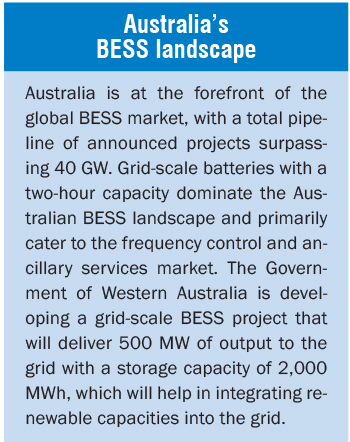
Energy transition is disrupting traditional grid operations. The integration of large-scale variable renewable energy requires the modernisation of technologies and systems used for grid operations. Digital technologies such as advanced supervisory control and data acquisition, wide area measurement system, automatic generation control (AGC), renewable energy management centres (REMCs), dynamic line rating (DLR) and real-time data offer significant potential to accelerate the energy transition while enhancing grid resilience.
India has set up REMCs, which are strategically co-located with state load dispatch centres. These REMCs leverage advanced artificial intelligence-powered tools for renewable energy forecasting and scheduling. They are connected with IoT devices, which enable continuous monitoring by feeding real-time data to the REMC, which is essential for situational awareness among grid operators. WAMS has helped GRID-INDIA in real-time monitoring and operation through better visualisation of system dynamics and grid parameters.
 Creating a supportive policy and regulatory environment
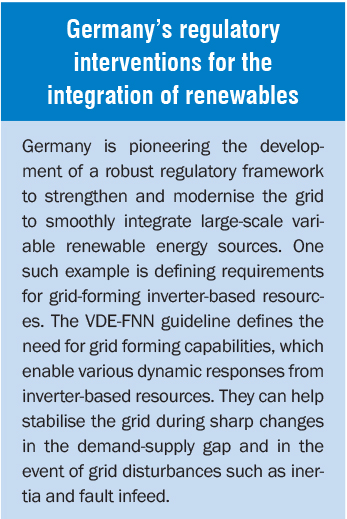
For more than two decades, India has been strengthening its grid infrastructure and grid operations by periodically revamping various regulations such as the Indian Electricity Grid Code, Power Market, Ancillary Services and Open Access. These updates introduced tighter frequency control (via AGC, ancillary services), protocols for effectively managing reactive power to maintain voltage stability, and technologies to enhance operational flexibility and
grid resilience.
The regulations also introduced compliance protection performance indices (such as the dependability index, the security index and the reliability index) to enhance grid stability. Several regulations have been introduced to develop a vibrant power market covering trading of conventional and green electricity. In addition, security-constrained economic despatch and security-constrained unit commitment are being explored to contribute to reliability and resource optimisation.
Conclusion
Strengthening the transmission system with modern physical infrastructure and advanced digital technologies will help accelerate the energy transition by effectively integrating large-scale variable renewable energy. To achieve this, stakeholders should focus on five elements – building resilient transmission infrastructure, deploying cutting-edge grid technologies, linking power markets via interconnectors, leveraging advanced digital tools, and creating a supportive policy and regulatory environment. Successful and timely implementation of these elements will require close collaboration among the government, regulator, TSOs, technology companies and other stakeholders.