
In a significant green financing development, state-owned Power Finance Corporation (PFC), India’s largest non-banking financial company, recently signed a general agreement with the Japan Bank for International Cooperation (JBIC) to set up a credit line of up to JPY 120 billion, of which the JBIC portion is JPY 72 billion. This marks JBIC’s largest green financing deal with an Indian company. The credit line will enable PFC to finance energy projects in India, including renewable, next-generation energy supply, and energy-efficient power generation and heat supply.
Loan details
The long-term loan facility has been extended to PFC by JBIC under its Global action for Reconciling Economic Growth and Environmental Preservation (GREEN) initiative.
GREEN operations were launched on April 1, 2010 to support projects with a positive environmental impact, such as solar PV plants, energy-efficient infrastructure and advanced environmental technologies. The recent JBIC-PFC agreement, which is four times the scale of their previous deal, highlights Japan’s long-term commitment to India’s economic and environmental sustainability goals.
Under the current agreement, JBIC will provide JPY 72 billion while the remaining amount will be financed by commercial banks, according to a statement by PFC. This is the second credit line from JBIC to PFC. The first agreement was signed on July 7, 2022, where JBIC extended a credit line of JPY 30 billion to PFC also part of JBIC’s GREEN initiative.
Parminder Chopra, Chairman and Managing Director, PFC, stated in a press release, “We have successfully utilised the first credit line from JBIC in 2024. This new credit line is four times larger than the previous one and provides a longer tenor of up to 20 years. Promoting non-fossil-fuel-based energy is a key priority for the Government of India. With the support of international lenders like JBIC, PFC will play a pivotal role in advancing this vision.”
 Outlook
With India’s ambitious renewable energy targets, including 500 GW of non-fossil fuel capacity by 2030, this credit line will help accelerate investments in solar, wind and energy-efficient
power infrastructure.
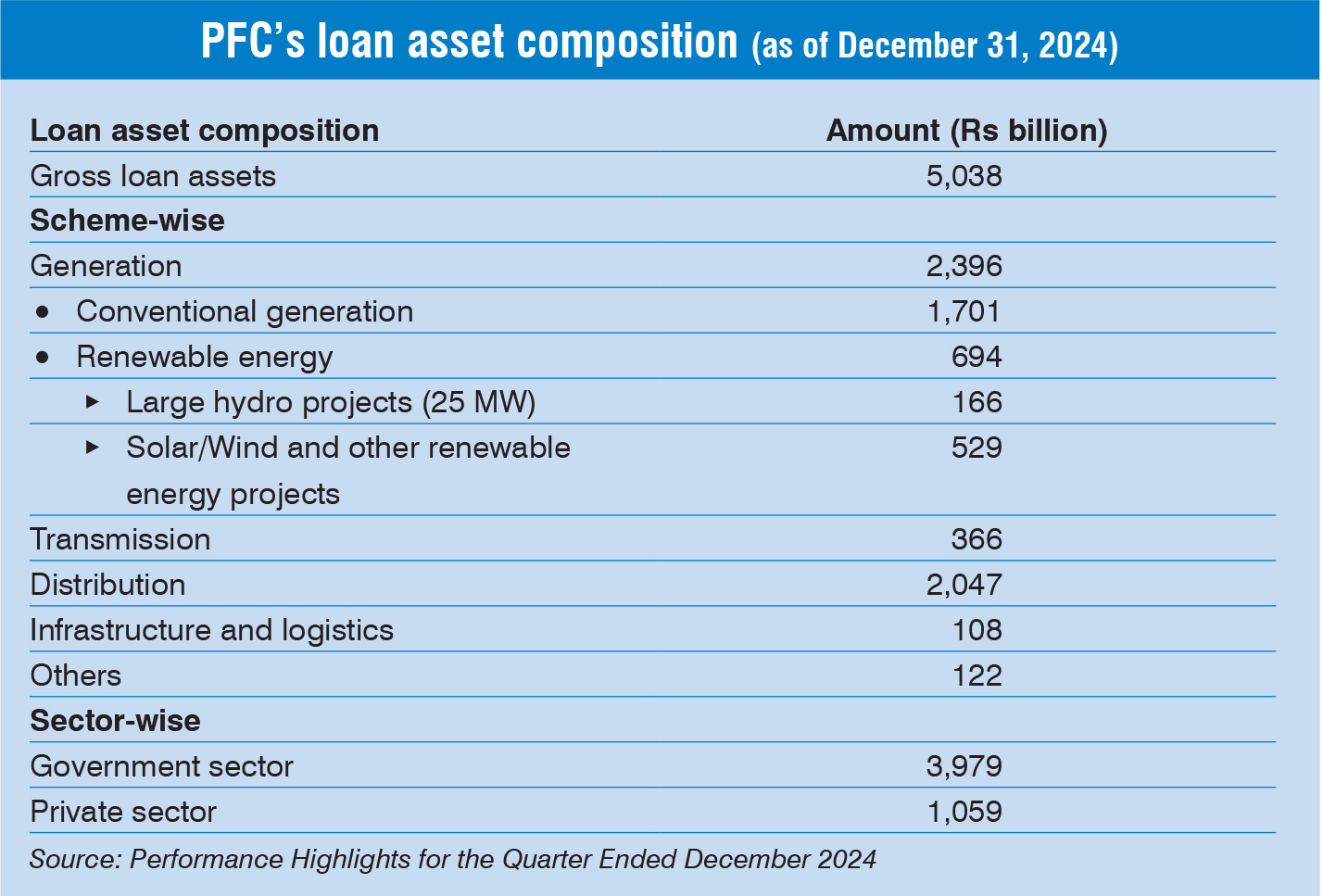
PFC has played an important role in facilitating the development of over 50 GW of renewable energy capacity, which is approximately 25 per cent of the country’s total installed capacity. With a renewable energy loan book exceeding Rs 600 billion, PFC stands as the largest renewable energy financier
in India.
Previously, in October 2024, it secured a foreign currency term loan of $1.26 billion, marking the largest foreign currency loan ever raised by an Indian PSU. This facility, arranged through multiple banks at IFSC GIFT City, Gandhinagar, was exclusively intended for funding green energy projects, excluding thermal generation. The five-year loan, carrying a floating interest rate of 4.21 per cent per annum, was backed by a consortium of leading domestic and international banks, including SBI, IDBI, Axis Bank, MUFG, Deutsche Bank and SMBC, with SBI serving as both the primary lender and facility agent.
Conclusion
As India aims to achieve 50 per cent cumulative electric power generation from non-fossil-fuel-based energy resources by 2030 as part of its Nationally Determined Contribution, the country is investing heavily in initiatives such as expanding green hydrogen production capacity and promoting energy efficiency technologies. Green finance is a key tool in the transition to net zero emissions.