

 By S.K. Soonee, Former and Founder CEO, POSOCO; Dr Deb Chattopadhyay, Senior Energy Specialist, The World Bank; and Debasis De, Former Executive Director, NLDC Grid-India
India’s electricity sector is undergoing a significant transformation. With rising demand, a high dependence on coal and increasing concerns about air quality and climate change, the challenge today is not just to produce electricity to meet demand, but to do so in a way that is reliable, affordable and environmentally sustainable. Traditionally, power dispatch in India has been guided by a singular objective – cost minimisation. This is known as the “merit order” or economic dispatch, where power is generated from the cheapest available sources to meet demand. There has been increasing recognition of the need to observe security constraints, and the Security Constrained Economic Dispatch (SCED) model has been followed by the National Load Despatch Centre (NLDC) for six years now to save costs and maintain good grid discipline and generator health. However, this approach still does not consider the environmental cost of emissions. As a result, highly polluting but cheap coal-based plants get dispatched more often than their cleaner and efficient, but expensive counterparts. System operation is expected to go through a paradigm shift when emissions come under greater scrutiny with respect to economy and security in day-to-day dispatch decisions.
 To address this gap, a new framework called Security and Emission Constrained Economic Dispatch (SECED) is being developed. NLDC implemented SCED in the year 2019 and has been following it successfully, generating cumulative savings of more than Rs 50 billion over the last six years. SCED has not only saved money, but has also enhanced the security of the grid and disciplined the generators to operate within safe operating parameters for ramping and minimum loading. The new SECED framework adds environmental concerns directly into the dispatch decision-making process and reduces emission through re-dispatch. In simple terms, it tries to find a balance among all three objectives: minimising the cost of generation (“cheap”), reducing harmful emissions (“clean”) and ensuring secure operation of the power system (“certain”). Through re-dispatch, SECED actually increases the dispatch of low-polluting plants and decreases the dispatch of high-polluting plants.
 This is a timely initiative, as carbon emissions will receive increasing attention with the Indian Carbon Market (ICM) scheduled to start in 2026. Though the power sector is not included in the initial phase of ICM, it is important that generators, regulators, system operators and traders start preparing for it ahead of its inclusion in the carbon market. The SECED model is designed to fit seamlessly into the existing SCED model, to achieve a more balanced dispatch decision.
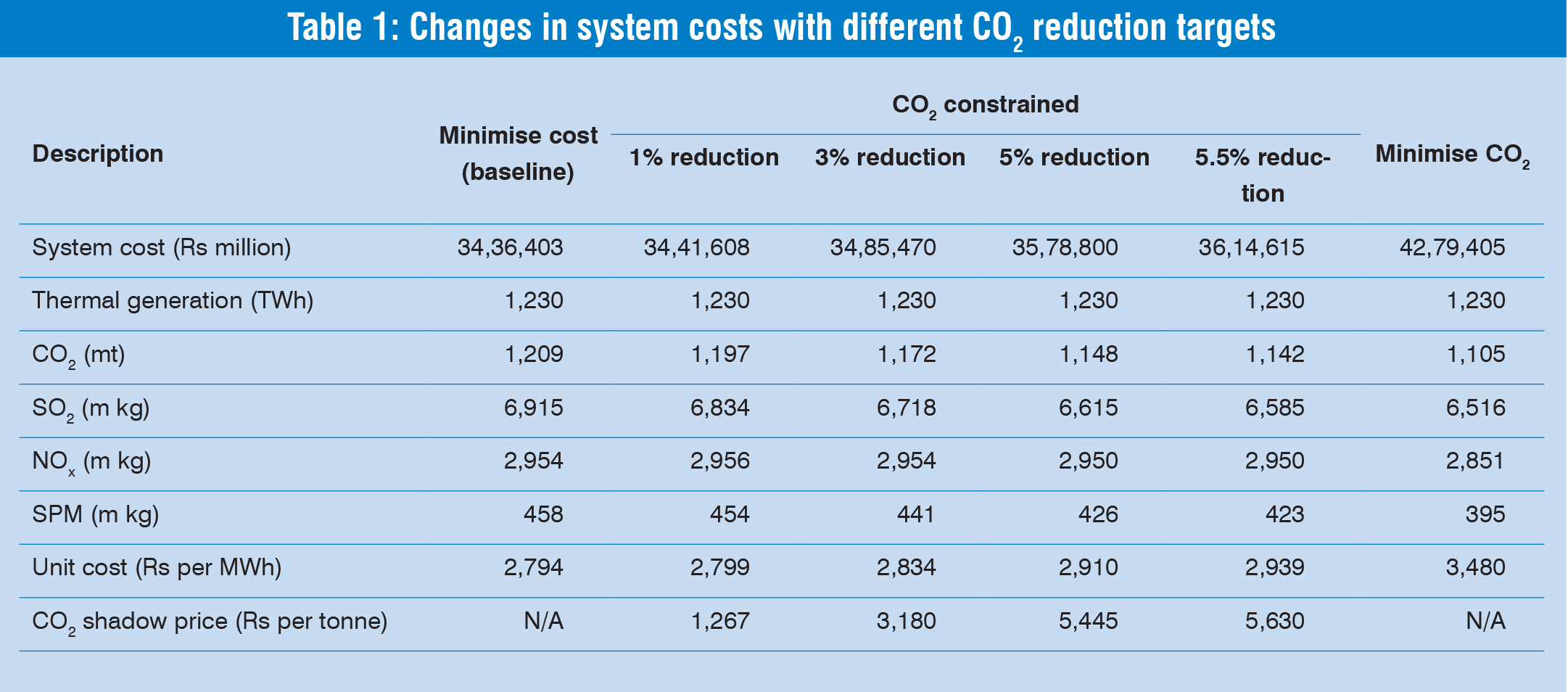
SECED has been developed at an All-India level, considering the details of 265 thermal plants in the country, including their variable costs, and emissions coefficients for CO2, SOx, NOx and particulate matters. The first study after the development of the SECED model was conducted using publicly available data from the CEA and NITI Aayog websites. The model considered emissions from all major thermal generators as additional constraints relative to the unconstrained/observed emissions for 2023, and retained the technical constraints of the SCED. The results were compared with a baseline scenario that followed traditional economic dispatch, that is, with no environmental constraints. The findings showed that when emission constraints were explicitly included in the optimisation, the overall emissions from power generation could be significantly reduced through re-dispatch, albeit at the expense of the rising variable cost of the power system. A CO2 reduction constraint was considered based on the daily unconstrained level to mimic the process of the forthcoming carbon market, which will need to set a cap based on the observed level of CO2. System costs (including the cost of unserved energy, surplus energy, adjustments needed to meet carbon limits, etc.)go up as the carbon limit is tightened. The observations are shown in Table 1.
It can be observed from the results that for a very shallow cut at 1 per cent (or 12 mt of CO2 per annum), there is a negligible increase in system cost at approximately 0.15 per cent. It can also be seen that a 5 per cent reduction (60 mt of CO2 per annum) could be achieved through more expensive re-dispatch involving a coal-to-gas switch, for which the cost would increase by Rs 143 billion.
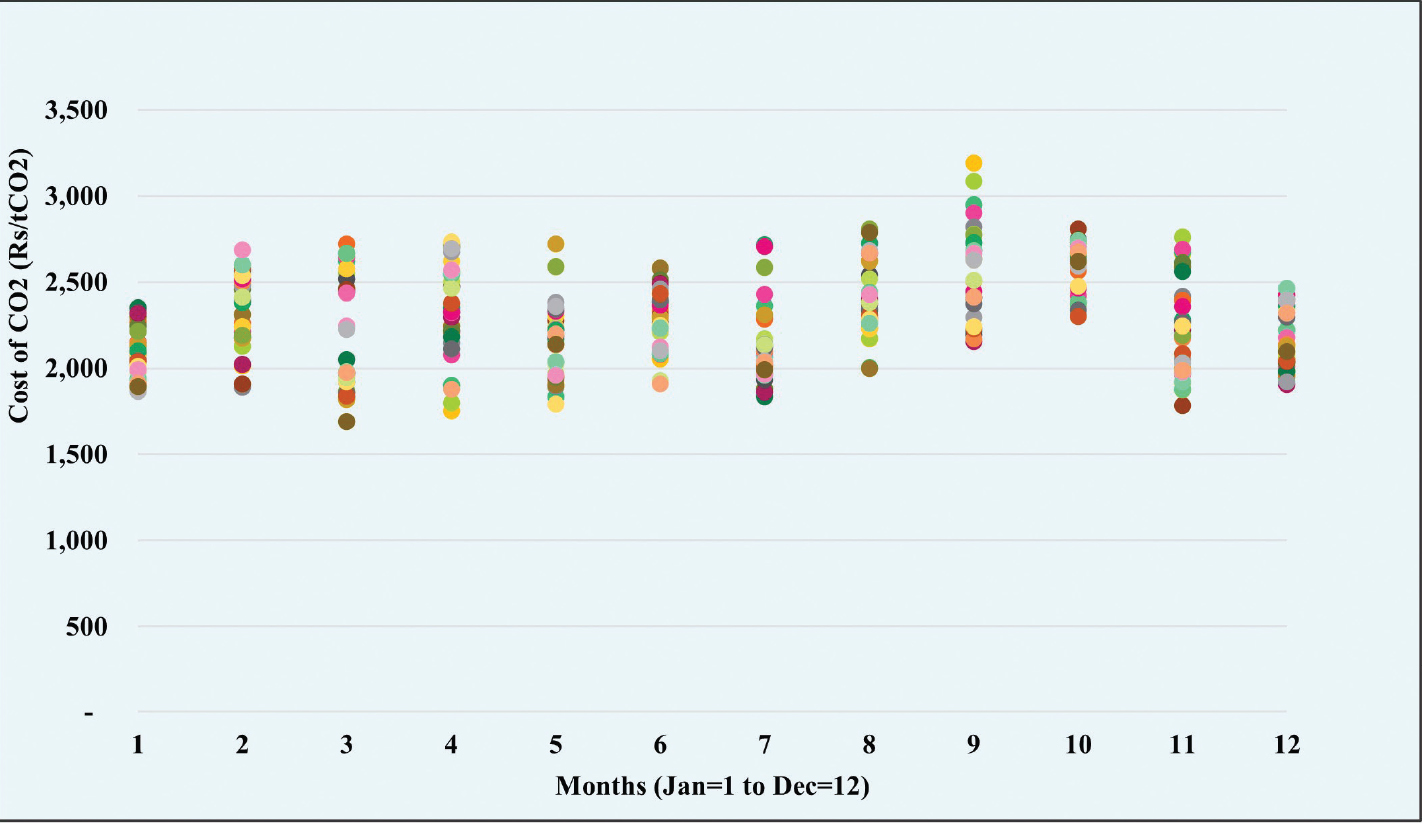 It has been observed that the average cost of CO2 also varies during the day and according to the season, as shown in Figure 2. Although we do not present the results here, there are also some co-benefits in terms of reduction in local pollutants. In other words, measures taken to reduce CO2 may also lead to a reduction in SOx, NOx and particulate matter, albeit these would be highly dependent on specific plants and combustion technologies.
One of the key strengths of the SECED model is its flexibility. It allows system operators to set different priorities/targets based on policy or regulatory needs. For example, the system operator may set the target flexibly for each day, or only on weekends, or the goal may be to lower CO2 emissions in line with climate targets.
In addition to emission reductions, the study also showed how the generation pattern changes under different scenarios. Some coal plants that are cheaper to operate under economic dispatch were not selected under SECED due to their high emissions. Instead, the system relied more on more efficient coal plants, gas-based units, and in some cases, imported power from neighbouring regions. These patterns reveal that India already has some capacity to shift to cleaner generation within the existing system, provided that dispatch decisions are adjusted across the entire system.
The SECED framework not only helps in understanding the cost of cleaner generation, but also allows policymakers to set informed priorities. In addition to dispatch adjustment, generators may prefer to buy permits if those are cheaper than adjusting their own dispatch. They may also be interested to add renewables to their portfolio to offset emissions. A further extension model, therefore, has also been studied, considering the permits available in the carbon market and the possibility of new, cleaner renewable energy generation to meet the targeted emission reduction. The observations of this study are shown in Table 2.
It may be seen that with a low carbon certificate price, the volume of permits is greater; however, with an increase in the permit price, cleaner generation is taken up under the model to meet the emission reduction target. Another key takeaway is that the SECED framework is fully compatible with power system security. All dispatches under the SECED model respected generator constraints and demand-supply balance. This shows that environmental goals do not have to come at the cost of reliability. With proper modelling, both emissions and security can be managed together.
The implementation of SECED in India requires extensive research and pilot studies to evaluate its feasibility and effectiveness. The way forward is to undertake a pilot study, and to create a regulatory sandbox to carry out this study in a real-time environment, which is considered essential before full-scale implementation. A pilot project could involve a small set of power plants operating under a simulated SECED framework, allowing regulators and system operators to assess its real-world implications. Once it is tested and found in order, India can move toward a power system where cost, security and environmental sustainability go hand in hand.
In conclusion, the SECED approach marks an important step in the evolution of power dispatch in India. It helps shift the focus from least-cost dispatch to least-impact dispatch – one that considers both the cost to the economy and the cost to the environment. As India prepares for the carbon market and continues its clean energy transition, models such as SECED will be essential tools in ensuring that the power system is not just powerful, but also responsible.