
The Central Electricity Authority (CEA) has released its latest report on failures in extra high voltage (EHV) transmission line towers across India, covering incidents from January to December 2024. The report highlights key structural, environmental and operational challenges, consolidating data from 12 utilities to analyse failure patterns, compliance gaps and risk factors. Many failures were attributed to high-intensity winds, sabotage, foundation instability, ageing infrastructure and inadequate maintenance. The findings highlight the need for enhanced infrastructure resilience and adoption of updated technical standards. The report also provides recommendations to prevent recurring failures and ensure long-term grid stability.
Tower failure patterns
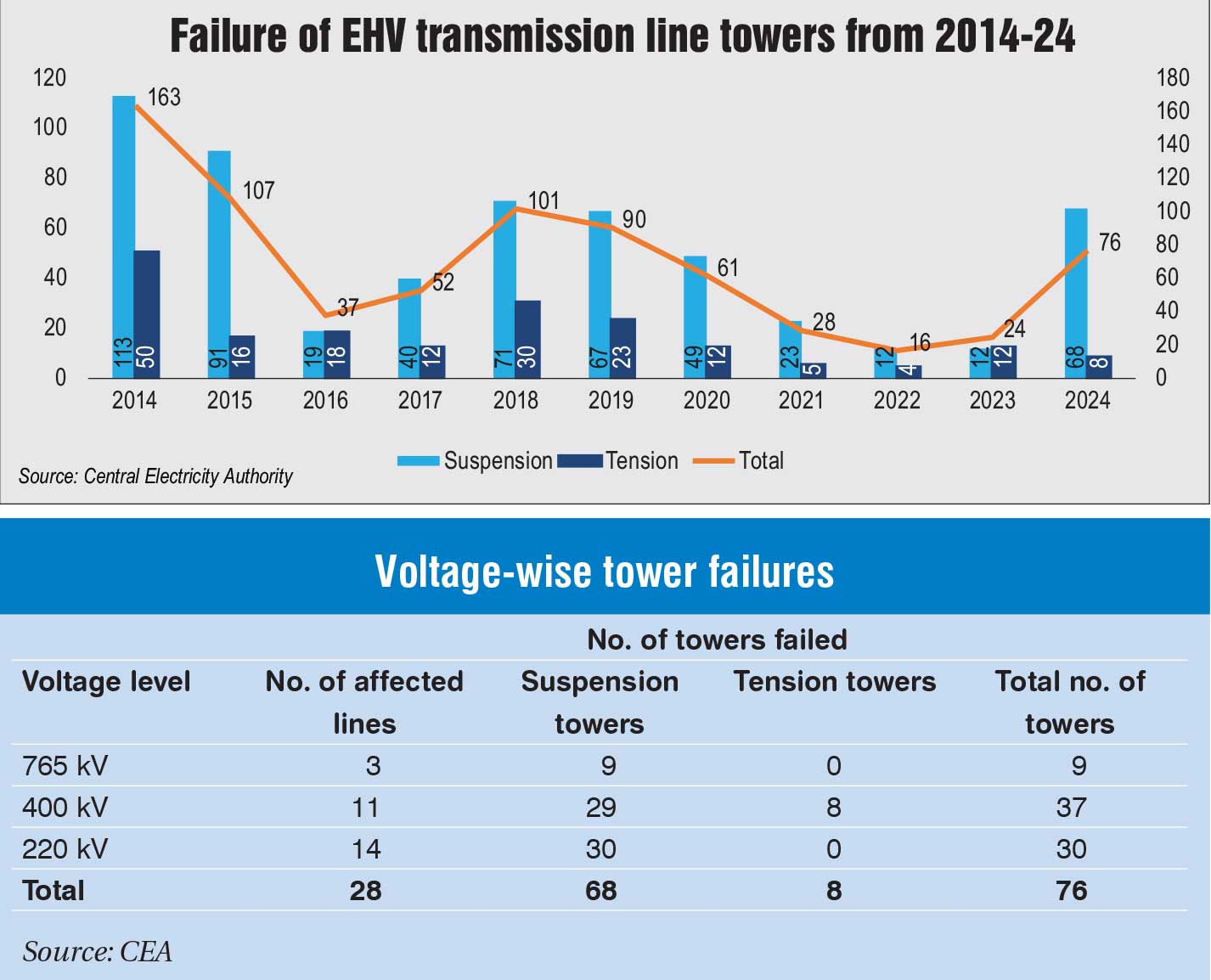
In 2024, a total of 28 EHV tower failure incidents were reported, involving 76 towers (68 suspension type and eight tension type). At the 765 kV level, nine suspension towers failed across three transmission lines. At 400 kV, there were 37 tower failures (29 suspension and eight tension) across 11 transmission lines. At the 220 kV level, 30 suspension towers failed across 14 transmission lines. The majority of failures occurred in towers within Wind zones 2 and 4, which also cover the most geographical area.
Despite regulatory mandates, only four utilities – Power Grid Corporation of India Limited (Powergrid), Adani Power Limited, Damodar Valley Corporation Limited, and Rajasthan Rajya Vidyut Prasaran Nigam Limited – intimated failures within 48 hours for 10 of the 28 events. Detailed failure reports were submitted within the prescribed one-month time frame for just 14 of the cases. Four utilities, namely, Transmission Corporation of Andhra Pradesh, Maharashtra State Electricity Transmission Company Limited, Gujarat Energy Transmission Corporation Limited and NTPC Limited, either delayed submissions until prompted by the CEA or failed to submit entirely. The lack of timely reporting severely restricted site-based investigations and delayed the identification of systemic weaknesses.
The Standing Committee of Experts constituted by the CEA has noted that the failure rate of suspension-type towers is significantly higher than that of tension-type towers. This is primarily because transmission lines in normal terrain typically use more suspension towers. Additionally, these towers are not designed to withstand horizontal forces in the longitudinal direction, making them vulnerable to cascading failures when one tower collapses. To address this, IS 802:2015 has introduced stricter loading criteria by increasing the longitudinal and transverse force requirements for suspension towers under security conditions.
Tower failures generally involve structural issues such as deformation in the legs and cage area near the bottom cross arm. Buckling at the stub level is common and can lead to complete tower collapse, with or without foundation damage. Failures may also occur above the first panel level, potentially affecting the foundation. In some cases, structural collapse starts from the bottom, top cross arm or peak without damaging the lower sections.
Common failure causes
- Wind-induced damage: Utilities often failed to substantiate claims of wind-induced damage with real-time meteorological data, largely due to the unavailability of wind speed records at tower locations. The report has underscored the need for utilities to collaborate with the Indian Meteorological Department (IMD) and other agencies to procure wind data and validate their design benchmarks.
- Foundation failures: Foundation failures emerged as a repeated issue in hilly and riverine regions. For instance, a recurring failure at tower location 144 on the 400 kV Kishenpur-New Wanpoh III and IV lines was attributed to land sinking. Although geological instability had been flagged in earlier failures, recommended remedial actions, including slope stabilisation, were not implemented by Powergrid.
- Sabotage: Sabotage was identified as a factor in several incidents, with the deliberate removal of tower components. The Abdullapur-Bawana line saw the removal of 40 bracings and members. Inadequate patrolling and delayed detection allowed these thefts to compromise structural stability. Similarly, older assets like the 220 kV MIA-BTPS line reported multiple theft-related collapse incidents, prompting discussions around the economic feasibility of line dismantling.
- Whirlwinds and flash floods: There were also cases where high-intensity whirlwinds and flash floods led to failures. In the 765 kV Gwalior-Agra line, for instance, a suspension tower collapsed due to a flash flood caused by the opening of a dam gate. Here, the committee stressed the importance of advanced coordination with dam authorities and the need for pile-type foundations in vulnerable zones.
Committee recommendations
The committee has directed all utilities to report tower failure incidents in line with regulatory timelines, with intimation within 48 hours and detailed reports within one month, to allow timely site investigations. It also noted the need for utilities to provide actual wind velocity data for each incident by coordinating with the IMD, nearby airports or other authorised meteorological sources for accurate wind-related analysis.
It was observed that some towers were being reconstructed using outdated IS 802:1995 standards instead of the updated 2015 edition. The committee reiterated that all replacement and spare towers are expected to comply with the latest technical standards. In states such as Manipur and Haryana, utilities had adopted local engagement for patrolling in theft-prone areas, but implementation remained inconsistent. The committee has highlighted the importance of sustained patrolling and local involvement in theft prevention.
 The digitisation of spares and inventory using tools such as SAP was recommended to improve asset tracking and emergency readiness. Utilities were also expected to carry out regular operation and maintenance (O&M) of transmission lines, prevent right-of-way (RoW) encroachments and control theft. A summary of O&M practices followed across networks was requested. The committee encouraged the use of IMD wind sensor data for failure analysis.
Given changing wind patterns, the committee advised state electricity regulatory commissions to initiate the revision of the national wind zone map in collaboration with the IMD. It also noted that towers built under old design codes need to be assessed and strengthened as per IS 802:2015 standards. Updated drag coefficients as per IS 802:1995 should be applied in design calculations based on solidity ratios.
With the rise in high-wind incidents, the committee called for increased line patrolling, prompt replacement of missing members and bolts, and correction of rusting, misfitted parts and poor quality erection work. Failures linked to erection and maintenance deficiencies were seen as avoidable through better execution and oversight. For towers in high-wind or critical locations, it was recommended to design redundant members using actual load data and non-linear analysis, and to adopt advanced erection and stringing methods.
In riverine and flood-prone regions, the committee recommended pile-type foundations, supported by detailed hydrological and soil investigations based on at least 20 years of river morphology. Towers near riverbanks require frequent patrolling and risk assessments to monitor potential changes in river course. Coordination with dam authorities was advised in locations where tower foundations may be affected by dam-related discharge. In case of any damage to foundations, a design review was considered necessary. The committee noted the importance of verifying material quality through test reports and ensuring chimney casting and stub placement align with approved drawings. Improper erection, leading to residual stresses, was identified as a recurring factor in failures.
Finally, the committee stressed the need to clear RoW encroachments and strengthen erection, patrolling and maintenance practices. Regular patrolling is critical to detect unauthorised activity near tower structures. In cases involving theft, vandalism or accidental damage, FIRs are expected to be filed and submitted as part of documentation.
Conclusion
With climate variability and extreme weather events occurring more frequently, transmission utilities are expected to incorporate resilience into their core planning and asset design processes. The recurring failure of suspension towers highlights underlying structural and operational issues that require proactive, long-term solutions rather than reactive measures.
Going forward, utilities will increasingly adopt data-driven design validation, enforce strict adherence to updated technical standards, and strengthen coordination with meteorological and planning bodies. Timely reporting, proactive risk assessment and investment in modern monitoring tools will be essential to enhance infrastructure durability. As the grid faces growing environmental and operational challenges, building a robust and adaptive transmission system will be key to ensuring long-term reliability and system security.
Aastha Sharma