
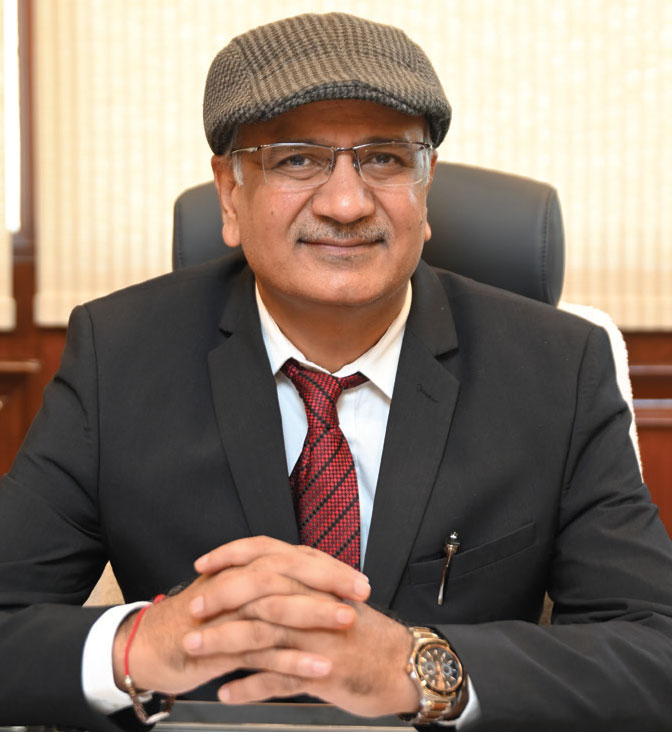
 In a recent interview with Power Line, Dr Manoj Kumar Jhawar, Chairman and Managing Director, PTC India Limited, shared his views on the evolving power trading landscape in India, key market reforms such as market coupling and electricity derivatives, and the opportunities arising from the green energy transition. He also outlined PTC India’s strategic priorities in renewable energy, cross-border trade and digital transformation. Edited excerpts…
What is your assessment of the current state of the power sector, and particularly power trading?
India’s GDP is growing at 5.5-6 per cent annually, which is one of the fastest among large economies. However, our per capita power consumption is still at about 1,400 units per annum, which is among the lowest in the major growing economies. So, on the demand side, we see decent headroom for growth in power demand, averaging around 7.5-8 per cent per annum in the medium term. We also see the share of renewables growing at a much faster rate, driven by cheaper solar generation and declining costs of energy storage systems. The trading market is directly connected with energy generation. Further, with market-based reforms, such as the compulsory scheduling of unrequisitioned surplus power, virtual power purchase agreements (VPPAs), over-the-counter platforms and the general network access amendment, we expect the share of trading in the total energy basket to grow faster than demand. This growth will be further supported by digitalisation and the expansion of distributed energy networks across the value chain.
What are the biggest challenges and opportunities in the sector?
The biggest challenge, and also the biggest opportunity, is managing the energy transition to green sources. For a very long time, we have been heavily dependent on fossil fuel imports to meet our growing energy needs. Now, we have a real opportunity to become significantly self-reliant, if we can manage this energy transition well. For this to become a reality, we will need to work on many things, such as strengthening Make in India capabilities for green energy plants/equipment and energy storage systems, overhauling IT systems and resources for managing the integration of renewable energy, and developing the necessary supporting infrastructure and technologies. So, the opportunity basket is expanding to include green energy, energy storage solutions, smart transmission and distribution infrastructure, advanced metering solutions, communication technology and demand assessment tools and products. We expect the next decade (2025-35) to be spearheaded by distribution-side reforms, where discoms will enable consumers with choices and options based on their demand profiles, economics of procurement and preferred sources. The trading ecosystem will get the pivotal inclusion of the business-to-customer segment along with the bulk business of large generators and distribution utilities.
What, according to you, will be the impact of market coupling on power trading, market efficiency and power exchanges?
As an economic concept, market coupling is expected to enhance the efficiency of exchange platforms in terms of higher volumes, better price discovery and improved services for market participants. With three exchanges (licensed by the regulators) and actual transactions expected to commence by January 2026, we feel that liquidity-based limitations for other exchanges should ease. As participants mature and adapt to the coupled ecosystem, an increasing share of transactions will come under its fold, making a sizable impact on total traded volumes.
How do you see the electricity derivatives market evolving in the near to medium term? What are the steps needed to ensure wider participation?
Derivatives, whether financial futures, options or more bespoke hedging tools, will provide market participants with price discovery, volatility hedging and credit risk management. Currently, only a simple monthly settlement instrument has been launched, which does not cover all the types of market-based products being traded in physical markets. So, the requirement will be to launch new products mirroring the physical market. In the next two to three years, we hope to see the potential of derivatives unfolding in hedging and in enabling new capacity investments in the sector.
However, given the small size of the spot markets and the high degree of volatility, a carefully phased introduction of more complex derivatives is important. Liquidity, robust clearing mechanisms and prudential risk frameworks must precede large-scale derivatives trading. Eventually, such tools will allow us to smoothen price spikes, enhance investor confidence and deepen the power market.
What are PTC India’s recent initiatives in renewable energy integration and green power trading? What are some of the new initiatives that PTC India is pursuing?
We remain committed to being a catalyst in India’s energy transition, from predominantly conventional energy to green energy sources. On the policy front, we are engaging with the Ministry of New and Renewable Energy to secure renewable energy implementing agency status for PTC. Commercially, we have engaged with private capital owners for market-based PPAs in the renewable energy space. With the Central Electricity Regulatory Commission expected to issue guidelines on VPPAs, we expect distributed renewables capacity to get a boost. PTC will continue pursuing evolving opportunities.
What is PTC India’s strategy for cross-border power trading? What are the future plans?
The Indian grid is interconnected with the electricity grids of neighbouring countries, namely Nepal, Bhutan, Bangladesh and Myanmar (3 MW) through a very small low-voltage connection.
As a frontrunner in power trading, PTC India is engaged with all of these neighbouring countries for cross-border power trading. Cross-border transactions continue to remain a vital component of our power trading portfolio, with total volumes reaching 8,262 MUs in the current year, compared to 7,584 MUs in the previous one.
At PTC, we offer a comprehensive suite of services to our cross-border clients, facilitating the import and export of power on a bilateral basis across long-term, medium-term and short-term durations. In addition, we facilitate cross-border power trade through Indian power exchanges, ensuring flexibility and efficiency in transactions. Our cross-border engagements with Nepal and Bhutan typically include export of power during the dry season when hydro generation falls, and import of surplus power to India during the wet season. Bangladesh, meanwhile, imports power from India to meet its growing energy demand. Through these initiatives, PTC plays a pivotal role in enhancing regional energy cooperation, optimising resource utilisation and strengthening power connectivity across South Asia.
We are committed to further enhancing these relationships and aim to increase regional power trading among the countries. However, technical infrastructure is a major limiting factor, which calls for immediate attention on transmission interconnection. Further the conducive business environment in neighbouring countries will enable the future growth in cross-border power trade.
What have been the key achievements of PTC India in the past one year or so?
The past 12 months have been very encouraging. We closed the year with a trading volume of 82.75 BUs, which is an increase of 11 per cent over the previous year. On a consolidated basis, we earned a record profit of Rs 8.54 billion during 2024-25. We also successfully divested PTC Energy Limited to ONGC Green Limited in an all-cash deal during the previous financial year. We will strive to keep up the momentum. Our overall trading portfolio has shown growth across all segments. Long-term and medium-term volumes (including cross-border trade) stood at 32,957 MUs in 2024-25, compared to 32,405 MUs in the previous year. Exchange-traded volumes rose to 42,843 MUs, up from 37,348 MUs, while bilateral trade volumes (short-term transactions without an exchange platform) increased to 6,951 MUs, up from 5,088 MUs.
What are PTC India’s future plans and priorities? What are its expectations of trading volumes in the near to medium term?
Last year, we completed 25 years of doing business, and we are bootstrapping ourselves for the next 25 years. Going ahead, our next milestone is to cross 100 BUs within the next 18-24 months. The trading business is set to evolve with the growing role of renewable energy (both large-scale and distributed), storage solutions (battery, pumped storage projects and hydrogen), the sharing of transmission corridors with green developers, and the integration of digital data sources (both open and closed) to provide services not purely as energy but also coupled with deep data analysis. Our positioning as a trusted partner in the energy market is being strengthened through the company’s digital makeover plan. Broadly, we are endeavouring to get more share of the commercial and industrial segment, in addition to the already established model of serving distribution utilities.