
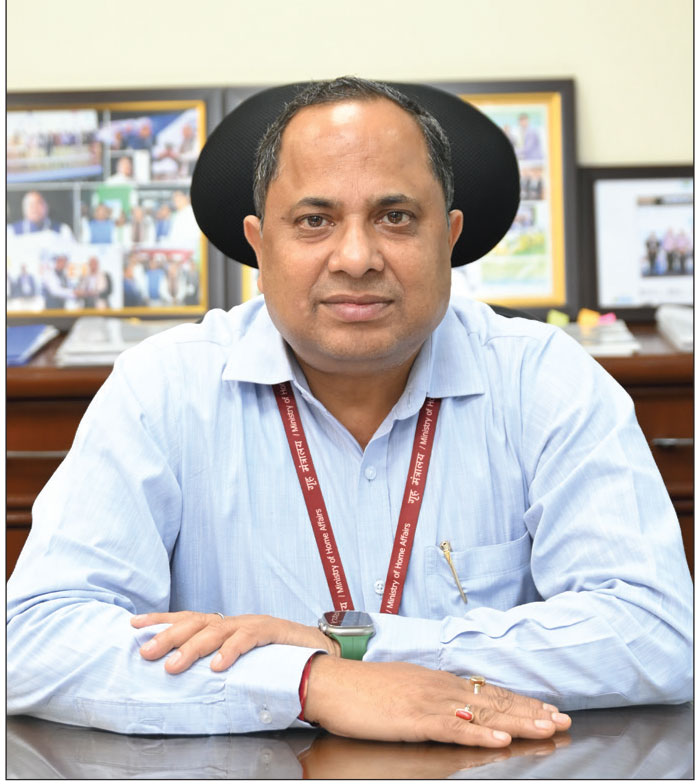
 In a recent interview with Power Line, Ghanshyam Prasad, Chairperson, Central Electricity Authority (CEA), shared his views on the performance of the power sector over the past year and the progress towards the country’s clean energy goals. He also discussed the challenges in renewable energy integration, the growing focus on hydro pumped storage projects (PSPs) and advances in transmission planning. Edited excerpts…
What is your assessment of the current state of the power sector? How has the sector performed in the past one year or so?
The power sector has performed exceptionally well, particularly in the past year. We successfully met the highest-ever peak demand of 250 GW without any load shedding. A key achievement was our ability to shift demand during solar hours, which is crucial for supporting the energy transition as more solar capacity is integrated into the grid. Over the past decade, solar capacity has expanded from a negligible base to 123 GW, while wind capacity has reached around 53 GW. Today, our total installed renewable capacity stands at about 195 GW and installed non-fossil fuel generating capacity stands at about 251 GW, i.e., more than 50 per cent coming from non-fossil sources. This has enabled us to achieve our NDC (nationally determined contributions) commitment of 50 per cent non-fossil capacity nearly five years ahead of schedule. Notably, the earlier 40 per cent target was also achieved nine years in advance.
In 2024-25 alone, we added a record generation capacity addition of 34 GW. This year, as of August 2025, 27.7 GW has already been commissioned, and we are likely to cross 40 GW in a single year – setting a new record. These achievements have been supported by dynamic resource adequacy planning for generation, carried out in consultation with distribution utilities and the states. The plan is revised annually for a rolling 10-year horizon. The latest plan extends up to 2034-35, and work is under way for 2035-36, expected to be completed by November 2025.
We have accelerated the pace of adding renewable energy resources and are now considering revising our commitments upwards. Another important focus area is waste-to-energy (WtE). The current installed capacity in this segment is quite small – around 854 MW across the country – but there is significant potential, particularly in large cities. A joint programme of the Ministry of Power (MoP) and the Ministry of Housing and Urban Affairs is aimed at scaling up WtE plants, helping manage urban waste and saving land for dumping of waste.
What are the biggest challenges and opportunities in the sector?
The biggest challenge facing the sector is the variability of renewables. To address this, we are accelerating hydropower development, with a strong focus on PSPs. Policy reforms over the past four years have helped unlock this potential in a big way.
Until 2024-25, pumped storage capacity was nearly stagnant at 4.7 GW, with little progress over the past decade. This scenario is now changing. In the current year, 2025-26, we will be commissioning 2.68 GW, followed by 2.92 GW in 2026-27. During 2028-29, annual additions are expected to be around 6.35 GW and from 2029-30, they will be 13 GW or more, taking the total PSP capacity to 57 GW or more by 2032.
In the past, hydropower development was largely concentrated in the Himalayan states, including Arunachal Pradesh, Himachal Pradesh, Uttarakhand, and Jammu & Kashmir. Geological complexities and infrastructure bottlenecks in these regions often caused significant delays. We broke this dependency by encouraging closed-loop, off-stream PSPs, which face fewer environmental challenges and have faster project timelines of three to four years.
We persuaded the Ministry of Environment, Forest and Climate Change to delink closed-loop PSPs from the conventional hydro clearance process, recognising them as “water batteries” and renewable sources. Further, PSPs have now been classified into three categories – closed-loop off-stream, open-loop and conventional – with priority accorded to closed-loop off-stream projects to accelerate development.
Several other measures have also been introduced to accelerate pumped storage development. These include financial support of up to Rs 10 million per MW for enabling infrastructure; streamlining the appraisal process through the “Jalvi Store” portal; simplifying detailed project report requirements; granting early excavation permissions to speed up project timelines; and making concurrence optional for closed-loop PSPs. These reforms have encouraged private sector participation and shifted the development of PSPs to mainly the peninsular region, where the geology and infrastructure are more favourable.
India has also performed remarkably well in transmission development compared to other countries. On average, we are able to commission transmission lines within 24-36 months, ensuring timely connectivity. While occasional delays occur in one or two projects due to right-of-way (RoW) issues, the sector has largely delivered consistently on this front. This has helped in the faster development of renewable energy projects.
However, new challenges are emerging. In states like Rajasthan and Gujarat, renewable capacity now requires high-voltage direct current (HVDC) transmission lines. These projects are far more complex and typically take at least five years to complete, creating bottlenecks in the evacuation of renewable energy resources.
To address this, we have started optimising intra-state transmission networks. In Rajasthan, for instance, our analysis has shown that up to 32 GW of renewable power can be accommodated through shorter transmission lines, reducing dependence on long HVDC corridors. A similar exercise is under way in Gujarat and other states.
Another challenge comes from the growing demand for renewable power from emerging industries such as green hydrogen and data centres. Meeting this demand requires very long transmission lines to deliver renewable power to industrial hubs. This is undoubtedly a complex task, but we are actively engaging with stakeholders to find practical solutions. Encouragingly, most discussions so far have led to constructive outcomes, helping ensure that India’s transmission expansion keeps pace with the green energy transition.
What is the expected growth in the transmission network, and what will be the investment requirement?
Earlier, we had estimated an investment requirement of roughly Rs 9 trillion in the transmission segment alone. Since then, we have begun conducting resource adequacy studies for transmission. This exercise, which we are now undertaking with all the states, will help assess the intra-state requirements as well. We expect the overall investment requirement to remain in the same range, or slightly higher.
A positive development at the state level is the shift towards tariff-based competitive bidding (TBCB). This allows private players to participate and invest in transmission projects, ensuring faster roll-out even when state utilities face financial constraints. This is similar to the success achieved earlier in the interstate transmission system (ISTS).
Another important intervention is the push for technological solutions to address RoW challenges. We are encouraging the use of monopoles and other innovative structures to minimise the RoW footprint. In addition, new guidelines have been introduced, enabling compensation at market rates for landowners. Looking ahead, we are also planning to upgrade system voltage levels from the current 765 kV HVAC to 1,200 kV HVAC.
What is your assessment of power demand in the medium to long term? What are the key factors driving growth and variability?
Power demand will continue to grow strongly. Earlier, we had estimated an annual growth rate of about 6 per cent but in reality, it may average 7-8 per cent, over the next decade. In fact, after the brief lull during the Covid 19 period, demand bounced back sharply, at times touching double-digit growth. This surge has been driven by the revival in economic activity, rapid industrialisation, increased connectivity across the country and improving living standards.
A particularly significant factor is the rising air conditioning load. Earlier, most households and establishments relied on fans, but today air conditioners are becoming common – in homes, offices, schools and industries. This shift is creating new challenges for distribution utilities, especially during periods of peak summer demand.
At the same time, weather patterns have created unpredictability. This year, for instance, prolonged rainfall from April through September moderated both agricultural load (as irrigation demand declined) and cooling load (as temperatures remained lower). As a result, demand, which was projected to rise from 250 GW to 270 GW, remained at around 243 GW. Conversely, when rainfall is intermittent, demand can spike suddenly between two spells, requiring utilities to remain prepared for short-term surges.
What are your thoughts on the India Energy Stack and the ongoing digital transformation in the power sector?
The India Energy Stack is certainly a positive step forward. While sectoral databases already exist, integrating them onto a common platform could create significant value. That said, the usefulness of such integration will depend on how it is structured. Power plants, for instance, generate an enormous amount of operational data, but not all of it is required for managerial decision-making. At the senior level, what matters are key datasets that provide actionable insights. If the stacking framework focuses on compiling only these critical data points, it can become a powerful tool to support better, faster decisions. This will require substantial expenditure. A cost-benefit analysis should also be done to prepare an optimal plan so that it does not raise the cost of power to consumers.
Beyond the India Energy Stack, which digital technologies do you believe are the most promising for the sector?
The biggest digital transformation will take place in the distribution segment. Transmission and system operation levels are already highly automated, with data flowing seamlessly from state load despatch centres to regional and national despatch centres. We also have the National Power Portal (NPP), which provides extensive data. At the distribution level, visibility has historically been limited. The real breakthrough is the roll-out of smart meters. Earlier, data collection was manual, error-prone and delayed. Smart meters, with their bidirectional communication, enable accurate, real- time data flow, supporting efficient network planning, demand forecasting, theft detection and outage management. With timely and precise information, many routine tasks can be automated, leaving manual intervention only for major faults. Smart metering also lays the foundation for the distribution system operator model, giving discoms much greater visibility and control.
Given the poor financial health of discoms, smart meters were not immediately viable. This is why prepaid meters were introduced, which allowed utilities to secure revenue in advance and manage their business better. It is encouraging to see states like Bihar take the lead, with discoms moving from loss-making to profit-making entities. They are now ahead not only in smart meter deployment but also in prepaid mode adoption, which has supported sectoral reforms.
Two key changes will drive the transformation of distribution. First, the roll-out of smart meters will ensure real-time data flows, enabling network planning, demand management and theft detection, and paving the way for DSO functions that give discoms much greater visibility and control. Second, automation in supply restoration will make outage management faster and more efficient, with routine faults resolved automatically and major issues addressed swiftly using precise location data. Together, these advances, supported by digitalisation in planning, implementation and inventory management, can fundamentally reshape how distribution is managed.
Looking specifically at the CEA, what are some of the studies, regulations, or new initiatives that are currently under way?
In the recent past, two major developments stand out. The first is the introduction of a culture of scientific planning at the state level. Earlier, most states and discoms planned with a limited visibility of three to five years, often without using robust models. With the adoption of resource adequacy planning in generation, this approach has changed. To support this, the CEA has developed an indigenous software tool called STELLAR. Training programmes have already been conducted for all states. The tool is being provided free of cost, enabling utilities to perform their planning independently.
Complementing this, the second key initiative relates to intra-state transmission planning. The CEA/CTUIL has been updating interstate transmission system plans every six months, and the same approach is being extended to intra-state networks. So far, this exercise has been completed for 11 states, and the goal is to complete 10-year intra-state transmission plans for all states by December 2035.
Looking ahead, the CEA is exploring the possibility of moving into distribution network planning. While this is not strictly within its central mandate, achieving it would complete the entire value chain. Our philosophy is not to centralise everything, but to build systems, provide initial handholding for states and enable them to continue independently. So practically, we have only one bidding zone in the country.
On the regulatory side, amendments are under way for connectivity regulations and construction standards. The need for this arises from the integration of new technologies into the grid, including battery storage, pumped hydro storage, synchronous condensers, harmonic filters, reactive compensation, and large-scale solar and wind. The revised regulations are expected to be finalised within the next three to four months.
What are the CEA’s long-term priorities?
In the long term, the CEA’s priorities are aligned with Viksit Bharat by 2047 and India’s net-zero target for 2070. For 2047, the CEA has prepared detailed projections that now serve as benchmarks for the MoP and the Viksit Bharat task force. For the 2070 net-zero scenario, the CEA conducted the first comprehensive study for the power sector and shared it with NITI Aayog, where it is being integrated into the broader energy roadmap.
In the transmission segment, India has built an extensive network of 4,97,372 circuit km with 13,75,418 MVA of transformation capacity and 120 GW of interregional links as of August 2025. This has enabled the vision of one nation, one grid, one frequency and even one price, with congestion levels down to just 0.02 per cent, a performance far ahead of many advanced countries. So, practically, we have only one bidding zone in the country.
A key shift has been potential-based transmission planning. With solar and wind coming online in just 12-18 months, we now plan and build transmission systems proactively in high-potential zones, ensuring generation and evacuation stay aligned.
The grid itself has become far more sophisticated, integrating STATCOMs, synchronous condensers and harmonic filters to enhance quality and stability.
Finally, cross-border interconnections are gaining traction. Interconnections with neighbouring countries – Nepal, Bhutan, Bangladesh, Myanmar and Sri Lanka – are expanding, further strengthening regional energy cooperation. We may interconnect the South Asia gridwith the Southeast Asia grid. This will be aligned with our vision of One Sun, One World, One Grid (OSOWOG).