
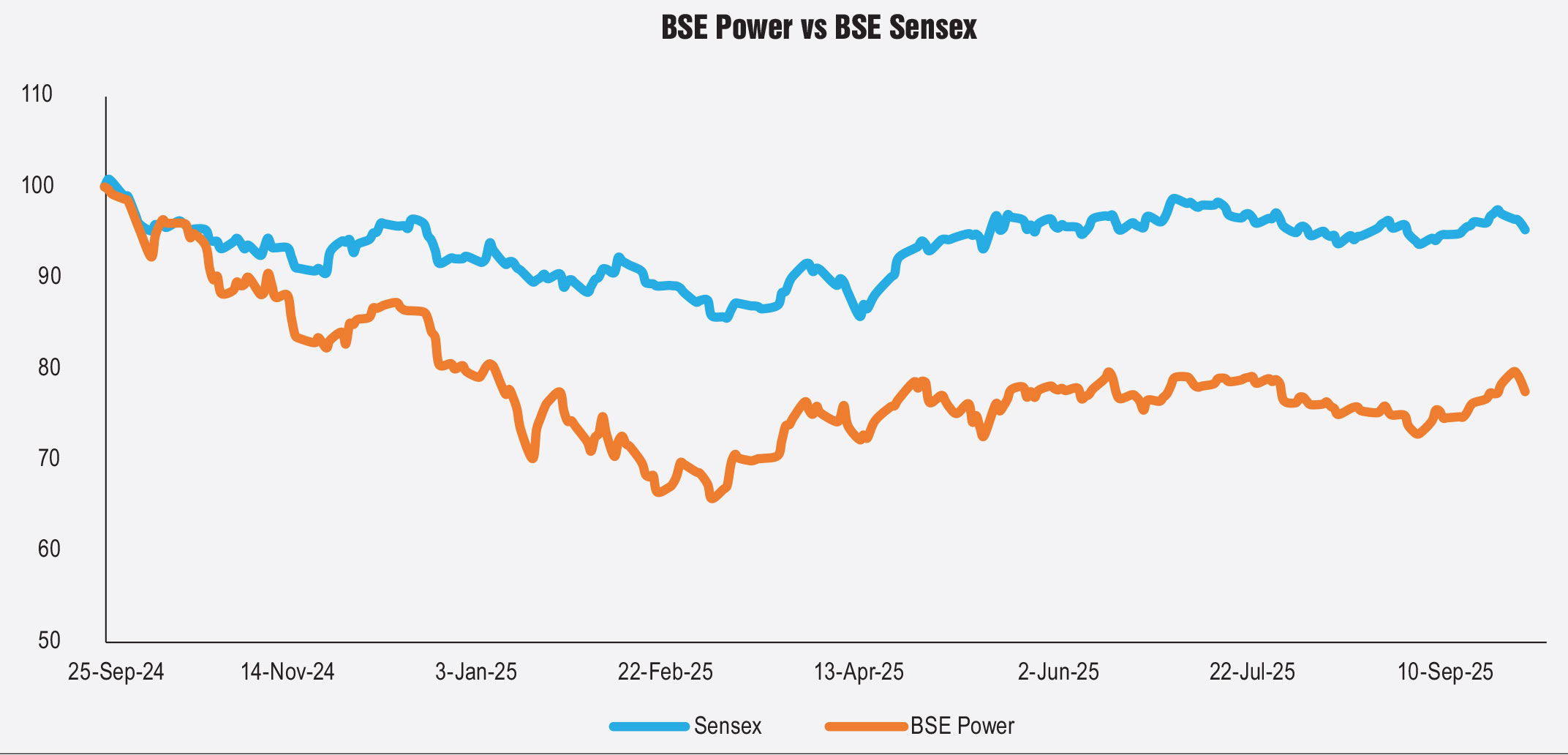
The power sector has underperformed the overall market in the past year. The BSE Power Index of the Stock Exchange, Mumbai, which has 12 constituent companies, has dropped from 8,768 points on September 25, 2024 to 6,694 points on September 25, 2025, a loss of 22.5 per cent.
For context, the Sensex, which tracks 30 of the largest listed companies across the broader market, fell 4.7 per cent during the same period. This correction comes after a strong performance between September 2023 and September 2024, when the Power Index registered a whopping 81.4 per cent gain, while the Sensex moved up 29.1 per cent during the same period.
There are 12 companies on the BSE Power Index, spread across various segments of the power sector, including generation, transmission and equipment supply. Notably, the power exchange segment is not represented on the index, and the pure-play renewables segment remains somewhat under-represented in the absence of NTPC Green.
Of these 12 companies, only one, Adani Power, has reported positive returns during this period, with its share price rising 11.9 per cent (after adjusting for a stock split). Investors in the remaining 11 companies suffered capital losses, ranging from a relatively modest loss of 2.2 per cent for CG Power to a high loss of 47.8 per cent for Adani Green.
In terms of financial performance, most of the companies had acceptable results in 2024-25 and even in the first quarter of FY 2026 (April-June 2025). However, there was a slowdown in both revenue growth and profits. During Q1 FY 2026, demand reduced further due to unseasonal weather. Heavy rainfall during this period resulted in fewer high temperature and high humidity days, which reduced cooling-related demand. As a result, peak demand was lower, overall power generation was lower, coal despatches from Coal India Limited were lower and the average price of units traded on the power exchanges was lower. The combination of a moderate FY 2025 and a subdued Q1 FY 2026 has been instrumental in power sector stocks trading lower.
A look at the financial highlights of these companies, with a focus on their performance in FY 2025 along with some key metrics. The stocks are organised by segment…
Generation
The BSE Power Index has seven generation companies – NTPC Limited, NHPC Limited, Adani Power, Adani Green, Tata Power, Torrent Power, and JSW Energy.
A PSU major, NTPC’s stock price fell by 21.9 per cent, from Rs 436 on September 25, 2024 to Rs 340 on September 25, 2025. In terms of consolidated financial performance, NTPC reported a net profit of Rs 239.5 billion for 2024-25, an increase of approximately 10.9 per cent over the net profit of Rs 213 billion recorded in the previous fiscal. Furthermore, the company reported a total income of Rs 1.9 trillion for FY 2025, a rise of 5.35 per cent from Rs 1.81 trillion in FY 2024. NTPC’s market cap is about Rs 3.26 trillion.
NTPC also listed NTPC Green in November 2024, while retaining an 89 per cent stake in its subsidiary. NTPC Green now has a market cap of Rs 838 billion, following an initial public offering that raised over Rs 100 billion. The company currently has an installed capacity of 83,696 MW and plans to expand this capacity to 130 GW by 2032.
Another PSU, hydropower major NHPC Limited saw its share price falling 6.99 per cent from Rs 92.90 on September 25, 2024 to Rs 86.40 on September 25, 2025. In terms of financial performance, NHPC reported a revenue of Rs 117.29 billion in FY 2025, a rise of 6.7 per cent over the Rs 109.94 billion registered in FY 2024. It recorded a net profit of Rs 31.3 billion in 2024-25, reflecting a decline of 13 per cent compared to Rs 36.04 billion in the previous year.
As of September 1, 2025, NHPC’s total installed capacity stood at 8,247.18 MW, including 1,681.7 MW in joint ventures. The company is currently engaged in constructing projects with an aggregate capacity of 9,789.72 MW. NHPC’s own hydro capacity of 7,771.2 MW accounts for approximately 15.7 per cent of India’s total installed hydro capacity of 49,628.16 MW. NHPC has a market cap of about Rs 850 billion.
Tata Power saw a drop of 17.5 per cent in its stock price, which fell from Rs 468 on September 25, 2024 to Rs 386 on September 25, 2025. In terms of financial performance, the company reported a net profit of Rs 47.75 billion for FY 2025, which is 11.6 per cent higher than the Rs 42.8 billion reported for 2023-24. The total income rose by 5.9 per cent to Rs 669 billion in 2024-25 from Rs 632.72 billion in 2023-24. The market cap is about Rs 1.23 trillion. The company has moved into renewables in a big way, installing solar capacity, manufacturing modules, investing in wind projects, etc. It has 5,644 MW of renewables capacity and 4.9 GW of manufacturing capacity for modules and cells.
Adani Power split its stock in a 5:1 ratio during the period under review. Adjusted for that split, it was the only stock on the BSE Power Index to register a gain. The stock price witnessed a growth of 11.9 per cent. The share price stood at Rs 149 on September 25, 2025, as compared to Rs 665 on September 25, 2024, which would adjust down to Rs 133 on the split. The market cap is Rs 2.82 trillion.
During 2024-25, Adani Power recorded a net profit of Rs 127.5 billion, marking a substantial drop of 38.8 per cent compared to the net profit of Rs 208.29 billion reported in the previous year. The company’s total income fell by 2.3 per cent, from Rs 602.81 billion in 2023-24 to Rs 589.06 billion in 2024-25. Operational revenues were, however, higher at Rs 562 billion in FY 2025, compared to Rs 503 billion in FY 2024. The company has an installed capacity of 17,550 MW, projects of 13,120 MW in progress and a target of 30,670 MW by 2030.
Adani Green Energy Limited’s (AGEL) share price fell 47.8 per cent from Rs 2,066.75 on September 25, 2024 to Rs 1,079.55 on September 25, 2025. The market cap is Rs 1.72 trillion. AGEL was India’s first company to surpass 10,000 MW of renewable energy capacity (in the 2024 fiscal). As of June 30, 2025, its installed capacity stood at 15,539.9 MW, including 11,005.5 MW of solar, about 1,977.8 MW of wind, and another 2,556.6 MW of wind-solar hybrid capacity. By 2030, the company targets 50 GW of capacity, with about 71 per cent being contributed by solar, wind, hybrid and pumped storage capacity. During FY 2025, the company’s revenues rose 60.5 per cent to Rs 207.5 billion from Rs 129 billion in FY 2024. The company registered a profit after tax (PAT) of Rs 7.6 billion in FY 2025, against a loss of Rs 4.9 billion in FY 2024.
Torrent Power Limited’s share price dipped by 33.5 per cent between September 25, 2024 and September 25, 2025, reaching Rs 1,254 in September 2025, down from Rs 1,886.90 in the previous year. In terms of financial performance, the company reported a net profit of Rs 30.6 billion in 2024-25, up 61.3 per cent from Rs 18.96 billion for 2023-24. The total income rose by 7.3 per cent, from Rs 275.18 billion in 2023-24 to Rs 291.65 billion in 2024-25. The market cap is around Rs 620 billion. The company has a portfolio of coal-based, gas-based and renewable power plants with an aggregate capacity of 4,328 MW.
JSW Energy Limited’s share price stood at Rs 784 on September 25, 2024 and by September 25, 2025, it had fallen to Rs 528.60, reflecting a drop of 32.6 per cent. JSW Energy recorded a net profit of Rs 33.17 billion in 2024-25 compared to Rs 25.06 billion during 2023-24, an increase of 32.4 per cent. The company’s total income increased by 5.84 per cent to Rs 126.4 billion in FY 2025, from Rs 119.41 billion during FY 2024. JSW Energy has a generation portfolio of 10 GW, with 61 per cent renewable capacity. The market cap is around Rs 915 billion.
Transmission
The shares of Power Grid Corporation of India Limited (POWERGRID) were traded at Rs 284.40 on September 25, 2025, compared to Rs 363.75 on September 25, 2024, reflecting a drop of 21.8 per cent. In terms of financial performance, the company recorded a net profit of Rs 152.85 billion in 2024-25, representing a dip of 0.35 per cent compared to Rs 153.38 billion during 2023-24. The company’s total income experienced a modest rise of 1.16 per cent, increasing to Rs 474.6 billion from Rs 469.13 billion in 2023-24. POWERGRID owns and operates about 45 per cent of India’s electricity transmission network. It also owns assets abroad and serves as a consultant in multiple countries. Its market cap is around Rs 2.62 trillion.
 Equipment suppliers
As of September 25, 2025, Bharat Heavy Electricals Limited’s stock was priced at Rs 234.60, down around 16.85 per cent from Rs 282.15 on September 25, 2024. The power equipment manufacturer reported net profits of Rs 3.7 billion during FY 2025, a rise of 85.6 per cent over reported net profits of Rs 1.99 billion during FY 2024. The total income for FY 2025 stood at Rs 288 billion, 17.9 per cent higher than the total income of Rs 244 billion during FY 2024. However, the results for Q1 FY 2026 (April-June 2025) were disappointing, with a reported loss of Rs 4.5 billion, which has resulted in significant selling. The PSU has an outstanding order book of Rs 2 trillion, which is nearly seven times the revenue generated in FY 2025. So, it has clear revenue visibility, provided it can improve its operational efficiency. Its market cap is about Rs 804 billion.
Wind turbine manufacturer Suzlon Energy Limited’s share price stood at Rs 56.64 on September 25, 2025, down 31.7 per cent from Rs 82.96 on September 25, 2024. The company’s total income for 2024-25 rose by 67.4 per cent to Rs 109.9 billion, compared to Rs 65.67 billion in 2023-24. Suzlon registered a steep 213 per cent jump in its net profit to Rs 20.7 billion in FY 2025 from Rs 6.6 billion in FY 2024. It has a market cap of about Rs 751 billion. Its order book stood at nearly 5.9 GW at the end of FY 2025.
ABB India’s share price suffered a steep correction in the past year. On September 25, 2024, its share price stood at Rs 8,178, and by September 25, 2025, it had fallen to Rs 5,200, reflecting a 36.4 per cent drop. In terms of revenue, for financial year ended December 2024, ABB India reported a total income of Rs 125.4 billion, reflecting a growth of 16.7 per cent over the Rs 107.5 billion reported for the previous fiscal year ended December 2023. The company’s PAT increased significantly, rising to Rs 18.71 billion in 2024, up by about 50.69 per cent compared to Rs 12.42 billion in 2023. ABB India’s market cap is Rs 109.6 billion.
In the April-June 2025 quarter, ABB reported a 20 per cent year-on-year drop in PAT. Order inflows were down 12 per cent year on year in the quarter at Rs 30.4 billion. The order book stood at Rs 100.6 billion as of June 30, 2025. The implementation of the new Quality Control Order meant that ABB India had to import a lot of components, leading to increased forex outflows and higher inventory holdings.
CG Power and Industrial Solutions (formerly Crompton Greaves) is the second-best performer on the index even though it suffered a small loss. Its share price stood at Rs 759.10 on September 25, 2025, down 2.2 per cent from Rs 775.85 on September 25, 2024. In terms of finances, the total income rose to Rs 100.7 billion in 2024-25 from Rs 81.52 billion in 2023-24, an increase of about 23.5 per cent. The company’s net profit was reported at Rs 9.72 billion in FY 2025, whereas it was Rs 14.27 billion in FY 2024. However, the results need to be adjusted for discontinued operations, which contributed Rs 5.51 billion in PAT during FY 2024. Adjusting like-for-like to eliminate the impact of this, profits rose by 11.7 per cent for continuing operations. The company’s market cap is around Rs 1.16 trillion.
Corporate actions in Siemens Limited also require adjustment before the returns can be calculated. During April-June 2025, several segments of the combined entity were spun off into Siemens Energy, which was listed as a separate company. Shareholders in Siemens Limited were given one share in Siemens Energy for every share held in Siemens Limited.
Adjusted for that listing, shareholders in Siemens and the newly listed Siemens Energy lost around 6.9 per cent by September 25, 2025. On September 25, 2025, the prevailing share price of Siemens Limited was Rs 3,156.30, while Siemens Energy was trading at Rs 3,527. The combined entity prior to the spin-off was trading at Rs 7,177 on September 25, 2024.
For financial year ended September 2024, the revenue of the combined entity stood at Rs 231.65 billion, an increase of 15.5 per cent over the reported revenues of Rs 200.5 billion in September 2023. However, owing to the spin-off and the associated restructuring, it is difficult to make future projections. The PAT was reported at Rs 26.8 billion in September 2024, an increase of 46 per cent over the profit of Rs 18.3 billion in September 2023.
Future outlook
The power sector’s performance is closely tied to economic growth, which implies that this period of moderate financial performance and negative stock market returns is a blip in a longer-term trend of growth since the Indian economy is growing fast.
The data suggests that the sector’s volatility of returns is higher than that of the broad market: a Sensex rise of 29 per cent was reflected in an 81 per cent rise in the BSE Power Index, whereas a Sensex drop of 4.7 per cent coincided with a 22.5 per cent drop in the BSE Power Index.
The sector is also in the middle of a transition where renewable capacity is in focus. Valuations for renewable energy companies are, by and large, higher than that for conventional thermal power companies. NTPC has unlocked value by taking NTPC Green public. Tata Power and JSW Energy could see valuation upgrades as their renewable energy exposure increases. Since solar and wind – the two largest renewable energy contributors – are both intermittent sources, there is a very strong case for investments in storage.
Another notable factor is the demand for cooling, especially household cooling, which may start increasing as room air conditioning penetration grows with rising household incomes. In China, for example, household cooling accounts for 15-20 per cent of power demand in the summer season. As Indian household incomes grow, this could mean bigger swings in weather-related demand. In the first quarter of FY 2026, rains lowered demand, but in a scorching summer there could be big upward spikes.
Devangshu Datta