
Smart meters, forming the backbone of the modern electricity distribution ecosystem, are driving operational efficiency, transparency and consumer empowerment. Yet, this rapid digitalisation also exposes a new layer of vulnerability: cybersecurity risks. The large-scale roll-out of smart meters, underpinned by the growing convergence of operational technology (OT) and IT, is reshaping the power sector’s cybersecurity landscape. This integration, while enabling automation and real-time data analytics, also expands the attack surface, introducing complex interdependencies across communication networks, data management systems and consumer interfaces.
As millions of meters become interconnected, each device represents both a node of intelligence and a potential point of intrusion. To navigate this evolving environment, utilities must move beyond viewing meters as billing instruments and instead treat them as critical digital assets requiring unified IT-OT governance, robust security frameworks and clear accountability mechanisms.
Cybersecurity risks in metering
Cyberattacks on the power sector have transitioned from a theoretical risk to a tangible operational concern. International incidents have demonstrated that connected devices can serve as entry points for hackers, potentially disrupting distribution networks or manipulating critical data. In the context of metering systems, these threats range from energy data tampering to large-scale denial-of-service (DoS) attacks that can impair communication networks and operational oversight.
In India, while large-scale cyberattacks on metering infrastructure remain limited, the expanding digital footprint of utilities makes proactive defence imperative. Vulnerabilities can arise at multiple levels of meter hardware, firmware and communication channels such as radio frequency (RF), power line communication or cellular networks, as well as head-end systems and data centres. Each layer requires coordinated cyber hygiene and monitoring to prevent exploitation.
Several high-risk vectors have emerged in the Indian context. Meter tampering and billing fraud remain significant concerns. Data breaches and privacy violations are becoming increasingly critical, as weak encryption in advanced metering infrastructure can expose sensitive consumer information; for example, a 2022 cyber incident at a National Capital Region discom compromised 300,000 customer records, as per the Computer Emergency Response Team-India (CERT-In). Utilities also face ransomware and malware threats, such as the 2021 Mumbai power outage linked to malicious software, and DoS attacks that disrupt both billing and grid monitoring operations.
Internal vulnerabilities, including insider threats and procedural lapses, further compound the risk. Structural weaknesses, such as the use of unencrypted RF or Zigbee communication in many smart meters, create additional exposure, leaving data susceptible to interception or manipulation. Collectively, these factors underscore the urgent need for comprehensive cybersecurity frameworks tailored to the metering ecosystem.
 Regulatory focus and policy direction
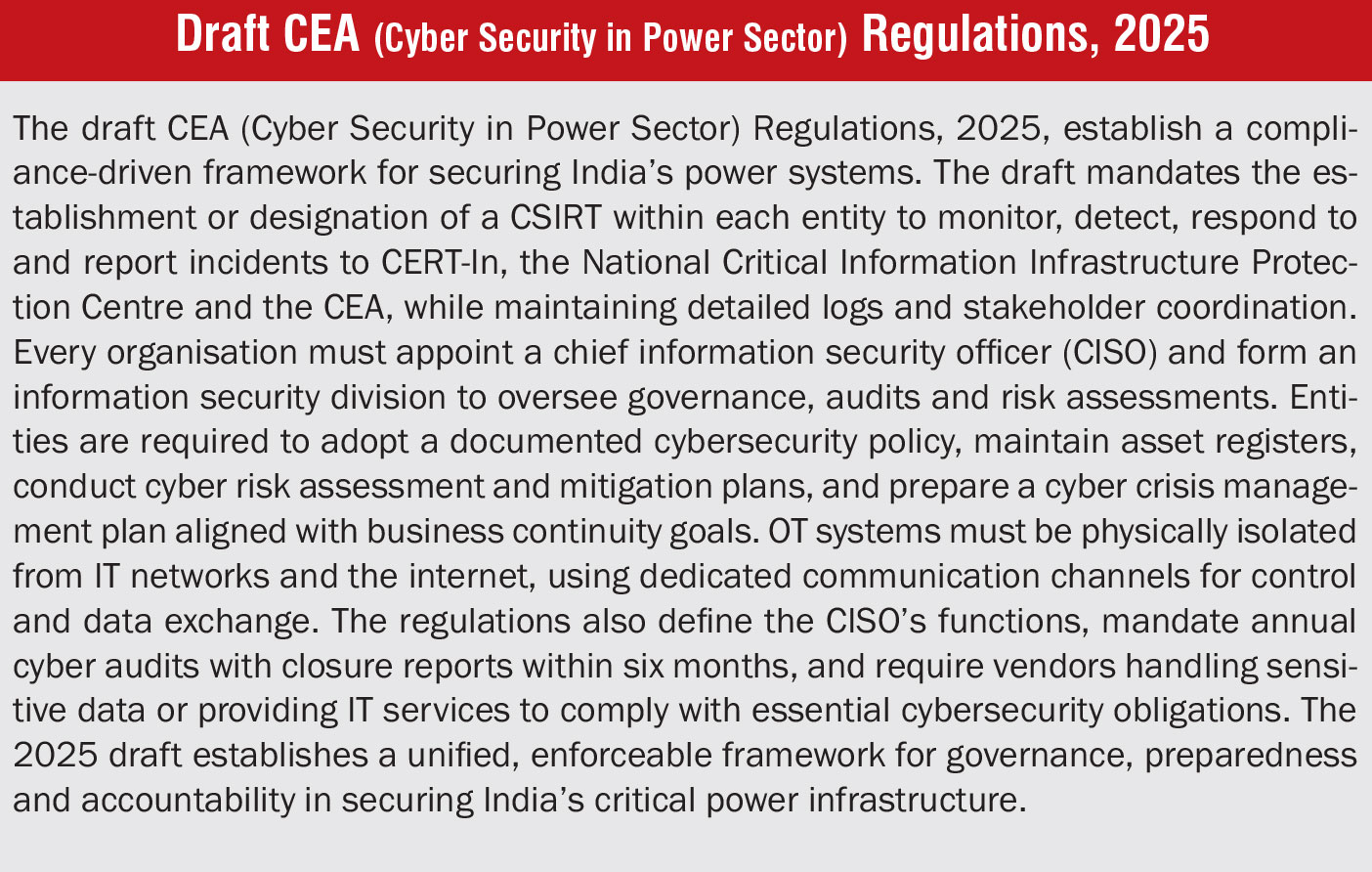
India has progressively built a layered cybersecurity framework for the power sector, particularly around smart metering and digital infrastructure. Foundational standards, such as IS 16664 and the Central Electricity Authority (CEA) Cyber Security Guidelines, 2021, established core controls for tamper detection, data integrity and system resilience. These were followed by the Draft Cyber Guidelines, 2024, which introduced structured oversight through the Computer Security Incident Response Team – Power (CSIRT-Power), operational security officers and annual audits. Recently, the CEA released the draft Cyber Security in Power Sector Regulations, 2025, marking a shift from advisory guidelines to a framework of enforceable compliance.
Utility preparedness
Utilities are increasingly embedding cybersecurity into the design and operation of smart metering systems. At the foundation is the selection of cyber-hardened meter hardware, equipped with tamper detection, secure firmware updates and encrypted communication modules. Equally critical is the implementation of end-to-end encryption across the data flow, from meters to head-end systems and meter data management systems, ensuring that energy usage information remains secure during transmission and storage.
Authentication mechanisms, role-based access controls and multi-factor verification further strengthen the security posture. Utilities are also enforcing vendor compliance, requiring original equipment manufacturers and system integrators to adhere to national security standards, conduct third-party vulnerability assessments and implement secure firmware signing to prevent unauthorised modifications.
Some utilities have adopted public key infrastructure models to authenticate devices and users, while others have integrated network operations centres with security operations centres for continuous monitoring of network traffic, anomaly detection and incident response. Beyond technology, utilities are formalising governance by defining roles and responsibilities, conducting regular audits and instituting cybersecurity training programmes.
Implementation challenges
Despite clear policies and regulatory guidance, practical challenges continue to impede effective cybersecurity implementation in metering. A significant hurdle is the shortage of skilled cybersecurity professionals, particularly at the field level, which limits utilities’ ability to monitor and respond to threats in real time. The integration of legacy IT and OT systems further complicates the landscape, as older infrastructure often lacks the security features necessary for a modern, digitally connected grid.
Supply chain security presents another critical challenge. With smart meters sourced from multiple vendors, ensuring the integrity of hardware and firmware throughout production and deployment is complex. Concerns regarding data privacy remain significant. The growing collection of consumer data, from usage patterns to remote disconnection events, demands transparent policies around ownership, access and consent.
Organisational challenges further complicate implementation. The CISO does not report directly to the chief executive officer or the board in over 80 per cent of cases, thereby limiting strategic oversight and accountability.
Cybersecurity functions are often not fully aligned with broader business objectives, and resource constraints affect over 50 per cent of utilities, restricting their ability to implement comprehensive protection measures.
These operational, technical and organisational challenges highlight the need for a holistic approach that combines skilled personnel, secure system design and strong governance to protect India’s smart metering ecosystem.
Mitigation measures
Securing India’s smart metering ecosystem requires a combination of technical, operational and regulatory interventions. On the technical front, all meter communications should use AES-256 encryption, while there is a need to replace legacy unencrypted protocols with secure alternatives such as low power wide area network technology (narrowband internet of things). Utilities are piloting AI-based anomaly detection to identify tampering, adopting zero trust architecture with biometric and OTP-based authentication, and leveraging blockchain to maintain immutable meter readings for anti-tampering assurance.
Operationally, best practices include annual penetration testing, ensuring meters are secure by design with BIS certification (IS 16444), and implementing role-based access control using Aadhaar-based authentication. Continuous real-time threat monitoring through CERT-In’s Cyber Swachhta Kendra and rigorous vendor risk management ensure vulnerabilities are promptly addressed. Additionally, privacy-preserving billing techniques, such as differential privacy, allow AI-driven data analytics without compromising consumer confidentiality.
Outlook
The evolution of India’s smart metering ecosystem requires a strategic and forward-looking approach to cybersecurity and data privacy. As digitalisation expands across the power sector, utilities must embed cybersecurity into planning, governance and operational frameworks to ensure the resilience of distribution networks. Strengthening human capacity, establishing clear accountability through CISO oversight and aligning cybersecurity functions with broader business objectives are key organisational priorities. Regulatory frameworks, such as the CEA Cyber Security Guidelines and Indian Electricity Grid Code provisions, along with emerging state-level mandates, provide a structured foundation for compliance, risk management and incident reporting.
Collaboration across central agencies, regulators and utilities through platforms such as CSIRT-Power and the Information Sharing and Analysis Centre for Power Sector will be essential for real-time threat intelligence sharing and coordinated responses. Integrating legacy systems with modern operational technology in a secure manner and maintaining consistent auditing and monitoring protocols will further enhance grid reliability. By adopting a proactive, risk-informed approach and fostering a culture of cybersecurity awareness, India can ensure that smart metering delivers efficiency, transparency and consumer empowerment.