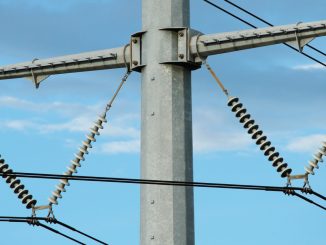
Transmission towers are vital structures that support overhead power lines, enabling high voltage electricity transmission. They are designed to withstand environmental forces and carry the weight and tension of transmission lines by transferring these loads to the ground through sturdy foundations. By maintaining proper height and spacing, towers prevent lines from sagging and breaking, while their insulating materials ensure safe operation by preventing current leakages. As electricity demand grows and renewable energy is increasingly added to the grid, it is important that the transmission network is expanded and made more flexible. To this end, transmission tower design is evolving, with technological advancements improving their efficiency, durability and sustainability.
Power Line takes a look at the new and emerging technologies in transmission towers and structures…
Digital solutions
Modern towers are increasingly being equipped with internet of things (IoT) sensors, edge computing systems and digital monitoring solutions that track tower health and electrical condition in real time. These devices continuously monitor towers on parameters such as stress, cracks, vibration, tilt and temperature, as well as environmental factors such as wind load, ice accumulation and humidity. Electrical parameters such as current, voltage and line load are also monitored in real time. The data collected is processed locally or transmitted to control centres, where machine learning algorithms detect anomalies and predict potential failures.
Aerial monitoring technologies such as drones equipped with light detection and ranging and high resolution cameras further complement these technologies by providing detailed visual and spatial data for inspection and mapping. They can survey vast areas quickly, identify structural defects, and generate 3D digital models at low cost and in less time as compared to manual inspections. The insights from drones and ground sensors together feed into digital asset management systems, ensuring timely maintenance and reducing unplanned outages.
In parallel, digital twin technology is fast emerging as a transformative tool for tower life cycle management. By creating virtual replicas of physical assets, utilities can simulate mechanical stresses, electrical loads and environmental impacts under varying operating conditions. This enables predictive maintenance, optimisation of tower geometry and material usage, and reduction in construction and maintenance costs.
Artificial intelligence (AI) is also transforming tower maintenance practices. AI-enabled drone imagery, computer vision and robotic crawlers are being deployed for automated detection of corrosion, missing components and conductor sag, enabling data-driven maintenance decisions.
Innovative tower designs
One of the key emerging advances in tower design is monopole towers. These towers are increasingly being favoured over traditional lattice towers, especially in forested and urban areas, due to their compact and streamlined design. Being taller and sleeker, they occupy approximately one-sixteenth the space required by lattice towers, significantly minimising right of way (RoW) and land acquisition challenges. Moreover, their design allows 40-60 per cent reduction in forest clearance, 60-80 per cent reduction in bird mortality, and improvement in wildlife permeability, making them particularly beneficial in regions with limited accessibility or dense vegetation. In terms of structural integrity, monopoles are designed to withstand high wind loads and extreme weather conditions. Their aesthetic appeal further enhances their suitability for urban landscapes. In addition, the adoption of hybrid materials and advanced coatings in monopole construction increases durability and reduces maintenance needs. To enhance resilience against climate vicissitudes, new tower geometries and base designs are being tested to withstand cyclonic winds, seismic shocks and flash floods. Some projects along India’s eastern and western coasts are already deploying cyclone-resistant monopoles designed for extreme weather.
Another innovative advancement in tower design is multi circuit towers. These towers are designed to carry multiple sets of conductors, often at different voltage levels, on a single structure. This way, they allow for higher power transfer while reducing RoW requirements and optimising land use, making them especially useful in areas such as densely populated urban centres and forests, or near substations.
Meanwhile, compact guyed towers act as a useful alternative over waterbodies, uneven land, or locations where conventional self-supporting towers are not feasible. These towers consist of a slender central mast, which is lightweight and occupies minimal space. The mast alone cannot withstand significant lateral forces, so stability is achieved through a symmetric arrangement of tensioned guy wires anchored firmly to the ground or seabed.
In urban or highly populated areas, transmission-cum-telecom towers that integrate power lines with telecom infrastructure reduce the need for multiple separate structures while optimising available space. Another innovative solution is hybrid alternating current/direct current (AC/DC) overhead line systems in which AC and DC circuits share the same tower or corridor. By converting or retrofitting existing structures to carry both AC and DC, utilities can increase transmission capacity and optimise land use without acquiring entirely new corridors. However, there are implementation challenges relating to high initial costs, electromagnetic coupling and intersystem faults.
Apart from these advancements, modular and prefabricated tower systems are gaining traction, allowing faster and safer installation in difficult or time-bound projects. These factory-built sections can be assembled on site with minimal machinery, significantly cutting project timelines and environmental disturbance. Apart from this, utilities and manufacturers are experimenting with 3D-printed components such as joints, clamps and insulator fittings to shorten supply chains and enable customisation.
Emergency restoration systems
Emergency restoration systems (ERSs) are an innovative method of restoring supply quickly. They comprise temporary towers that can be erected in less than a day and be deployed at any voltage level or terrain type to quickly restore power supply during emergencies, maintenance or line diversions. These towers are built from lightweight, modular and reusable components such as aluminium alloy or hot dip galvanised steel or a combination of both. Unlike permanent towers, which can take four to six weeks to rebuild due to foundation and erection works, ERS towers can be installed within a few hours, as they do not require conventional foundations. Instead, they use base plates and anchoring systems suited to different soil conditions.
To reduce reliance on imported ERS components, the Power Grid Corporation of India (POWERGRID) has developed modular ERSs in collaboration with Indian partners. Capable of supporting transmission lines up to 400 kV, these locally manufactured systems enhance infrastructure resilience and have been deployed at test sites for training and evaluation.
Advanced tower foundations
A strong and sturdy foundation is essential for the stability of a tower. Among newer designs, micropile foundations are increasingly being used in desert and hilly terrain, and marine environments. They use piles that are less than 200 mm in diameter and can be drilled into difficult or weak soils, providing high load-bearing strength with minimal excavation. Some emerging tower foundation designs include helical and auger cast piles. Helical piles feature steel shafts with helical plates that are screwed into the ground. Because of their design, helical piles are versatile in many soil types, cause minimal site disturbance, and are quick to install. Auger cast piles are installed by drilling a hollow-stem auger into the soil to the desired depth. Concrete or grout is then poured into the hole as the auger is withdrawn, after which a steel reinforcement cage is placed. Other options are precast foundations, which save time during short construction windows, and grillage foundations, which are used in weak soil where traditional foundations are less feasible.
Composite materials
Towers are constantly exposed to moisture, salt and industrial pollutants that can cause steel corrosion and reduce service life. To address this, ongoing research has led to towers made from composite materials, which combine materials such as fibre glass, carbon fibres or resin, with a polymer or metal matrix. These materials are emerging as strong alternatives to conventional steel and concrete owing to their superior strength-to-weight ratios, lightweight performance, increased durability, low maintenance and resistance to corrosion. In parallel, material innovation continues, with utilities exploring lightweight aluminium and hybrid alloy lattice towers that offer 25-30 per cent lower weight and improved corrosion resistance, particularly for coastal and hilly terrain. Sustainability is emerging as a core design principle, with a focus on recyclable materials, low-carbon steel production and the reuse of dismantled tower steel as part of utilities’ circular economy initiatives.
Composite cross-arm insulators are increasingly becoming mainstream as replacements for traditional steel or non-insulated cross arm. These insulators improve power transfer while staying within safety limits, and also support voltage upgrades by reducing the risk of flashovers. They allow towers to be more compact with smaller foundations, thus leading to less disruption to the environment, while being more economical over the long term.
Advanced galvanising techniques are being developed to extend the lifespan of steel towers by increasing resistance to corrosion. A new and emerging technology is cold-spraying zinc, in which fine zinc particles are accelerated at high speeds using a gas jet and deposited on-to a steel surface. The high-velocity impact causes the zinc particles to deform and break through their surface oxide layers, allowing them to bond directly with the metal substrate to provide effective protection against corrosion. Another emerging trend in the power sector is thermal diffusion galvanising, which diffuses vaporised zinc on-to the steel surface, forming a thick, uniform and environmentally safer protective layer. Apart from these, nano-coatings such as nano zycosil and the combination of chemical admixtures such as fly ash in concrete foundations are other new approaches to prevent chloride ingress and steel corrosion.
Conclusion
Overall, transmission towers are evolving to meet the growing electricity demand while enhancing efficiency, reliability and sustainability. Advances in tower design, materials and digital technologies are helping utilities transmit more power safely, optimise land use and extend tower lifespans. Together, these innovations are paving the way for a smarter, more resilient power transmission network.