
By P. Phani Kumar, Divisional Engineer, Telangana Generation Corporation Limited
In thermal power plants (TPPs), ash generated from coal combustion is categorised into fly ash and bottom ash. Fly ash, which constitutes approximately 70-80 per cent of the total ash, is evacuated and disposed of in silos, while bottom ash, making up 20-30 per cent, is typically handled through ash ponds.
Before disposal in the ash pond, bottom ash is passed through grinders and crushed into slurry ash for onward conveying to the ash pond. Sometimes, due to boiler operating conditions, the ash inside the boiler reaches fusion temperature, resulting in the formation of large clinkers (hard lumps of fused ash). These clinkers can be too hard for the grinders or roller crushers to grind effectively, posing a serious risk of mechanical damage to the bottom ash hopper plates due to their hardness and impact force. As the clinkers fall from the top of the boiler, the impact of the clinker directly hits the mother plate of the bottom ash and may cause serious damage.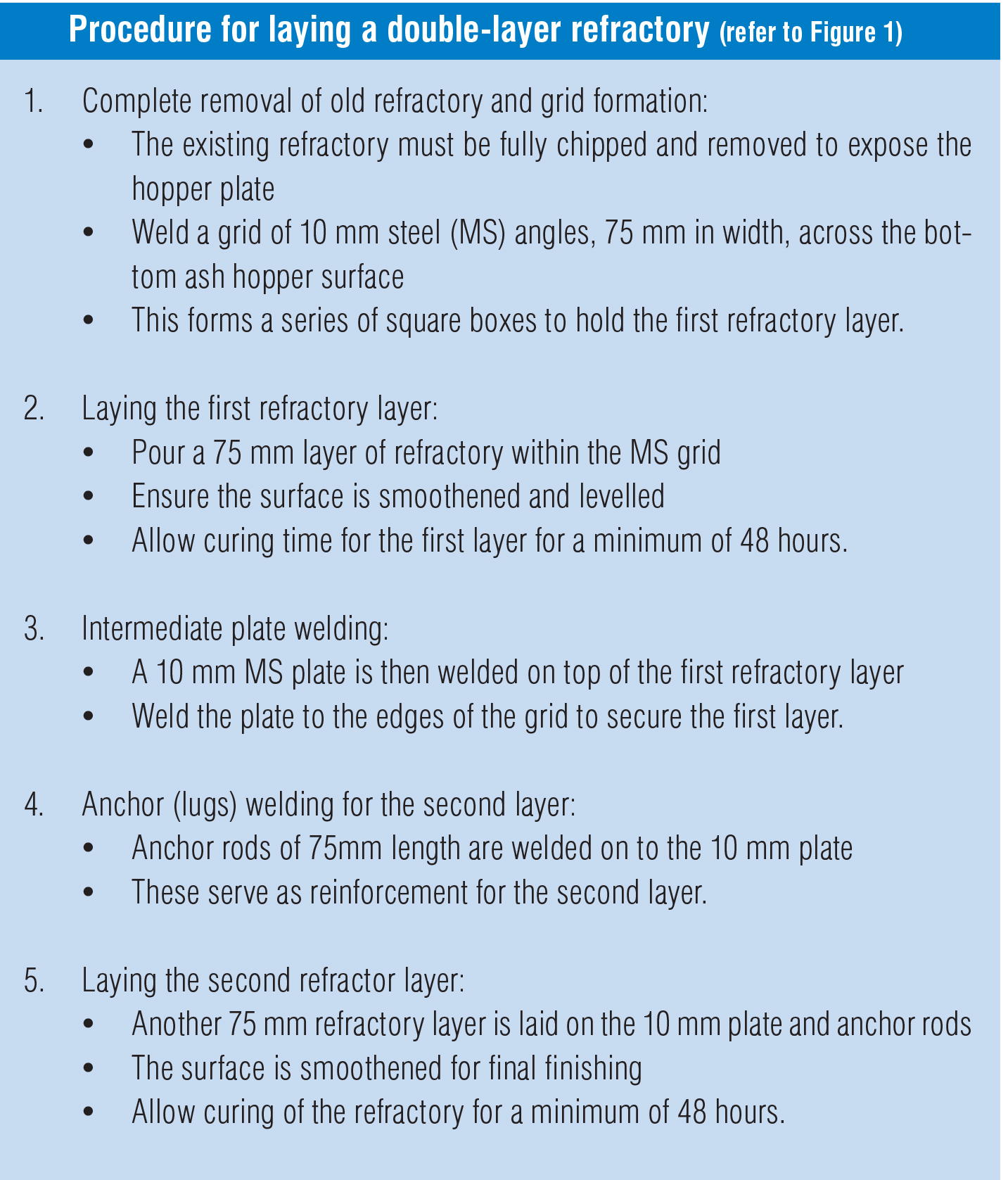
In most 600 MW units, damage due to clinker impact is observed in specific areas of the bottom ash hopper. These clinkers tend to strike the corners of the hopper, particularly the right-side corner (often referred to as Corners 3 and 4), with significant force. This impact can lead to the buckling of supporting beams of the bottom ash hopper, distortion of stiffeners, shear or rupture of hopper mother plates and water leakage from the hopper. Once such structural distortion is noticed, immediate rectification is essential to prevent further deterioration.
A critical component in mitigating this damage is the refractory lining inside the bottom ash hopper, which acts as a protective layer against high boiler temperatures and mechanical impact. If the refractory becomes brittle or loses its strength, the mother plate of the hopper is exposed and poses a serious threat to the bottom ash hopper. In practice, a single layer of refractory is laid inside the bottom ash hopper with the support of anchor rods, with a thickness ranging from 150 to 170 mm. Due to major impacts from the clinkers, the refractory may sometimes peel off, exposing the hopper mother plate to thermal stress. To rectify this, the unit has to be shut down. To overcome the issues faced with single-layer refractory, a foolproof double-layer refractory was attempted for the first time in one of the 600 MW TPPs in Telangana.
 The refractory properties in the bottom ash hopper of the 600 MW unit are as follows:
- Type: Alumina castable fire crete super
- Bond type: Hydraulic
- Maximum grain size: 5 mm
- Maximum service temperature: 1,450 °C
- Chemical composition:
- Al2O33: 68-72 per cent
- Fe2O3: 4.8-5.5 per cent
- CaO: 5.2-6.0 per cent
Proper laying, curing and quality assurance of the refractory material is essential to ensure long service life and resilience against high-temperature clinkers.
Traditionally, a single-layer refractory is used in the bottom ash hopper. However, it has shown several limitations. These include frequent refractory failures due to vibration and clinker impact, the need for frequent maintenance, and repairs that require a shutdown of 48-72 hours, affecting unit availability. In the long term, it can also deform or damage the hopper plate, leading to catastrophic failures.
To address these issues, a double-layer refractory system was implemented in one of the 600 MW TPPs in Telangana. This approach has shown significantly better performance in shielding the hopper plate and improving the reliability and lifespan of the bottom ash hopper structure.
After deployment of the double-layer refractory, the bottom ash hopper plate has better shielding against clinker impact, preventing the failure of the hopper plates. This method has been successfully adopted in one of the 600 MW TPPs in Telangana and has proved very helpful in bottom ash handling. This activity requires a minimum of 45 days.