

 By Parikshit Pareek, Assistant Professor, Department of Electrical Engineering, IIT Roorkee, and S.K. Soonee, Senior Adviser, Independent Consultant, Founding CEO of POSOCO (now Grid-India)
By the end of this decade, India’s data centres could consume as much power as an entire state, such as Chhattisgarh did at its 2024 summer peak (about 6.5 GW). Standing at the cusp of a massive digital build-out, data centres are expanding at unprecedented speed. They are the backbone of cloud computing, artificial intelligence (AI) and high-performance computing. Colliers India estimates operational capacity at 1,263 MW (April 2025), projected to exceed 4,500 MW by 2030, backed by $20 billion-$25 billion of investment. ICRA forecasts 2,000-2,100 MW by FY 2027, while JLL projects about 1,825 MW in the same period, driven by 5G and AI adoption. The Institute for Energy Economics and Financial Analysis’ high-growth case reaches 9 GW by 2030, about 3 per cent of national demand. At this pace, data centre load alone could soon rival a mid-sized state’s demand, underscoring the need for anticipatory grid planning, operational flexibility and spatial diversification to prevent regional grid stress.
All roads lead to metros
Market assessments indicate that nearly three-fourths of India’s data centre growth is concentrated within key metropolitan corridors: Mumbai, Hyderabad, Chennai-Vizag, and Delhi-National Capital Region. Mumbai alone hosts a multi-GW pipeline and ranks among global leaders in under-construction capacity, while Hyderabad and Chennai continue to attract hyperscale and colocation projects due to strong connectivity and land availability. Recently, Google announced a gigawatt-scale data centre cluster at Vizag. This clustering creates high local nameplate capacities, often hundreds of MW per campus and turns select substations into systemic power hubs. As these sites align with major internet exchanges and fibre trunks, their electrical demand becomes geographically concentrated and temporally correlated with urban business cycles, amplifying stress on metropolitan networks.
Taking things to the edge
As most large data centres remain clustered in metros, latency and regional access gaps persist. To bridge this, edge data centres, which are smaller facilities built closer to users, are expanding rapidly, with capacity expected to triple from 60-70 MW in 2024 to about 200 MW by 2027. While individually modest, their spread into Tier II and III cities will create new data centre load hotspots far from established metro corridors, posing new challenges for local distribution networks, reliability and cybersecurity, but also offering opportunities for localised flexibility and digital inclusion.
Why data centre load matters for the grid
Unlike industrial plants whose patterns follow production cycles, data centre demand depends on algorithms, not human activity. AI training workloads can run for days without pause, drawing nearly constant power from GPU clusters. Each rack can consume 40-60 kW, which is 5-10 times the traditional server intensity, and any voltage disturbance can trigger automated protection, instantly shifting load to backup. These “silent exits”, observed in the US and ERCOT studies, can remove gigawatts of load in seconds, producing frequency overshoot and reactive power swings.
Data centre load is high-density, high-velocity
Even a single hyperscale data centre can impose a demand comparable to a major industrial cluster, creating highly concentrated and fast-varying loads within already stressed urban grids. In cities such as Hyderabad, Delhi and Mumbai, where peaks range from a few to about 8 GW, an individual 100-500 MW facility may represent several per cent of total demand.
 From a power-engineering perspective, these centres represent a new class of localised, power-electronic-dominated loads whose dynamics directly influence grid stability. Their rapid, autonomous ramps and disconnections can cause instantaneous power imbalances, steep frequency excursions and high rates of change of frequency, quickly exhausting reserves and degrading area control error performance. At substations, converter and UPS systems draw and inject reactive power dynamically, distorting voltage profiles and occasionally triggering protection operations or voltage instability. Since they are dominated by non-linear electronics, data centres also generate harmonics that propagate through the network, affecting nearby sensitive equipment. As multiple campuses cluster around the same 220/440 kV nodes, transformer loading, short-term balancing and protection coordination all face new stress regimes, underscoring the need for predictive local planning and dynamic control strategies.
Unlike conventional industrial demand that follows daily or seasonal cycles, data centre load shows weak correlation with time-of-day or consumer activity. High-performance computing and AI training tasks can run continuously for days, creating near-constant or burst-type consumption that may peak during off-peak hours. As India begins hosting large AI clusters, such workloads could trigger sudden gigawatt-scale power draws without prior disclosure. Since real-time utilisation data are rarely shared due to commercial and cybersecurity concerns, planners face a “black box” in forecasting intraday ramps. This opacity complicates scheduling and reserve management, underscoring the need for mandatory telemetry and anonymised operational data-sharing to help operators anticipate computational surges in real time.
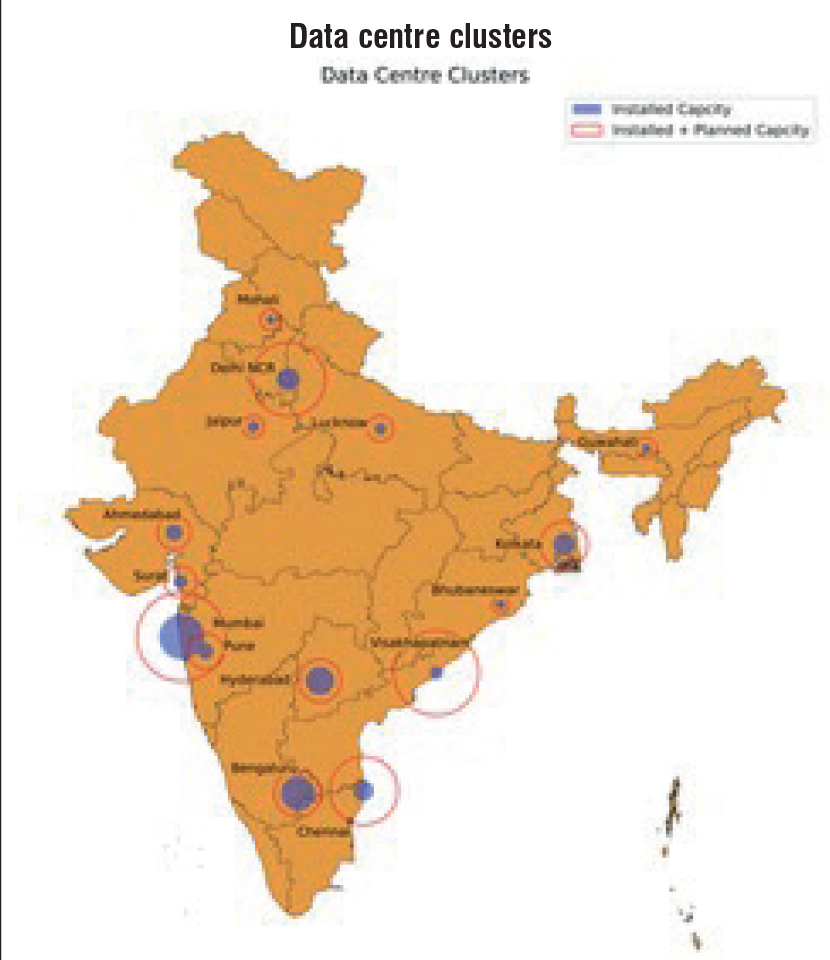 Modelling data centre load: Beyond static assumptions
Behind the steady hum of a data centre lies a dynamic system of servers, cooling units, UPS banks and power-electronic converters – all interacting within milliseconds. Traditional ZIP (constant impedance, current and power) models cannot capture these rapid, non-linear shifts in consumption. Recent work now moves toward component-based and dynamic models that simulate how IT loads, cooling and auxiliary systems respond during voltage dips or fault events. Such models, endorsed in IEEE 2781, are vital, as AI-driven workloads introduce bursty, unpredictable demand patterns. For India’s planners and grid modellers, adopting these advanced representations will be essential to anticipate how hyperscale and edge facilities influence system stability, transient behaviour and reliability margins across an increasingly digital grid.
From Virginia to Dublin: Global lessons
Across the world, rapid data centre growth is reshaping power systems and market dynamics. In the US, PJM’s capacity market for 2026/27 cleared at its maximum price of $329.17 per MW-day and thus, signalling tight supply and localised surges. Utilities such as Dominion Energy have revised multi-year investment plans to meet Virginia’s soaring data centre-driven load. Ireland offers a sharp warning: with data centres consuming nearly one-fifth of national electricity in 2023, the government imposed a temporary moratorium on new Dublin projects to avoid grid stress. Such concentrated growth introduces regulatory and planning risks, including high augmentation costs, potential stranded assets and dependence on a handful of large consumers.
Operational incidents in the US and Europe reveal that sudden multi-gigawatt disconnections of voltage-sensitive loads can cause frequency overshoot and instability. Studies document extreme load ramps, forced oscillations and harmonic distortions from dense power electronic deployments. Beyond electricity, water use and emissions are emerging flashpoints: a 100 MW hyperscale data centre may consume about two million litres per day, while Microsoft reported a 29 per cent rise in emissions since 2020.
From burden to flexibility
While data centres impose challenges, they also offer potential as flexibility assets. Global practice highlights three pathways: demand response, self-generation and workload shifting. Companies such as Google have demonstrated demand modulation to aid grid stability. Texas Senate Bill 6 (2025) requires controllable shutdown capability for large consumers, while Europe’s Market Model 3.0 integrates data centre flexibility into ancillary markets. India could adopt analogous frameworks linking tariff incentives to verifiable flexibility and telemetry performance.
Two self-provisioned strategies have emerged: (i) bring-your-own-battery (BYOB): co-locating battery storage with the load; and (ii) co-generation + battery: pairing on-site generation with storage. Each balance reliability, cost and regulatory complexity differently (Table 2). Both align with the US Department of Energy’s Section 403 vision, where large consumers must become active, flexible participants in grid reliability.
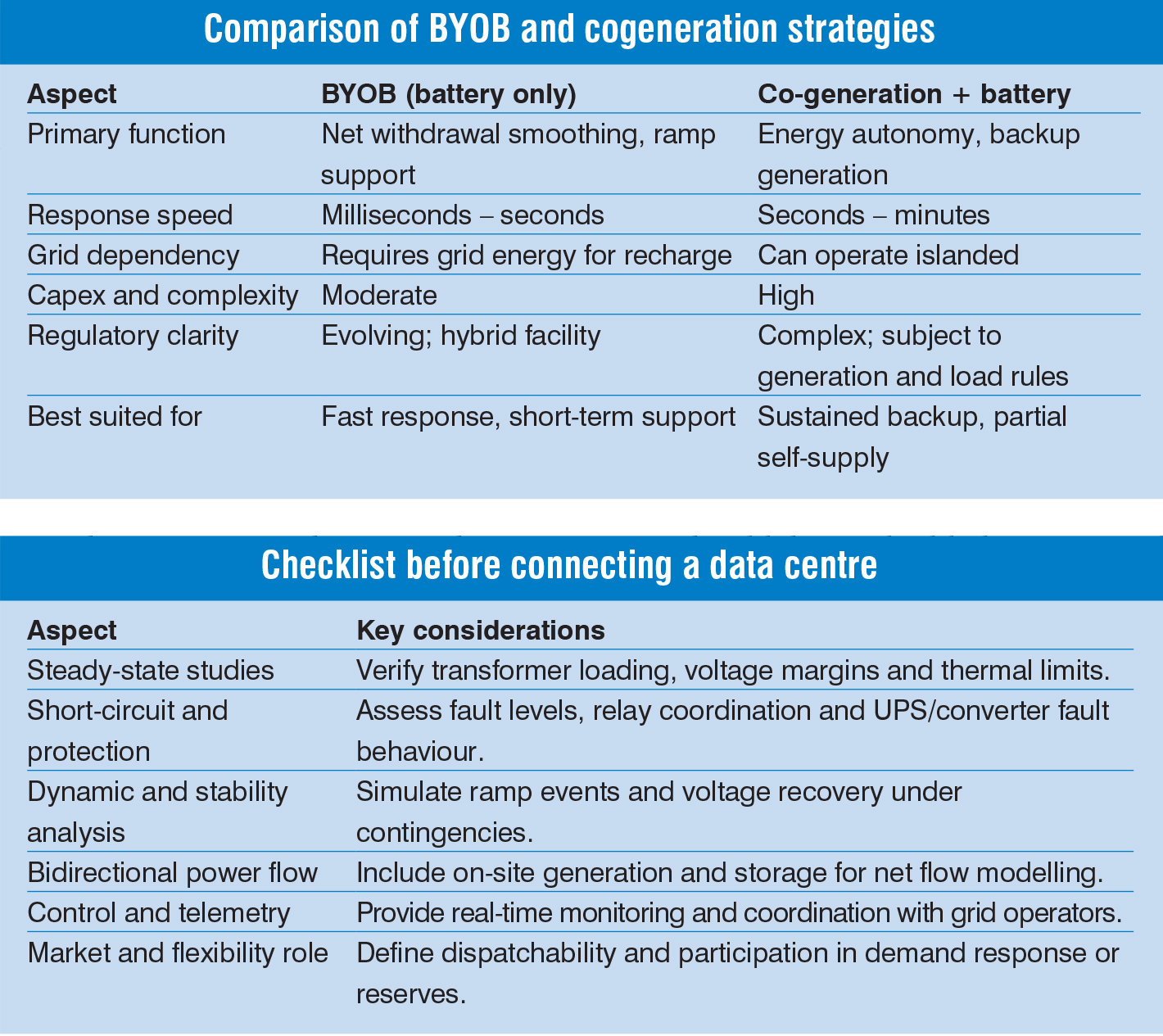 Connecting responsibly: What must be checked before the plug-in?
Before linking a hyperscale data centre to the grid, planners must treat it not as a passive load but as a dynamic, inverter-dominated system. Frameworks such as IEEE 2800 (inverter-based resources), IEEE 1547 (distributed interconnections), ISO 17800 (energy management) and IEC 62786-102 (grid-connected storage) form the technical foundation. Unlike conventional loads, data centres require high-resolution dynamic modelling to capture rapid ramp rates, on-site storage or generation and bidirectional power flows. They increasingly participate in market and ancillary-service frameworks, behaving more like hybrid resources than static consumers. Their scale elevates interconnection requirements to generator-level standards such as voltage ride-through and frequency stability.
How should data centres pay?
Designing tariffs for data centres requires moving beyond flat industrial rates to a structure that reflects their scale, reliability needs and grid impact. A modern framework should explicitly separate energy charges, capacity or reservation fees, network access or wheeling charges, reliability surcharges, and green energy incentives. As India transitions to five-minute despatch, data centres, especially those with on-site storage or cogeneration, should be recognised as active grid participants. Tariffs must allow direct market procurement while ensuring discoms are compensated for infrastructure delivery, maintaining fairness between open-access buyers and captive users.
A precedent exists in the US, where in July 2025, the Public Utilities Commission of Ohio approved a data centre tariff for AEP Ohio, replacing ad-hoc interconnection approvals with codified, load-specific rules. The tariff mandates billing guarantees, ramp-up schedules and financial assurances for loads exceeding 25 MW, ensuring cost recovery and discipline. Since adoption, AEP’s interconnection queue has fallen by 50 per cent, filtering speculative projects and expediting credible ones.
What should India do?
India’s rapidly growing data centre capacity requires planners to move beyond conventional load forecasting toward proactive, disclosure-based and geographically aware planning. State and central agencies must mandate early submission of detailed load characteristics (planned IT load, PUE, UPS configuration, backup mode and commissioning timelines) as part of interconnection approval, integrating these into the Central Electricity Authority’s Transmission and Distribution Planning Criteria and the Ministry of Electronics and Information Technology‘s National Data Centre Policy 2025. Given the risk of grid stress around metro clusters such as Mumbai, Delhi and Hyderabad, load diversification should be embedded in national and state data centre policies through location-based incentives, zoning rules and fiscal measures that encourage siting in Tier II or renewable-rich states. Further, interconnection standards must include mandatory voltage ride-through, harmonic limits and telemetry at the point-of-interconnection to prevent “silent exits” and capture dynamic behaviour, following emerging reliability guidance from the North American Electric Reliability Corporation’s Large Load Task Force.
Planners should integrate data centres into demand response and ancillary service programmes, as global pilots show that AI workloads can be curtailed by 20-30 per cent for short periods.
Indian utilities could design similar demand response contracts, pairing flexibility payments with visibility. On-site battery and UPS systems may provide fast frequency and voltage support, enhancing grid resilience. Finally, spatial and temporal workload migration, like moving non-critical processing to renewable-rich or underutilised regions, could align data centre expansion with sustainable grid operation.