The Central Electricity Authority (CEA) has released a Rs 6.42 trillion master plan for the evacuation of power from upcoming hydroelectric projects in the Brahmaputra basin. Based on the assessment of the region’s generation potential, the plan outlines a two-phase strategy for the development of transmission infrastructure. This network will be used to transport nearly 76 GW of capacity, comprising 65 GW of hydropower and 11 GW of pumped storage, from the Northeast to major load centres across the country. The overarching goal is to strengthen the transmission network across the north-eastern region to support the integration of the basin’s vast hydro potential into the national grid.
For the purpose of study, the Brahmaputra basin has been divided into 12 sub-basins – Lohit, Subansiri, Dibang, Siang, Pare (Dikrong), Kameng, Upper Brahmaputra, Lower Brahmaputra, Kalang (Kopili), Teesta, Tawang and Barak – spanning Arunachal Pradesh, Assam, Sikkim, Meghalaya, Mizoram, Manipur, Nagaland and West Bengal.
Hydro and pumped storage potential
The master plan follows a two-phase implementation timeline – Phase I (till 2035) and Phase II (beyond 2035). It includes all hydropower projects with an installed capacity above 25 MW, along with pumped storage projects planned in the region.
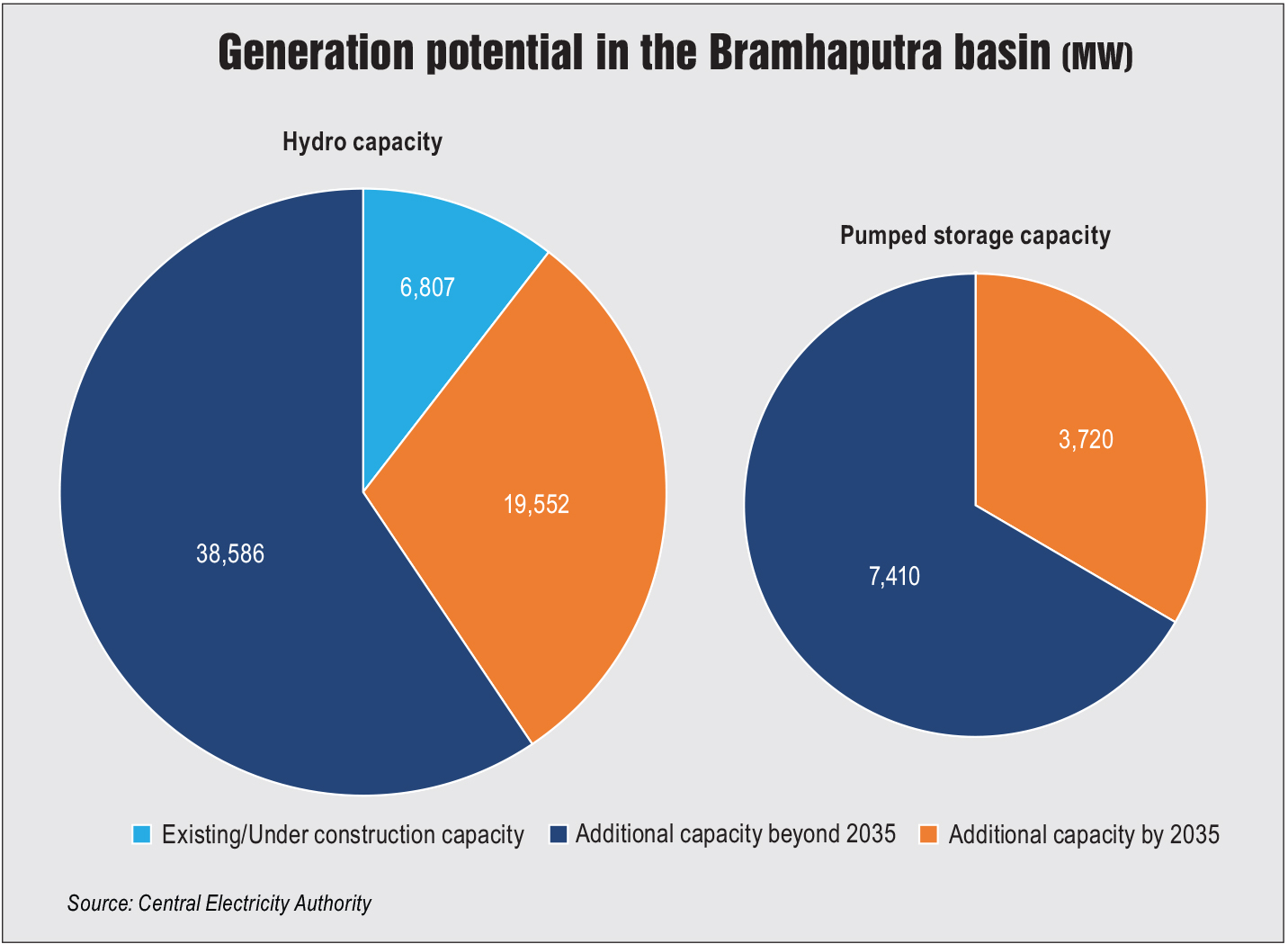
According to the assessment, the Brahmaputra basin has an exploitable hydroelectric potential of about 64,945 MW across 208 identified plants. This includes 4,807 MW of existing capacity and another 2,000 MW currently under construction. Three major sub-basins – Siang, Subansiri and Dibang – together account for nearly 70 per cent of this potential. The Siang basin alone contributes around 29 per cent (18,666 MW), followed by Subansiri with 19 per cent (12,290 MW) and Dibang with 14 per cent (8,801 MW). Smaller basins, such as Pare and the Upper Brahmaputra, have relatively modest potential and will be connected mainly through intra-state transmission networks. At the state level, Arunachal Pradesh emerges as the primary hydropower hub, hosting nearly 81 per cent (52,230 MW) of the basin’s total hydro potential.
The basin also holds significant pumped storage potential, estimated at around 11,130 MW. Of this, nearly 3,720 MW is envisaged by 2035, while the remaining 7,410 MW is planned for development post-2035. Mizoram accounts for the largest share of pumped storage potential, contributing about 54 per cent (5,950 MW) of the total.
Of the total 64,945 MW of hydropower potential, about 94 per cent will be integrated with the interstate transmission system (ISTS) to support large-scale power evacuation across regions. The remaining 6 per cent (4,045 MW) will be routed through intra-state networks in states such as Arunachal Pradesh, Assam, Manipur, Meghalaya, Nagaland, Sikkim and West Bengal. For the pumped storage capacity of 11,130 MW, nearly 74 per cent (8,210 MW) will be pooled into the ISTS network, while the remaining 26 per cent (2,920 MW) will feed into Assam’s intra-state grid.
 Transmission infrastructure planned
In line with the development timelines of the upcoming hydropower projects, the transmission plan is also structured in two phases. This phased approach helps map the growing evacuation requirements as more projects come online over time.
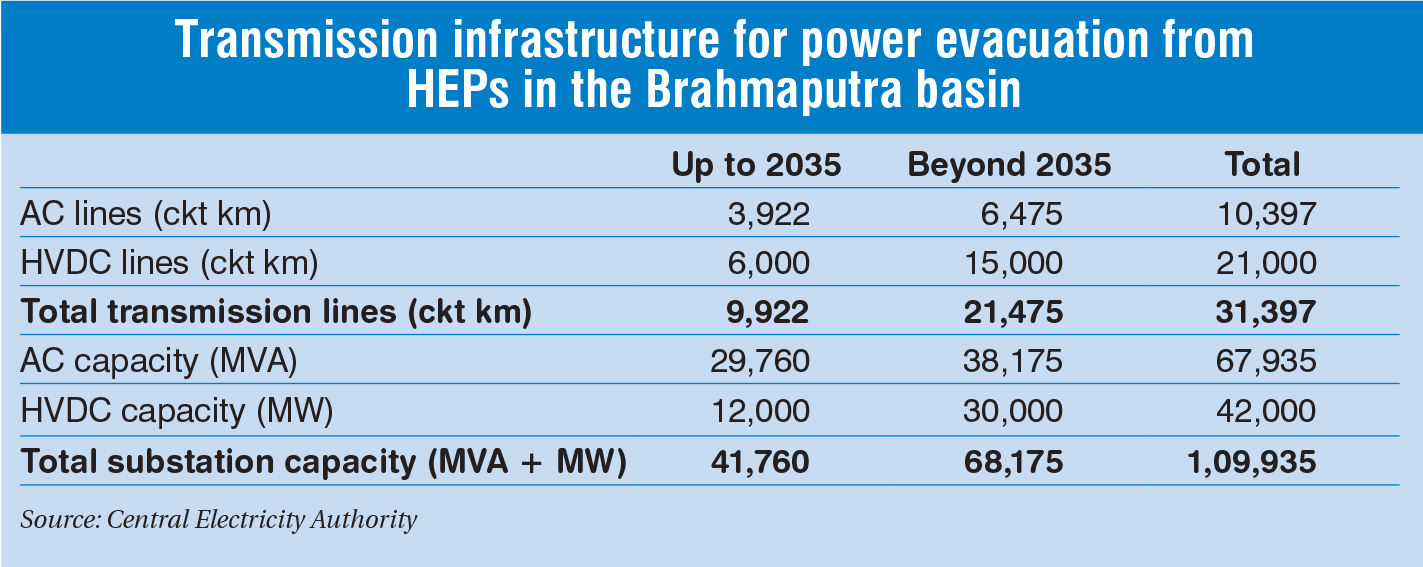
Overall, the master plan proposes building about 31,397 ckt km of transmission lines, of which 21,000 ckt km will be high-voltage direct current (HVDC) corridors. It also includes the addition of about 109,935 MVA of substation capacity, including 42,000 MW of HVDC-based capacity.
By 2035, about 9,922 ckt km of the planned transmission network (32 per cent), including 6,000 ckt km of HVDC lines, is expected to be completed. In the same period, about 41,760 MVA of the planned transformation capacity (38 per cent), including 12,000 MW of HVDC, will also be developed. This forms the first phase of implementation.
The remaining work will be taken up after 2035. This includes about 21,475 ckt km of transmission lines (68 per cent), with 15,000 ckt km of HVDC corridors. It also includes 68,175 MVA of transformation capacity (62 per cent), including 30,000 MW of HVDC-based capacity.
To ensure efficient evacuation, the transmission network has been designed as a combination of dedicated and common systems. Dedicated systems refer to project-specific lines that individual hydropower developers will build to connect their plants to the grid. Common transmission systems, on the other hand, include pooling substations and transmission corridors developed under the ISTS to carry power from multiple generating stations. The plan also incorporates additional measures to address the long distances between the Northeast region and major demand centres. These include strengthening intra-state networks and provisions for reactive power management such as switchable bus reactors at generating stations to maintain voltage stability.
The total expenditure for developing the required transmission network is estimated at Rs 6.42 trillion. Of this, about Rs 1.91 trillion (30 per cent) will be incurred up to 2035, and the remaining Rs 4.51 trillion (70 per cent) beyond 2035. In the first phase, most of the basin-wise expenditure is concentrated in the Dibang basin (50 per cent) and the Subansiri basin (48 per cent), with the remaining 2 per cent spread across Lohit, Siang and Barak.
While preparing this plan, the Central Electricity Authority (CEA) has adhered to the guidelines set out in the Manual on Transmission Planning Criteria, 2023. The manual recommends river basin-wise planning for hydro evacuation systems and sets out limits on the transformation capacity of generation pooling substations at various voltage levels. The final transmission configuration for each project will be decided once developers submit their connectivity applications to the designated nodal agencies.
 HVDC as the backbone
Under the plan, a total of 40 major pooling stations and substations have been proposed. The preliminary locations of these pooling stations have been identified based on discussions with the states, as well as assessments using the PM Gati Shakti portal and Google Maps. Notably, these stations include six large HVDC stations to be set up at Namsai, Roing, Niglok, Gogamukh, Rowta and Silapathar. Except for Silapathar, each HVDC station is planned with a capacity of 6,000 MW at ±800 kV. Silapathar will have a transfer capacity of 12,000 MW (2×6,000 MW). Together, the six stations will provide a total HVDC transfer capacity of 42,000 MW.
Power from these HVDC terminals in the north-eastern region will flow directly to major load centres in the eastern, northern and western grids. The final capacity of each terminal will be determined during the implementation stage, based on system requirements and the technologies available at that time. Depending on these assessments, the HVDC links may be built at higher capacities, or replaced with high-capacity AC links. The framework ensures that the region’s large hydropower potential can be evacuated efficiently and reliably.
Conclusion
The CEA’s master plan marks a turning point for hydropower development in the Brahmaputra basin, giving developers and states much-needed clarity on how power will be evacuated. By laying out a coordinated and phased transmission roadmap, it removes uncertainties that have long slowed project implementation in the region. The structured, phased approach ensures that generation and transmission assets are developed in parallel, reducing delays and improving the scheduling and integration of new hydro capacity.
Importantly, the use of digital mapping and real-time geographic visibility adds greater transparency and strengthens planning. As interregional links strengthen, the north-eastern region will be better positioned to supply reliable power to major demand centres across the country. Overall, the plan lays the foundation for a more reliable, robust, flexible and better-integrated national grid. If implemented as designed, it can significantly enhance grid stability, optimise power flows and strengthen the country’s transmission sector. All in all, the plan makes it clear that the expansion of India’s transmission network will ultimately determine the pace of its clean energy progress.