Robust operations and maintenance (O&M) strategies for hydroelectric power plants (HEPs) are essential to sustain performance and preserve asset value over time. An effective O&M framework supports long-term plant operations, optimises energy generation and minimises losses, while also reducing breakdowns and forced outages through timely preventive and predictive maintenance. With advances in technology, operators are increasingly deploying solutions such as artificial intelligence (AI), advanced control systems and real-time monitoring (RTM) tools to strengthen condition monitoring and enable more proactive asset management.
This article highlights the O&M best practices of NHPC Limited at its hydropower stations…
O&M best practices
Operational analysis of plants and units: To maximise generation performance, NHPC Limited undertakes detailed operational analysis of its generating stations and units, taking into account inflow conditions, grid requirements, reservoir levels and spillage. Key parameters such as vibration, temperature and other condition monitoring indicators are continuously tracked to ensure equipment health and reliability. At the same time, operations are carried out in compliance with statutory and regulatory guidelines to support grid stability. NHPC provides peaking support, monitors unit operation under automatic generation control and periodically reviews reactive power injection to maintain voltage stability
Tripping and breakdown analysis: Power stations are regularly monitored for tripping incidents and equipment breakdown. For each event, a detailed analysis is conducted covering the sequence of events, system conditions, protection system response, root cause analysis and restoration measures. These reports help identify system vulnerabilities and guide corrective and preventive actions to avoid recurrence. NHPC shares these reports across stations through its intranet to help prevent similar issues. Over the past five years, such monitoring and analysis have helped NHPC reduce the forced outage rate from 0.48 per cent in 2020-21 to 0.2 per cent in 2024-25.
Technical and dam safety inspections: Dams and hydromechanical equipment are among the most critical components of HEPs, requiring regular monitoring to ensure operational reliability. NHPC conducts technical inspections of all power stations twice a year through its corporate O&M division, typically before and after the monsoon. In parallel, the dam safety team from the design and engineering division undertakes biannual inspections of dams and associated hydromechanical equipment. Independent assessments are also carried out by the Comprehensive Dam Safety Evaluation Committee, with necessary corrective actions implemented based on its recommendations. 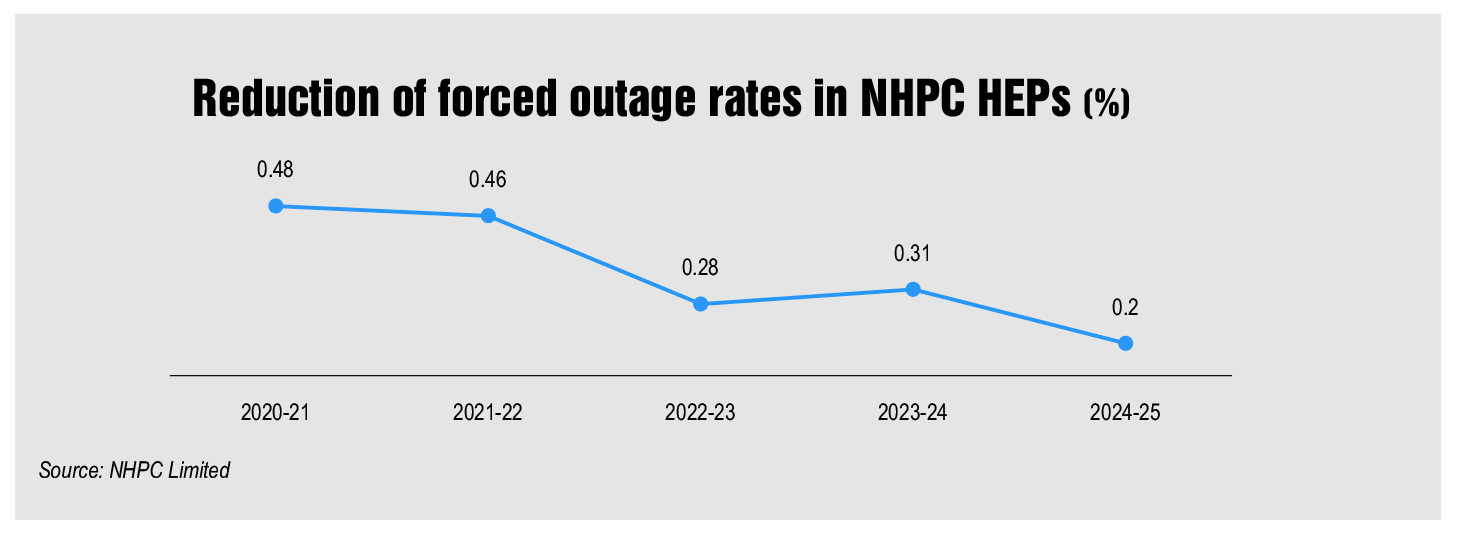 Silt and sediment management: Himalayan rivers carry heavy sediment loads, with over 80 per cent of the average annual inflow occurring during the monsoon. High sediment concentrations reduce reservoir storage capacity and cause hydro-abrasive erosion of underwater components. The presence of hard minerals such as quartz, mica, feldspar and muscovite in the sediment can cause severe erosion of runner blades, particularly at their thin trailing edges, leading to material losses of up to 3 per cent of the original runner weight. The issue is commonly faced by NHPC plants such as Salal, Dulhasti, Chamera-II, Dhauliganga, Teesta-V and Baira Siul.
To manage sediment, drawdown flushing can be used in smaller run-of-the-river projects. The process involves lowering the reservoir level to flush accumulated sediment through spillways, allowing the reservoir to temporarily behave like a natural river channel. Another method is drawdown sluicing, wherein reservoir levels are maintained near the minimum drawdown level during the monsoon so that much of the incoming sediment passes through the spillways, reducing trap efficiency. In addition, desilting chambers can be installed to remove coarse sediment particles before water enters the turbines, protecting underwater components from excessive wear. The durability of these components can be further improved through the use of harder materials and protective coatings, such as high-pressure, high-velocity oxyfuel coatings on runners and guide vanes.
Critical spares and inventory management: The non-availability of high-value critical spares, which often have long manufacturing lead times, can adversely affect the performance and availability of power stations. This challenge is further intensified by the remote locations of many HEPs, making efficient inventory management crucial. To address this, NHPC identifies critical spares for each power station, along with appropriate minimum and maximum inventory levels to ensure uninterrupted operations. Inventory requirements are assessed based on factors such as equipment criticality, procurement lead time, historical failure patterns, the useful life of spares, river basin conditions and the number of generating units installed at the station.
 Challenges and mitigation
As most HEPs in India are located along Himalayan rivers, their O&M activities must address several site-specific challenges. These include high silt inflows, reservoir sedimentation, elevated tailrace levels, and the accumulation of trash and debris at intake structures, which can choke cooling water systems and reduce generation efficiency. In addition, the hilly terrain makes these plants highly vulnerable to natural hazards such as landslides, cloudbursts and flash floods. For instance, in August 2025, intense rainfall and cloudbursts triggered flash floods in the Chenab, Parvati and Ravi basins, disrupting nine NHPC power stations and resulting in a generation loss of nearly 1,000 MUs.
To mitigate such risks, NHPC has developed the “e-AABHAS” early warning system for real-time flood monitoring. The system operates through a 24×7 master control room that monitors hydropower stations across the country. Sensors installed at upstream gauge and discharge locations continuously measure river water levels and transmit the data to the control centre in real time. Based on upstream flow conditions, the system forecasts potential discharge at dams. The sensors are installed at a sufficient upstream distance to provide a lead time of about one hour, enabling timely alerts and preventive actions to protect hydropower infrastructure and downstream communities.
To ensure uninterrupted communication during hazards, NHPC also maintains multiple redundant channels, such as INMARSAT, VSAT, mobile networks and regional load despatch centre VoIP. During the August 2025 cloudburst event, INMARSAT proved critical in maintaining communication with affected stations when other systems failed. In addition, NHPC conducts third-party protection audits in compliance with the Indian Electricity Grid Code 2023 to identify gaps in protection selectivity, sensitivity and coordination, and strengthen fault detection and root cause analysis.
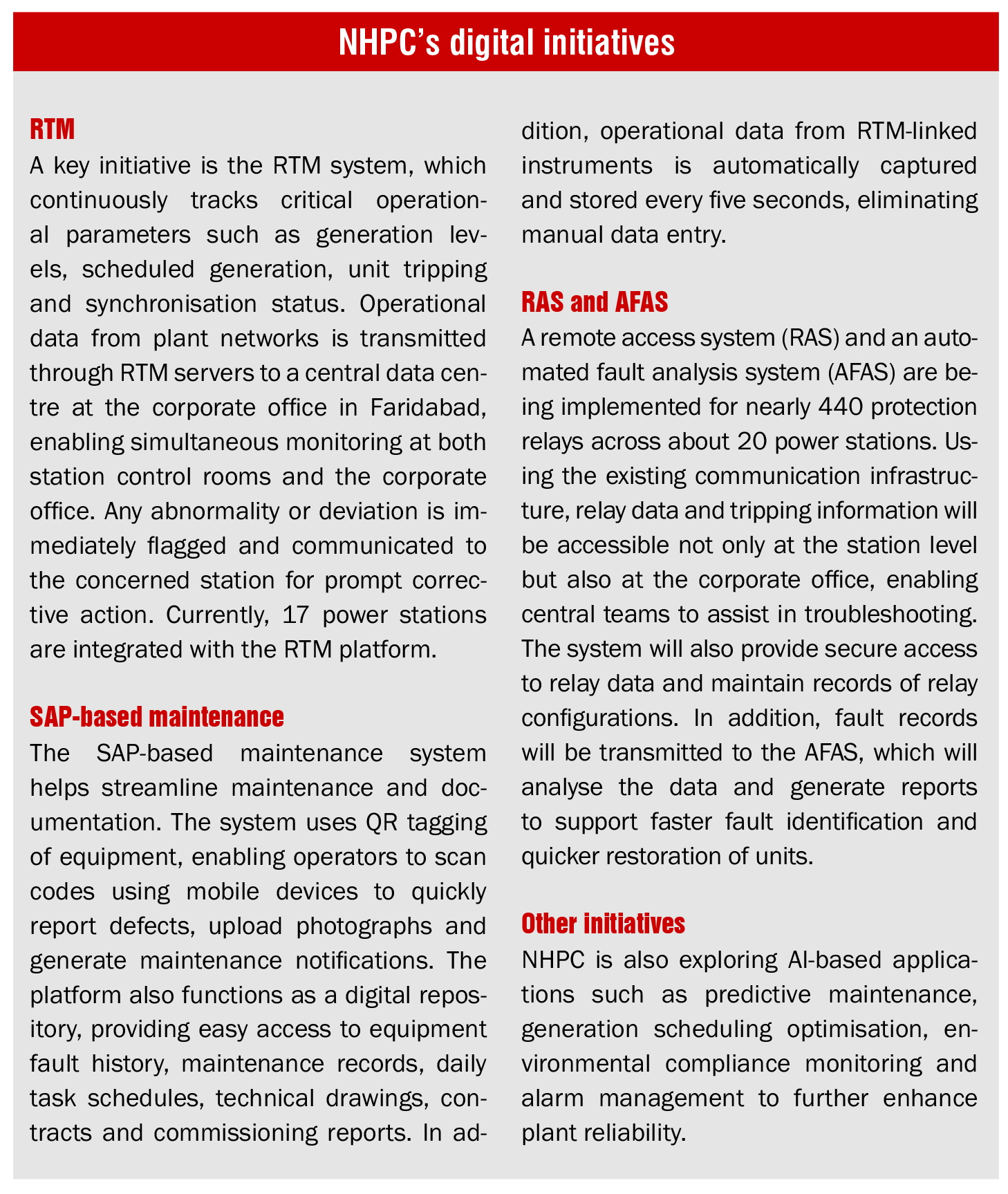
Overall, these initiatives enhance the resilience, reliability and operational efficiency of hydropower plants. Going forward, greater adoption of advanced monitoring systems and digital technologies, alongside conventional O&M practices, will be essential to further optimise plant performance and maintenance.
Based on a presentation by I.P. Ranjan, Executive Director (O&M Division), NHPC Limited, at a recent Power Line conference.