
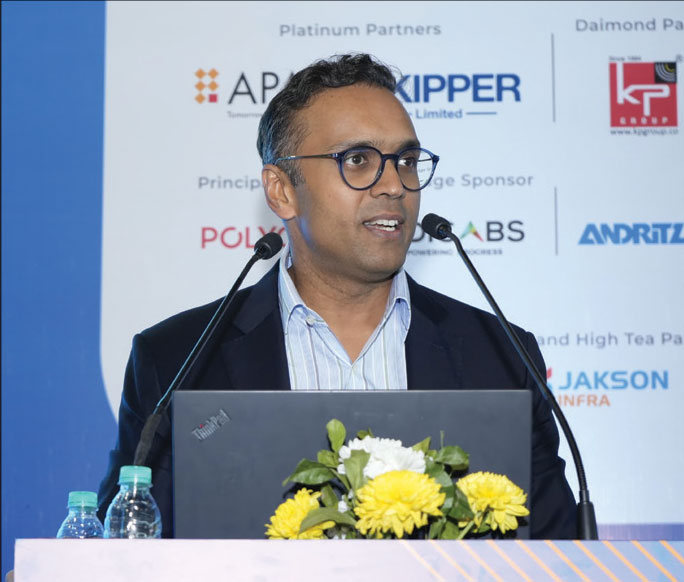
 Pratik Agarwal, Managing Director, Sterlite Electric, and Chairman, Resonia and Serentica Renewables, delivered the inaugural remarks at the Power Line TransTech India 2025 Exhibition and Conference. He highlighted the strong performance of India’s transmission sector and the growth of the transmission infrastructure. He also deliberated on the major opportunities and challenges in the sector. Excerpts…
Sector at a glance
POWERGRID has shown leadership in the sector and has consistently invested in introducing new technologies. India has emerged as one of the world’s largest countries to successfully implement the tariff-based competitive bidding (TBCB) model, which has encouraged private participation and innovation, and reduced project costs. The country has commissioned or is building more than 100 projects through the TBCB route. India has also strengthened its planning and market systems, creating a strong foundation for further growth and modernisation. India’s transmission sector has entered a new growth phase, with the focus shifting from the expansion of the central transmission network to the strengthening of state transmission systems. Over the next 10 years, states will need major investments to enhance their load-handling capacity and align the state grids with the national grid.
Opportunities
India’s legal framework, particularly Section 164 of the Electricity Act, 2003, enables the development of electricity transmission infrastructure projects with ease. Over the years, domestic suppliers, technology players, research and development institutions, academia, engineering, procurement, construction (EPC) companies and original equipment manufacturers have created a thriving ecosystem and have driven significant capex in transmission at both the central and state levels.
Regional and international interconnections present a strategic opportunity through initiatives such as One Sun, One World, One Grid. Further, with round-the-clock power becoming viable at prices that are globally competitive, there is an underlying opportunity for India to become a global energy powerhouse, exporting clean electricity through HVDC and submarine cable networks. This will enable India’s grid to connect not only to neighbouring regions, but also westward to the Middle East and eastward to Southeast Asia, including Thailand, Singapore and Japan.
Challenges
Project delays in the power transmission segment remain a major concern. Nearly 90-95 per cent of projects face delays of at least a year, with 30-40 per cent facing delays of over two years. Although India’s power transmission projects have an average completion period of four years, which is still among the best globally, there is scope to reduce it to three years or less to meet future electricity demand. Right-of-way issues cannot be resolved through financial compensation or enforcement alone, but require systematic stakeholder engagement built on trust and communication. In this regard, Resonia’s efforts to create a structured stakeholder management playbook are fostering collaboration and enabling smoother execution. In addition, the shortage of skilled labour and low levels of mechanisation in transmission construction pose a challenge in project execution. For instance, the development of 1 km of a 400 kV double‑circuit line still requires about 1,300-1,500 man‑days in India, versus around 700 man-days in Brazil or Thailand, and only 150 man-days in Europe.
The way forward
India is emerging as a global powerhouse, delivering 15-20 GW of round‑ the‑clock green power annually. The country’s unique capability to support upcoming high‑demand sectors such as data centres positions India as a potential global hub owing to its ability to deliver reliable, affordable and renewable power faster than most economies. In a scenario of rapid renewable capacity additions, adopting digital solutions can enhance grid flexibility and protect project returns.
With respect to manpower shortages in transmission project development, EPC partners can collaborate to build a fully mechanised, technology-enabled transmission construction ecosystem in India, targeting the global efficiency standards of about 200 man‑days per km.
While achieving global leadership is difficult, sustaining the position requires continuous innovation, faster project execution, adoption of advanced technology and progressive policy frameworks. In this regard, India is at the forefront of global electricity systems, with transmission as the central pillar enabling the future.


