While coal-based generation continues to underpin grid reliability, its role is shifting from steady baseload supply to dynamic, flexible support. This transition places direct operational stress on boiler, turbine and generator (BTG) systems, which are increasingly required to handle sharp ramps, frequent cycling and sustained low-load operation to balance renewable variability. Despite a declining share in the installed capacity, coal-based plants will continue to account for a substantial share of energy generation, especially during evening peak hours and non-solar periods. Ensuring that boilers, turbines and generators can operate safely, efficiently and reliably under flexible regimes has, therefore, become central to sustaining grid stability in India’s evolving energy transition.
Boilers
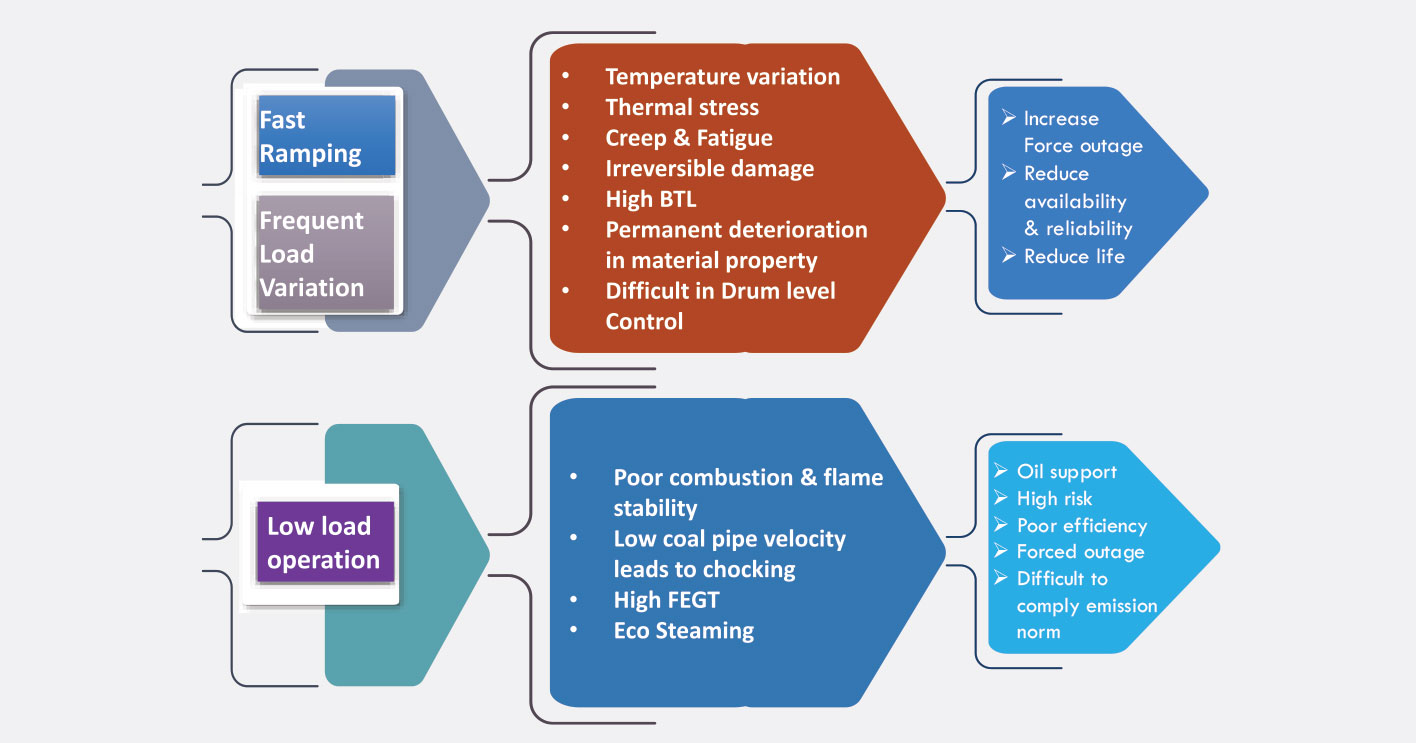
Boilers are the most affected components during flexible operation due to frequent thermal cycling and sustained low-load operation. Rapid load changes lead to temperature fluctuations, resulting in thermal stress, creep and fatigue damage. Over time, this accelerates deterioration of material properties and increases boiler tube leakage incidents and forced outages. Low-load operation further compounds operational challenges. Poor combustion and flame instability, low coal pipe velocities and increased oil support requirements reduce efficiency and raise safety risks. Ash deposition in ducts and heat transfer surfaces intensifies, while soot blowing effectiveness reduces at lower loads, often necessitating operation above 70 per cent load for extended durations to clean deposits. Fast ramping aggravates exfoliation-related issues, leading to partial or full choking of boiler tubes and downstream systems. Drum level control becomes increasingly complex during rapid transients, increasing the risk of trips.
Key boiler-side interventions include steam flow redistribution and metallurgy improvement in superheater and reheater sections, modification of desuperheating concepts to handle wider load ranges and improvements in degraded expansion joints. Enhanced materials for air preheater baskets enable operation in wet flue gas regions during low-load conditions. Operational reliability at low loads is further supported through automatic pressure control on mill roll and race assemblies, smart soot blowing systems, advanced burner tilt mechanisms, improved automated boiler drain arrangements, and introduction of ball and tube mills where required. Boiler fatigue monitoring systems are increasingly being deployed to track life consumption under cyclic operation and enable early intervention.
Turbines
Flexible operation imposes significant mechanical and thermal stresses on turbine systems. Frequent ramps and start-stop cycles increase casing ovality, reduce material hardness and elevate vibration levels in rotor trains. The risk of blade cracking, particularly in low-pressure stages, increases under such operating regimes.
High metal temperatures in turbine blading, seals, casings and cold reheat piping result in excessive distortion and creep damage. Steam valve internals experience accelerated wear, while excessive exhaust hood spraying during low-load operation increases the risk of blade erosion. Mitigation requires a combination of design modifications, enhanced monitoring and a revised operating philosophy. Turbine-side technology upgrades include adoption of sliding pressure operation, turbine heating systems and electric blankets to reduce thermal gradients during start-up and shutdown. Conversion from throttle governing to nozzle governing improves part-load efficiency and ramping capability, while welded rotor designs support faster ramps and reduced start-up times.
Structural improvements such as use of shrink rings on high-pressure inner casings in place of conventional joint flange bolt designs help manage thermal stresses. Enhanced vibration monitoring systems, blade vibration monitoring systems and rotor stress calculators enable continuous tracking of turbine health under flexible operation.
 Generators
While generators are relatively resilient, flexible operation increases thermal and electrical fatigue in stator and rotor insulation systems, excitation equipment, and auxiliary motors. Frequent cycling elevates the probability of insulation degradation and forced outages over time.
To address these risks, additional spares for generator stator and rotor components are required, along with deployment of rotor flux monitoring systems and enhanced protection schemes. Increased inspection frequency and condition-based maintenance are essential to sustain reliability under flexible operating conditions.
Auxiliary electrical equipment such as pumps, fans and motors experience higher wear due to frequent load variations. The adoption of variable frequency drives and predictive maintenance tools enables improved efficiency and asset life management.
Capital expenditure for BTG flexibilisation
Flexibilisation of coal-based units requires focused capital expenditure across boiler, turbine and generator systems to manage thermal cycling and accelerated life consumption. On the boiler side, potential investments include metallurgy upgrades in the final superheater and reheater sections, modifications to desuperheating systems, mills and burners for stable low-load combustion, improved expansion joints, upgraded air preheater baskets for wet flue gas operation, and installation of additional drain lines for effective start-up and low-load operation.
Turbine-related capital expenditure is directed towards enhancing ramping capability and durability, including augmentation of critical turbine spares, modifications to steam and control valves, erosion protection of low-pressure turbine internals, conversion from throttle to nozzle governing, adoption of welded rotor designs, and structural improvements such as shrink ring installation on high-pressure inner casings.
On the generator and electrical side, additional capital investment is required for stator and rotor spares, upgrades to excitation and protection systems, and deployment of rotor flux monitoring. Control and instrumentation upgrades form a critical element of BTG capex, covering extension of control margins to lower loads, ramp rate enhancement and improved control of steam temperature, drum level and feedwater systems. Condition monitoring systems, including boiler fatigue, vibration and rotor stress monitoring, are essential capital enablers for sustained flexible operation.
 The way forward
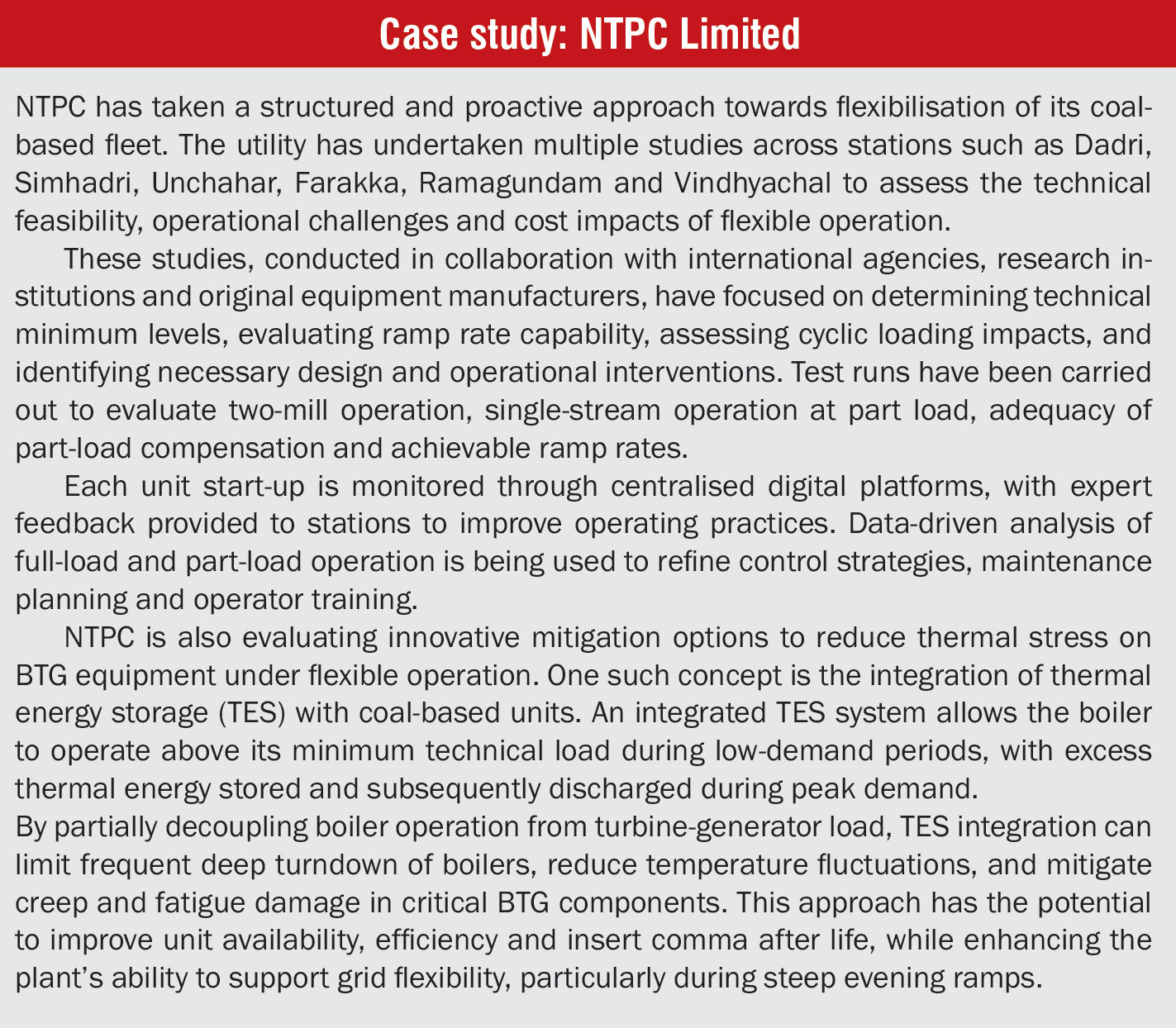
Advanced control strategies are required to maintain combustion stability and drum levels in boilers, regulate steam temperatures across a wide operating range, and ensure coordinated turbine–generator response during rapid load ramps.
Automatic generation control, primary frequency response obligations and evolving grid code requirements necessitate precise loop tuning and fast control response across BTG systems. Variations in coal quality further complicate boiler operation, increasing reliance on adaptive control logic and predictive algorithms to avoid instability and forced outages.
Digitalisation is increasingly being leveraged to support BTG flexibilisation. Online predictive tools enable early fault detection, combustion stability monitoring, turbine and generator health assessment, and condition-based maintenance advisory. Lifetime monitoring and assessment systems, fleet-level analytics and predictive tools for estimating cycling costs support least-cost despatch, while managing BTG life consumption. Digital platforms are also being used to strengthen operator training and decision support during start-up, shutdown and load ramping.