 By Dr U.R. Prasad, Advisor (Economics), Central Electricity Regulatory Commission
The spot electricity market is a wholesale marketplace where electricity is bought and sold for immediate or very short-term physical delivery, typically within the same day or the next. There are three power exchanges in India: the Indian Energy Exchange (IEX), Power Exchange India Limited (PXIL) and the Hindustan Power Exchange (HPX), which are undertaking operations in the spot electricity market. The power exchanges started their operations in the day-ahead market (DAM) and real-time market (RTM) in 2008-09 and 2020-21, respectively. The factors that influence the supply and demand for electricity result in price volatility.
To address the concerns of market participants and mitigate the damaging effects of high volatility and price spikes in the electricity markets, regulators undertake various measures, including the imposition of price caps and floors for the sale and purchase of electricity.
In August 2009, the Central Electricity Regulatory Commission (CERC) noticed that the prices of electricity transacted through power exchanges witnessed a steep increase (about three times of the lowest price), and the high prices prevailed for 24 hours. Weekly price volatility increased from 13.15 per cent during the week starting from August 3, 2009, to 40.67 per cent during the week starting from August 10, 2009. To ensure reasonable electricity prices, the CERC, through its order dated September 11, 2009, imposed Rs 0.10 per kWh and Rs 8 per kWh as floor and price caps, respectively, for a period of 45 days.
In March 2022, the prices discovered at the power exchanges were significantly high, mainly due to a rise in temperature, causing the early onset of summer; an increase in economic activities with the lifting of Covid-19-related restrictions; constraints in domestic fuel supply; and the impact of geopolitical factors on the price of imported coal/gas.
Keeping these factors in view, and the changes in the demand and supply of electricity, the CERC, through its order dated April 1, 2022, imposed Rs 0 per kWh and Rs 12 per kWh as floor and price caps, respectively, in the DAM and RTM. Subsequently, the floor and price caps were extended to all other market segments of the power exchanges.
Further, observing some spikes in electricity prices in June 2022 and October 2022, the floor and price caps were extended till December 31, 2022. The CERC, through its order dated March 31, 2023, directed the power exchanges to re-design their bidding software with effect from April 4, 2023, until further orders, with the price range of Rs 0 per kWh to Rs 10 per kWh for all the market segments, excluding high-price DAM; and Rs 0 per kWh to Rs 20 per kWh for the high-price DAM segment.
In 2022, the situation in the electricity markets of other countries was also not so different, with instances of regulatory and policy interventions ranging from the suspension of trading activities, imposition of price caps and automatic price adjustments. However, keeping in view the ill effects of price caps, there is a need to explore other possible measures to control price volatility.
The prices of electricity and their volatility need to be examined from time to time because it provides important feedback to investors, market participants, electricity users and regulators.
In this article, the prices of electricity and their volatility have been examined using the average daily prices of electricity transacted in the DAM and RTM of the power exchanges for the period from 2009-10 to 2024-25 with the following objectives:
- to examine historical volatility in the prices of electricity
- to identify major factors causing the volatility
- to provide possible measures for controlling the volatility
Among the three power exchanges operating various market segments, based on the availability of data and liquidity of the segments, the prices of electricity transacted in DAM and RTM of IEX and PXIL have been considered for the analysis. In order to estimate annual price volatility, the standard volatility measure (σ2), that is, standard deviation, has been used.
The daily data on the prices of electricity has been taken from the market monitoring report published by CERC to observe the trends in electricity prices and estimate annual price volatility. Years with fewer than 90 trading days have not been considered while computing price volatility. Before analysing price volatility, trends in electricity prices are analysed in the following section.
Trends in the daily electricity prices
The daily prices of electricity in the DAM of IEX and PXIL have remained relatively high, that is, above Rs 10 in 2009-10 and 2010-11 and in the 2021-22 and 2022-23. The prices were high during the first two years, mainly due to high energy and peak deficits (above 8 per cent), whereas the price was high in the last two years due to various factors, including the impact of geopolitical factors on the price of imported coal/gas.
It can also be observed that the prices in the RTM were relatively high when compared to the DAM. This was mainly because the scheduling of electricity was very close to real time. During 2023-24 and 2024-25, the prices of electricity were less than Rs 10 in the DAM and RTM of both the power exchanges, and this was mainly due to a change in the market design, that is, a reduction in the price ceiling from Rs 20 per kWh to Rs 10 per kWh.
 Volatility in the electricity prices
The volatility of electricity prices results from various factors, such as fuel prices, availability of generating units, production of hydro generation, demand elasticity and network congestion. The standard deviation is a statistical measure, which indicates the typical distance of prices from the average. A higher standard deviation means greater volatility and risk. The daily data on electricity prices has been used for computing the volatility.
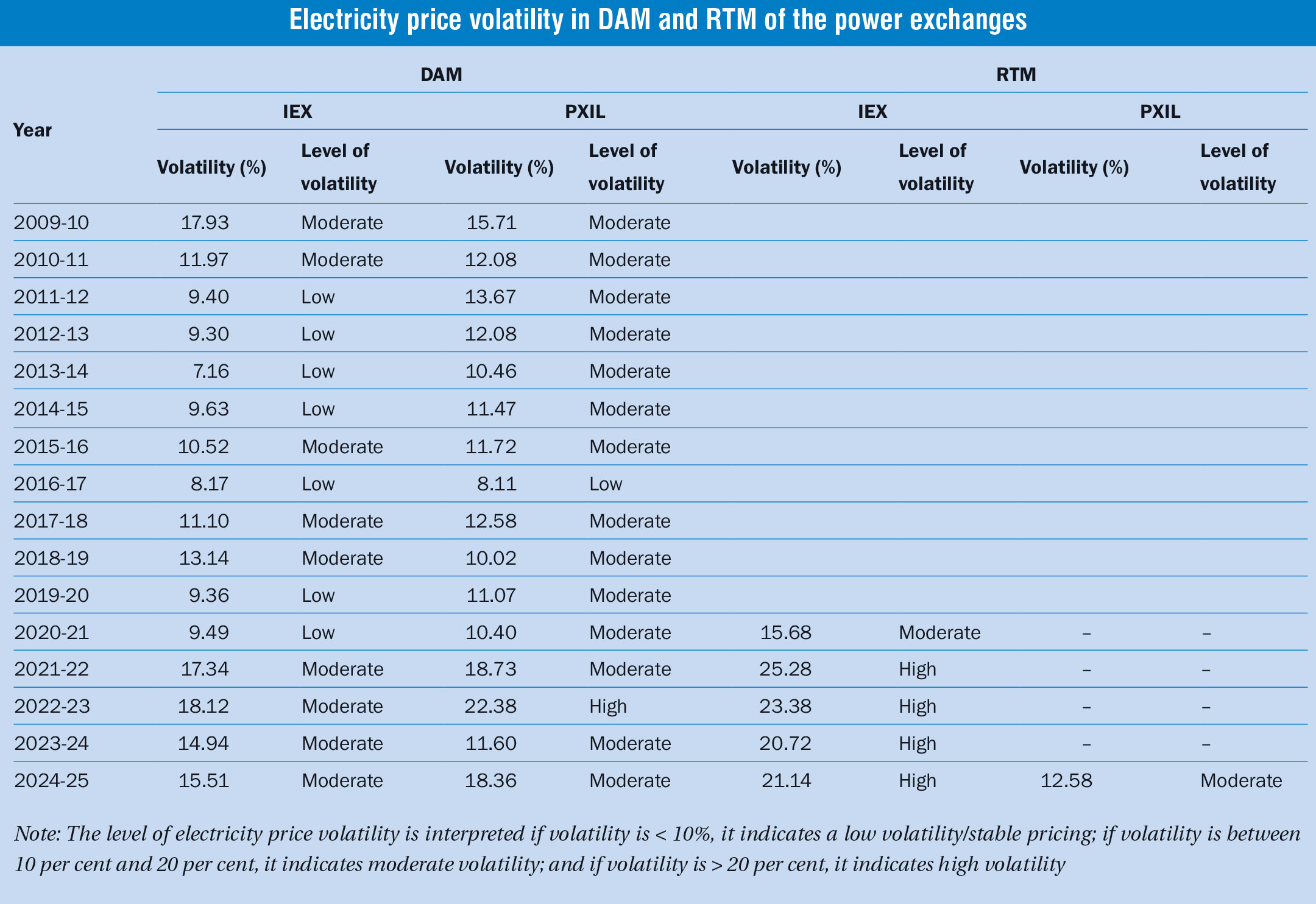
The definition of the level of volatility has been taken from KPI Depot: if volatility is < 10 per cent, it indicates stable pricing; if volatility is between 10 per cent and 20 per cent, it indicates moderate volatility and requires monitoring; and if volatility is > 20 per cent, it indicates high volatility and necessitates immediate action.
The level of volatility was either low or moderate in both the power exchanges (except in 2022-23 for PXIL because of low liquidity). It can also be observed that the prices of electricity were more volatile in PXIL as compared to IEX, as the volume of electricity transacted through PXIL was very limited (less than 1 per cent of the total volume transacted on the DAM of power exchanges during the past 10 years).
The level of volatility in the price of electricity transacted on the RTM was either moderate or high during all the years and in both the power exchanges. As expected, the volatility in the prices of electricity in the RTM was relatively high compared to the DAM, as the price discovery in the RTM is close to real time.
In 2021-22 and 2022-23, a sharp increase can be observed in electricity prices. This increase is closely related to geopolitical events (particularly the energy crisis after the Ukraine conflict), the significant volatility of fossil fuel prices, and the ongoing expansion of renewable energy sources without adequate flexibility mechanisms.
To control this high volatility, the CERC directed the power exchanges to reduce the price ceiling from Rs 20 per kWh to Rs 10 per kWh in their bidding software with effect from April 4, 2023. As a result, the volatility appeared to be under control in 2023-24 and 2024-25. The reduction in the price ceiling effectively acted as a price cap, particularly during months of high electricity demand.
The level of volatility has been defined based on the range of standard deviation for electricity prices, which varies significantly depending on the market (the country or region), time frame (daily, monthly or yearly) and prevailing market conditions.
As per the general definition, if the level of volatility is > 20 per cent, it indicates high volatility and necessitates immediate action. Price caps were imposed in the Indian electricity markets in 2009 and 2022 when the volatility was at about 18 per cent in the DAM. Keeping the experience in view, it may be appropriate to undertake intensive monitoring when the electricity price volatility is > 15 per cent.
Major factors causing electricity price volatility
There are several factors causing high volatility in the prices of electricity. The CERC, in its order dated September 11, 2009, and April 1, 2022, on price caps, highlighted the following factors as causes of high volatility and increases in electricity prices:
- Demand and supply of electricity
- Shortage of electricity
- Bad monsoons and drought-like conditions
- Rise in temperature, causing the early onset of summer
- Increase in economic activities with the lifting of Covid-19-related restrictions
- Constraints in domestic fuel supply
- Impact of geopolitical factors on the prices of imported coal/gas
Variations in the demand and supply of electricity will continue to cause electricity price volatility. Electricity shortages (energy and peak shortages) have reduced from about 11 per cent in 2008-09 to less than 1 per cent in 2024-25. However, we are still facing bad monsoons, rising temperatures and Covid-like situations.
In the future, concerns may arise regarding high volatility in electricity prices due to variable renewable energy, particularly from solar and wind. There is growing empirical evidence that variable renewable energy generation contributes to increased price volatility and price spikes in electricity markets.
Measures to control electricity price volatility
Normal price volatility is not necessarily a problem. However, extreme price volatility can increase the cost of risk management for electricity consumers and generators, and therefore may need to be avoided or controlled using the following measures.
- Price caps: Price caps have been used for controlling the volatility of electricity prices. However, imposing price caps will send contradictory signals to investors, which might affect fresh investments in the sector.
- Fixed price electricity contracts: These contracts can protect market participants from short-term price fluctuations, as they offer cost certainty. However, these contracts often come at a premium and may result in higher costs if market prices fall below the fixed prices.
- Electricity from renewables: An increase in the share of renewables (especially solar and wind) in the generation mix may lead to lower electricity prices but higher price volatility. The introduction of Green-DAM can reduce volatility in the DAM.
- Cross-border electricity trade: Cross-border electricity trade with neighbouring countries that have a different mix of energy resources can reduce the volatility. Electricity trade on the power exchanges started in 2021-22, and the volume of such trade remains very limited at present. An increase in trading volume through the power exchanges may reduce the volatility of electricity prices.
- Energy storage systems: Energy storage technologies can alleviate extreme price volatility through their capabilities for energy usage time-shifting, fast-ramping and price arbitrage. Batteries can reduce intra-day price volatility, while large pumped hydro reservoirs and hydrogen-based storage can reduce weekly, monthly and seasonal price volatility.
- Electricity derivatives market: Empirical evidence from developed countries shows that electricity derivatives markets can play an important role in reducing spot market price volatility. In India, the electricity derivatives market was introduced in July 2025 on the Multi Commodity Exchange and National Stock Exchange, allowing participants to hedge against price volatility in the physical power market.
Conclusion
Price caps were imposed in the Indian spot electricity market in 2009 and 2022 to control electricity price volatility, when it was at about 18 per cent in the DAM. Keeping the experience in view, it may be appropriate to undertake intensive monitoring when the electricity price volatility is >15 per cent.
The price caps are imposed only in exceptional circumstances, and for short periods. Except for price caps, most other measures have been introduced but are at a nascent stage. The impact of these measures on electricity price volatility is expected to become evident in the near future.
Electricity price volatility was relatively low in 2023-24 and 2024-25, compared to the previous year. This may be due to the reduction in the price ceiling in the DAM and RTM. The new price ceiling seems to be working as a price cap, particularly during high-demand periods; therefore, there is a need to examine its impact more closely.