
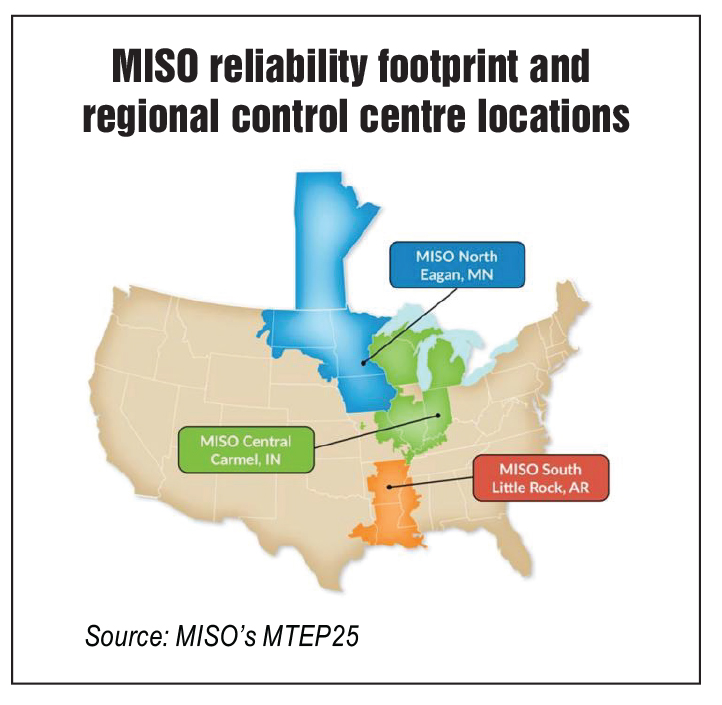
 The American electric grid stands at an inflection point. As the nation’s energy landscape undergoes its most profound transformation in generations, the Midcontinent Independent System Operator (MISO) has unveiled its 2025 Transmission Expansion Plan (MTEP25), which captures both the urgency and scale of the challenges ahead. Valued at $12.3 billion, the plan serves as a blueprint for keeping the lights on, as the grid confronts unprecedented, multidirectional pressures.
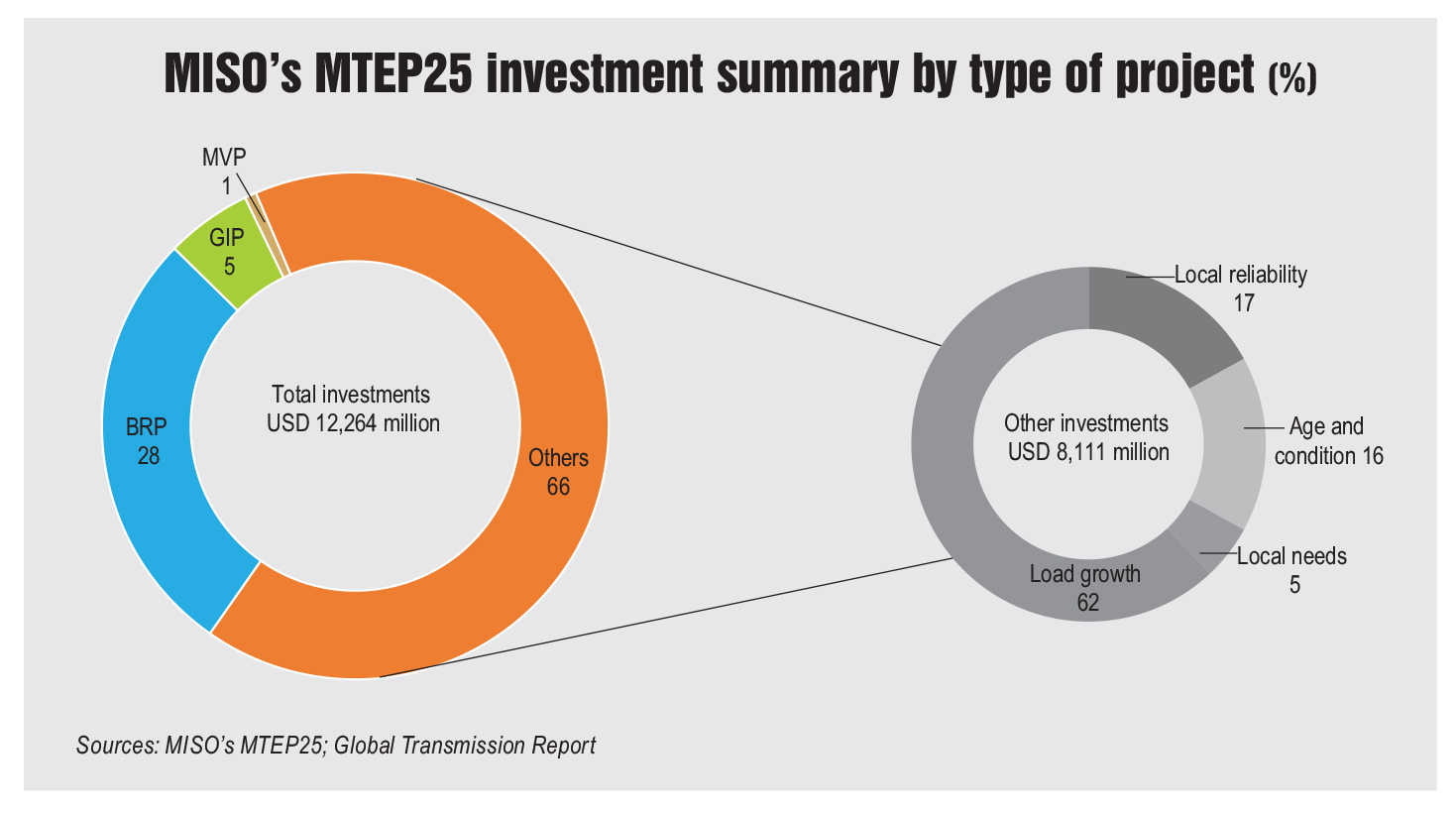
The MTEP25 emerges against a backdrop of what MISO describes as the “Reliability Imperative” – the convergence of multiple challenges reshaping the grid. Foremost among these is explosive load growth, driven largely by data centres fuelling the artificial intelligence (AI) revolution. The plan includes transmission to support a record 11.6 GW of large load additions, with 9.7 GW approved through expedited project review (EPR) processes. Load growth now accounts for 62 per cent of $8.1 billion in “Other” category projects, with the majority concentrated in the South (47 per cent) and West (32 per cent) subregions.
The implications extend beyond near-term infrastructure needs. Large load additions represent permanent changes in regional electricity consumption patterns. A data centre approved today is likely to operate for decades, requiring sustained system support over its lifetime. MISO’s planning must, therefore, balance the speed at which new loads are materialising with the long-term reliability requirements they impose.
Most concerning is how quickly system needs are emerging. Large prospective loads are not always fully captured in Load Serving Entity forecasts, yet they can move from speculative to firm within a single planning cycle. In response, MISO has refined the EPR process to advance urgent transmission projects outside the standard MTEP cycle, a clear indication of how rapidly the grid’s needs are materialising.
 Load growth is only a part of the story. The grid is simultaneously facing a historic generation transition. The retirement of despatchable resources, declining reserve margins and increasing reliance on weather-dependent renewables have fundamentally altered the system’s risk profile. MISO’s interconnection queue illustrates the magnitude of this transition, with more than 1,100 requests totalling over 200 GW – nearly twice MISO’s summer peak load. Solar, storage and hybrid resources dominate these applications, reflecting a dramatic shift in the generation portfolio.
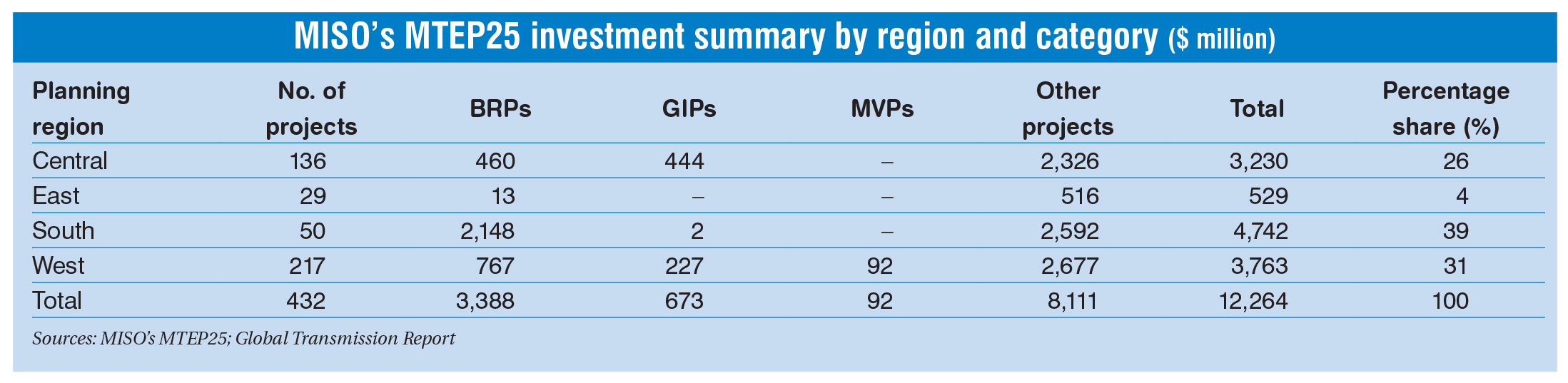
MTEP25’s significance lies in both its scale and the urgency driving it. This investment in MTEP25 is spread across 432 projects, spanning 1,901 miles (3,059 km) of new and upgraded transmission. Of the 432 projects, 49 were approved through the EPR process. Of the portfolio of new or upgraded transmission projects, about 72 per cent are targeted for completion within three years. The geographic distribution – 47 per cent of investment in the South, 29 per cent in the West, and 24 per cent in the Central region – maps directly on to emerging reliability challenges and growth patterns.
In a longer-term context, MTEP25 also highlights the accelerating pace of transmission development. Since 2003, MISO has advanced 6,871 projects across 22 planning cycles. Looking ahead to 2025-34, approximately 10,570 circuit miles (17,011 circuit km) of new or upgraded transmission are projected, showing evidence that the grid is being reshaped, not merely maintained.
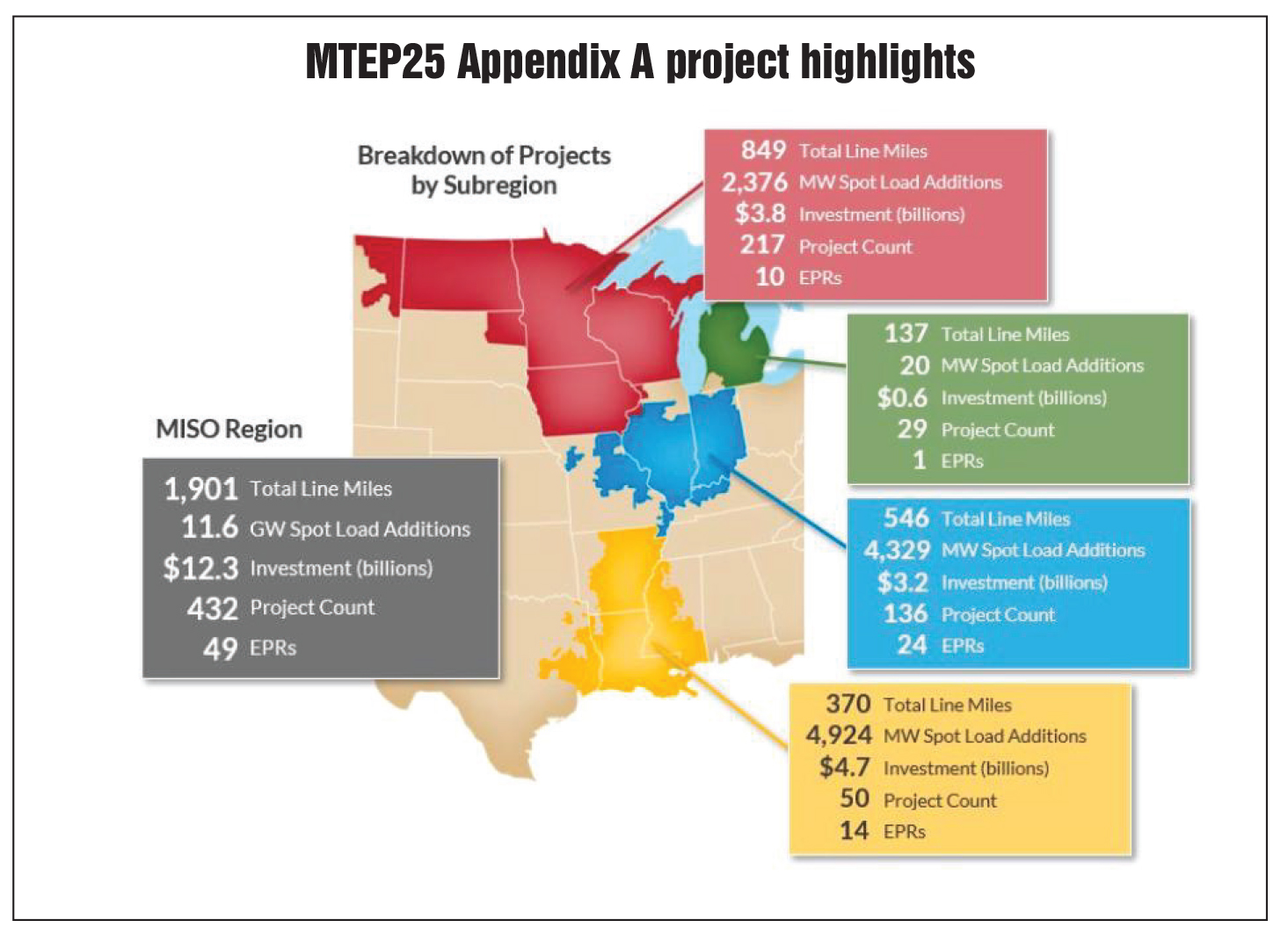 MTEP25: Key highlights
MTEP25 includes four categories of projects as given below:
- Baseline reliability projects (BRPs): Network upgrades required to meet North American Electric Reliability Corporation and regional reliability organisation standards. Costs are allocated to local transmission pricing zones.
- Generator interconnection projects (GIPs): Transmission access projects primarily funded by generators, with upgrades at 345 kV and above eligible for 10 per cent system-wide cost recovery.
- Multi-value projects (MVPs): Projects delivering regional or subregional public policy, economic, and/or reliability benefits, with costs shared across loads and export transactions.
- Other projects: Projects providing local economic or reliability benefits that do not qualify under the above categories.
- As mentioned above, within the “Other” category, 62 per cent of the investment is driven by load growth, 17 per cent by local reliability and 16 per cent by age and condition.
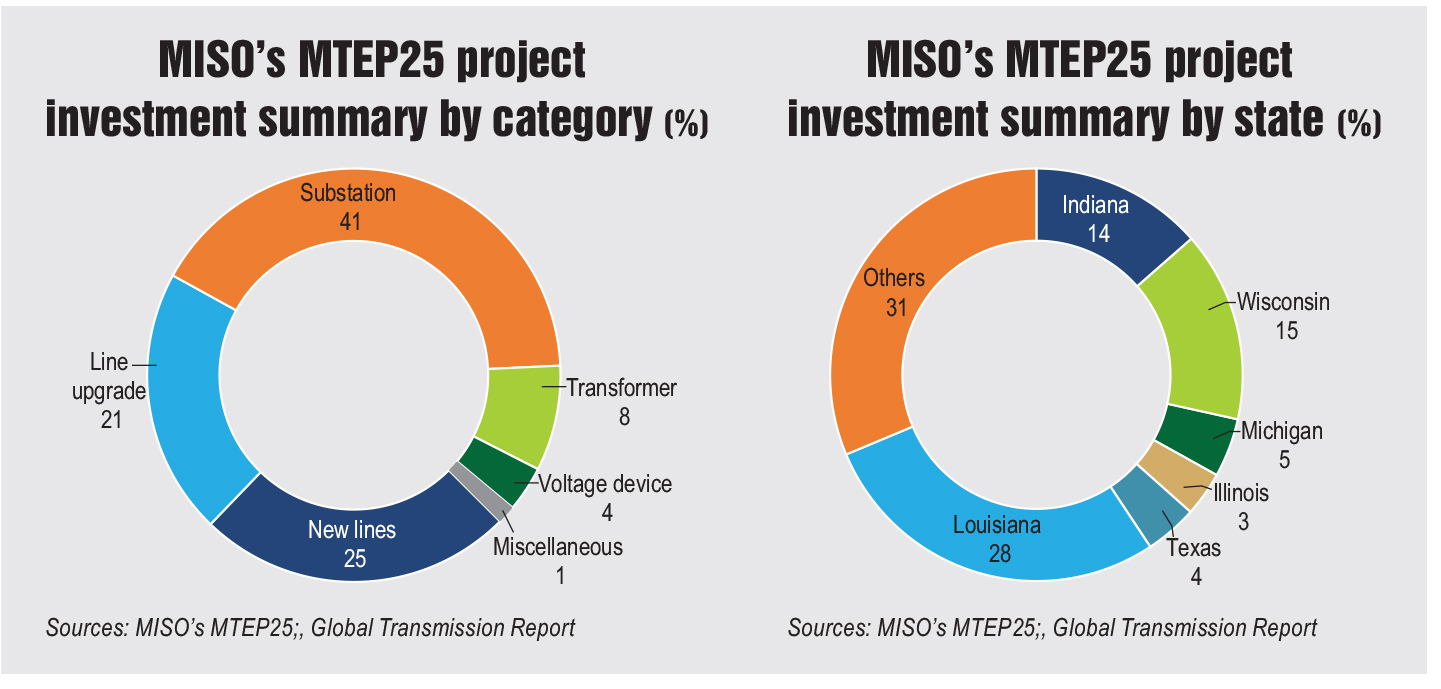
Region-wise, 39 per cent share of the total investment is set to be dedicated to the South region (which includes Arkansas, Louisiana, Mississippi and parts of Texas), which is followed by 31 per cent of the total for the West (including parts of North Dakota, South Dakota, Montana, Michigan and Illinois, and all of Iowa, Minnesota and Wisconsin); 26 per cent of the total for the Central region (including Missouri, Illinois, Indiana and Kentucky), and 4 per cent for the East (including Michigan). Among the states, Louisiana and Texas together accounted for 32 per cent of the total investment at $3.9 billion.
By asset type, 41 per cent of the investment is allocated to substations and switching stations, 25 per cent to new transmission lines on new rights of way, 21 per cent to transmission line upgrades, and the remaining 13 per cent to voltage devices, transformers and miscellaneous categories. The South region alone accounts for nearly 51 per cent of the total new line investment.
In total, MTEP25 includes approximately 1,901 miles (3,060.6 km) of new or upgraded transmission lines. Of these, 29 per cent are expected to enter service by 2028 and 93 per cent by 2030. More than half of the mileage, about 1,041 miles (1,676 km), will operate at 345 kV or above. Notably, the 10 largest projects account for roughly $5.4 billion, or 44 per cent of the total MTEP25 investment value.
LRTP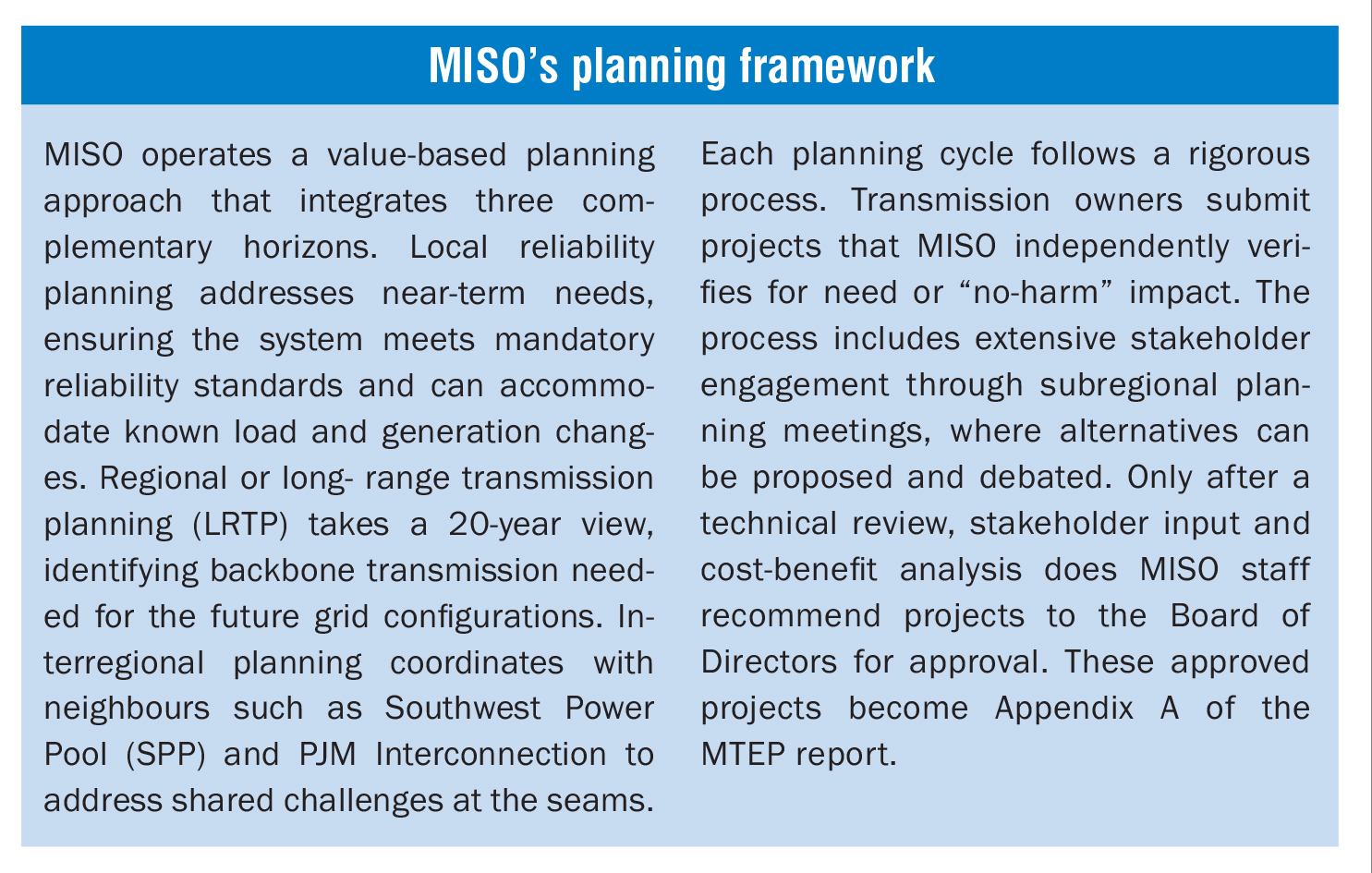
While MTEP25 addresses immediate reliability needs, MISO is simultaneously advancing LRTP initiatives with a 20-year horizon to develop regional backbone infrastructure capable of supporting large power transfers and evolving generation portfolios across multiple future scenarios.
LRTP Tranche 1, approved in 2022, encompasses 18 projects totalling $10.3 billion across the Midwest subregion. As of September 2025, many projects are progressing through regulatory approval processes. The portfolio demonstrates substantial value with a benefit-to-cost ratio of 2.6-3.8, well exceeding requirements.
LRTP Tranche 2.1 represents an even larger commitment: 24 projects, 323 facilities and $21.8 billion in investment, targeted for 2032-34 in-service dates. Approved by MISO’s Board in December 2024, the portfolio includes a 3,631-mile (5,844 km), 765 kV backbone. However, the portfolio faces a legal challenge. In July 2025, utility commissions from five states filed a complaint at the Federal Energy Regulatory Commission (FERC), alleging that flawed modelling overstated benefits. Subsequently, in September 2025, MISO and numerous stakeholders, including utilities, consumer groups and the Data Centre Coalition, opposed the challenge even as the complainants continue pressing for tariff modifications and declassification of projects as MVPs. This complaint remains pending with no final FERC decision issued. Despite the dispute, the portfolio remains approved and continues advancing through planning and development processes.
Combined, the two LRTP tranches represent $32 billion in long-term transmission infrastructure, operating in parallel with annual MTEP cycles. In 2026, MISO will continue LRTP evaluation in both the Midwest and South subregions, building on redesigned future scenarios that reflect recent policy changes and load growth trajectories.
 Interregional coordination
MISO also coordinates closely with neighbouring regions to address cross-boundary challenges more efficiently. Through collaboration with PJM and SPP, MISO has advanced several interregional planning initiatives. The MISO-PJM Interregional Transfer Capability Study, launched in 2024, identified more than 22 overlapping system issues across economic, reliability and transfer analyses, including over 250 economic and 800 reliability concerns. Approximately 60 potential solutions are now under evaluation.
In parallel, the MISO-SPP Coordinated System Plan applies blended regional models to identify interregional needs, with work continuing into early 2026. The Joint Targeted Interconnection Queue (JTIQ) process further strengthens coordination between the two regional transmission organisations. The $1.6 billion JTIQ portfolio, consisting of five 345 kV transmission projects across seven Midwest states, was awarded $464 million in federal Grid Resilience and Innovation Partnerships (GRIP) funding in October 2023. However, in October 2025, the US Department of Energy terminated this funding as part of broader grant cancellations totalling $7.56 billion. Despite losing federal funding, both MISO and SPP have affirmed their commitment to advancing the JTIQ portfolio, with MISO stating that the projects are not contingent upon the receipt of GRIP funding.
 Conclusion
MTEP25 reflects a grid in transformation, responding to serve explosive load growth while managing a historic generation transition. The $12.3 billion investment, combined with $32 billion in LRTP, positions MISO to meet both immediate reliability needs and longer-term challenges. In an environment defined by continual change, MISO’s integrated, dual-track planning approach is critical to maintaining reliability and enabling the grid for the future.