A defining feature of Union Budget 2026-27 was the launch of several new interventions. The most notable being the proposed outlay of Rs 200 billion over the next five years for carbon capture, utilisation and storage (CCUS) readiness across five industrial sectors – power, steel, cement, refineries and chemicals. The Budget has also proposed the restructuring of the power sector’s two key lending organisations – Power Finance Corporation (PFC) Limited and REC Limited – to achieve scale and improve efficiency in public sector non-bank finance companies that anchor power sector lending.
The Budget also focused on nuclear energy and the deeper integration of clean energy. Overall, energy remained a significant part of the union government’s outlay, as the Ministry of Power (MoP) accounted for about 27.51 per cent of the total energy expenditure in 2026-27.
Allocation highlights
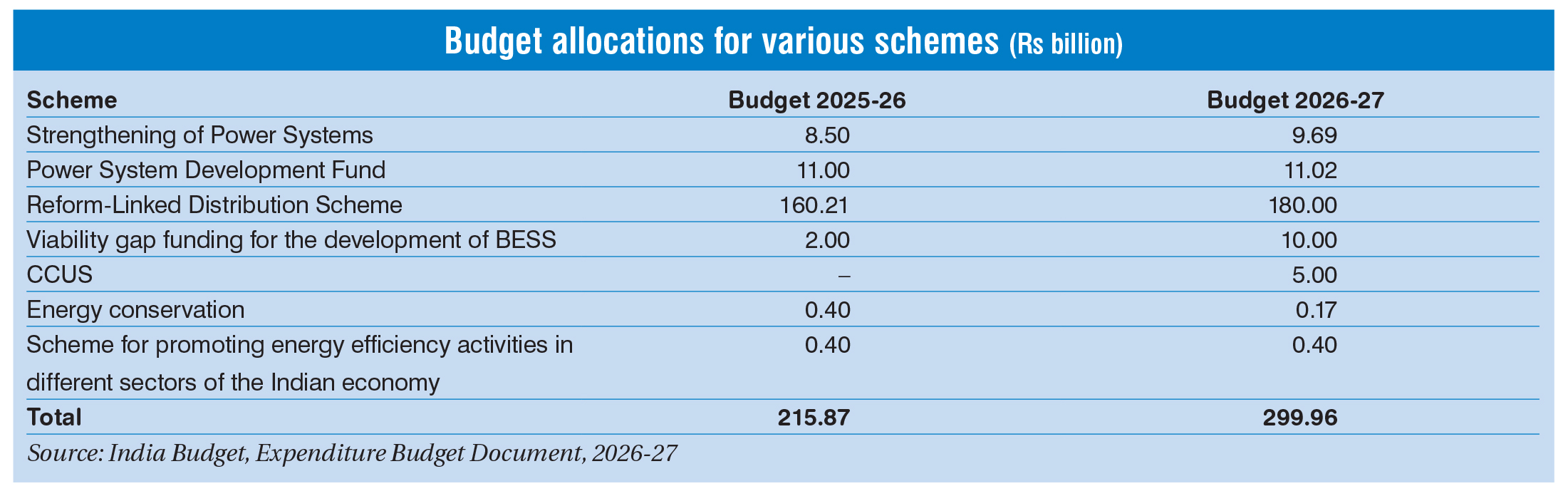
The MoP has been allocated Rs 299.96 billion in Union Budget 2026-27, 38.95 per cent over the revised estimates of 2025-26 (Rs 215.87 billion), signalling a clear push towards distribution reform and grid flexibility.
The viability gap funding for the development of battery energy storage systems (BESS) has been scaled sharply to Rs 10 billion from Rs 1 billion, an increase of Rs 9 billion or 900 per cent, signalling a shift from early allocations towards active market creation for storage as a flexibility resource to manage peak demand and renewable variability.
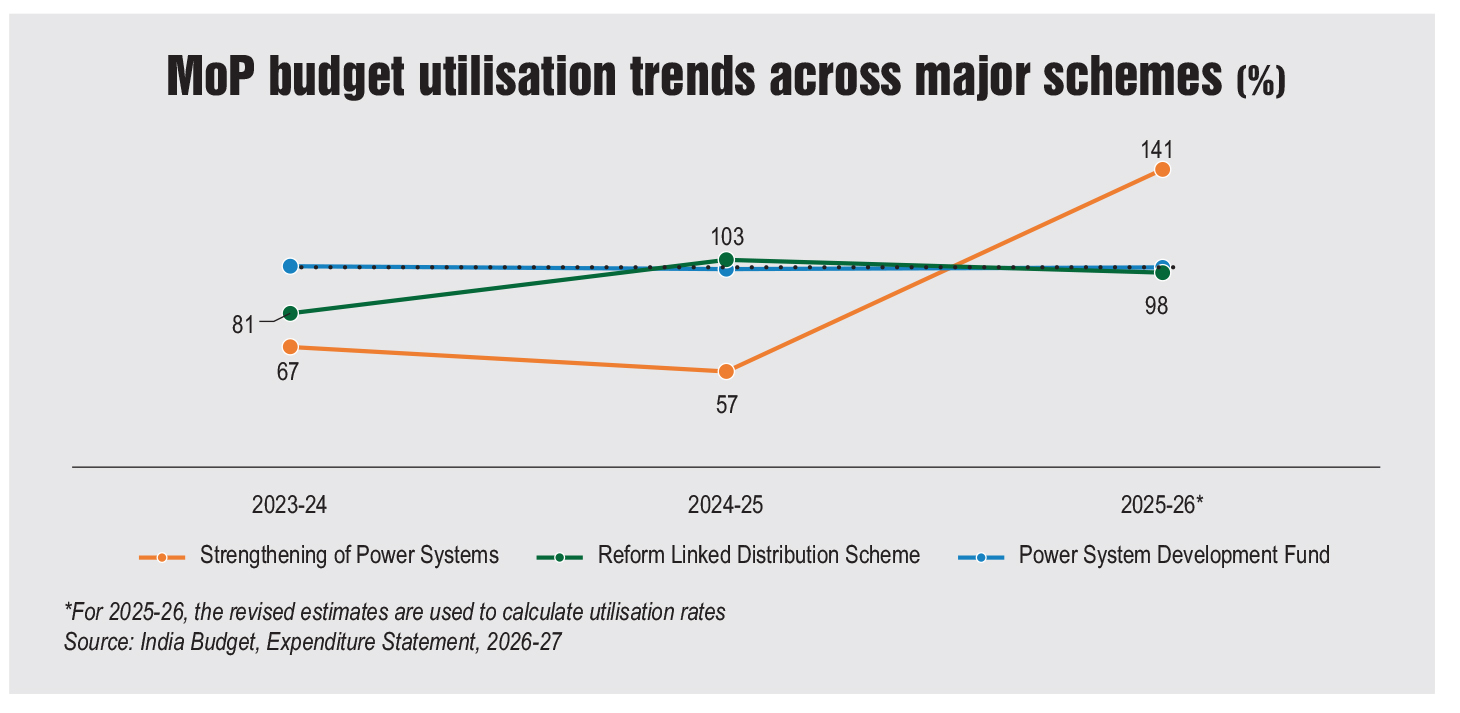 In parallel, the MoP is expanding its distribution reform agenda through the Reform-Linked Distribution Scheme (also known as the Revamped Distribution Sector Scheme ([RDSS]), which alone forms 60.01 per cent of the MoP’s total. The allocation for the RDSS for 2026-27 stood at Rs 180 billion. Higher allocation towards the RDSS remains a positive for the power sector, as this will help reduce aggregate technical and commercial losses as well as support the implementation of smart metering projects. However, allocations for power system strengthening has been lower at Rs 9.69 billion (from the previous Rs 11.94 billion), a reduction of Rs 2.25 billion or 18.86 per cent.
The Ministry of New and Renewable Energy (MNRE) has been allocated Rs 329.14 billion in Budget 2026-27, which is a 30.09 per cent increase from Rs 253.01 billion over the revised estimates in 2025-26.
Allocation for Pradhan Mantri Kisan Urja Suraksha evam Utthaan Mahabhiyan (PM-KUSUM) has been retained at Rs 50 billion. Meanwhile, the PM Surya Ghar: Muft Bijli Yojana (PM-SGMBY) has witnessed an increase to Rs 220 billion from Rs 170 billion, a rise of Rs 50 billion or 29.41 per cent.
Overall, these allocations signal a sharper alignment towards distributed solar delivery, with PM-SGMBY alone accounting for 66.84 per cent of the MNRE outlay and the single largest share among listed heads, followed by PM-KUSUM adding another 15.19 per cent. The combined share of the two flagship consumer and agriculture programmes stood at 82.03 per cent.
 Key announcements
In the Budget speech, the finance minister highlighted the vision for non-banking financial companies (NBFCs) under Viksit Bharat, with clear targets for credit disbursement and technology adoption, and stated that, as a first step toward achieving scale and improving efficiency in public sector NBFCs, the restructuring of PFC Limited and REC Limited has been proposed. The Boards of Directors of REC Limited and PFC Limited have accorded in-principal approval to proceed with a proposed merger. PFC currently holds a majority stake of 52.63 per cent in REC, following the acquisition of the Indian government’s shareholding in REC in 2019.
A Rs 200 billion CCUS roadmap has been announced over five years, covering power, steel, cement, refineries and chemicals.
The Infrastructure Risk Guarantee Fund has been announced, which is expected to promote private capital across power generation, transmission, distribution and storage, focusing on financial de-risking rather than direct subsidies.
The Budget proposes to set up dedicated “rare Earth corridors” in mineral-rich states across India, which is expected to create zones with the necessary infrastructure and incentives for companies to extract rare Earth minerals and reduce import dependence on critical materials.
Tariffs and duty changes
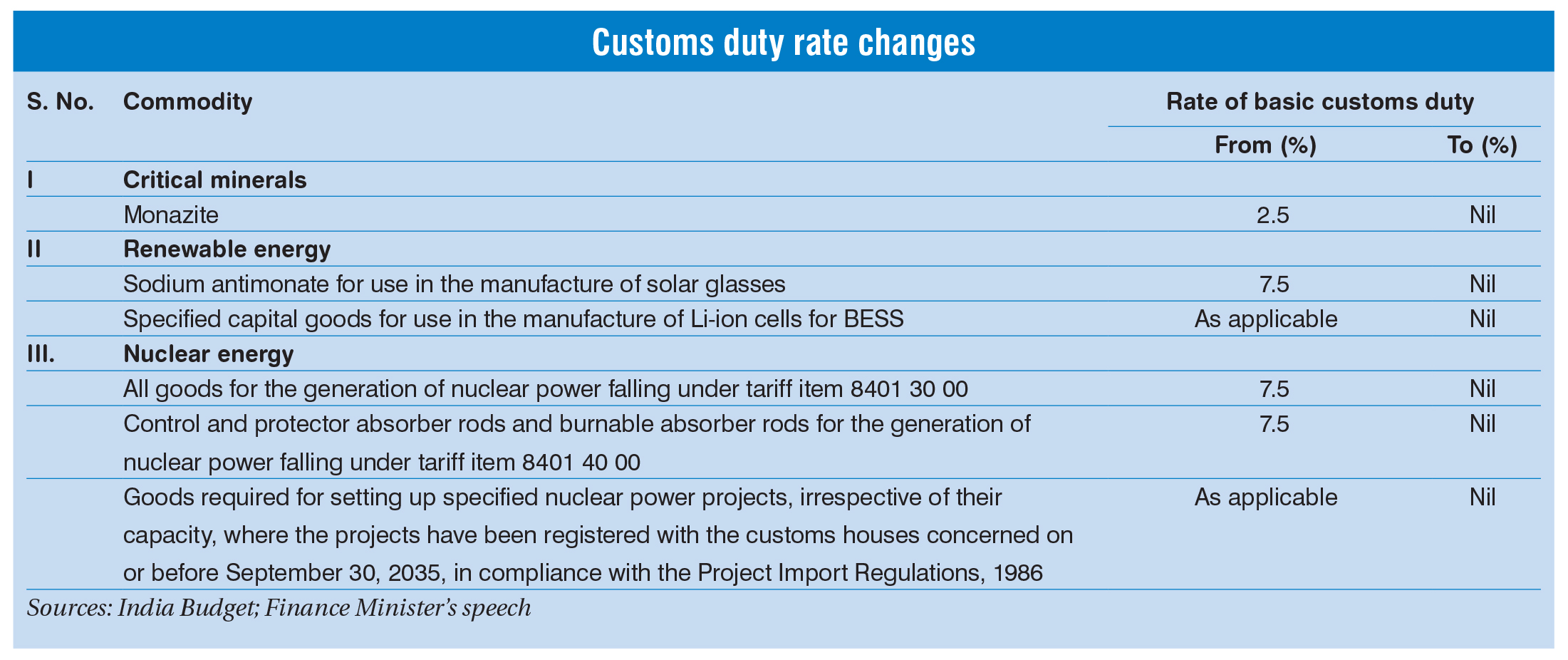
Another key highlight has been customs duty exemptions for all nuclear power project goods extended until 2035, regardless of plant capacity, reinforcing nuclear power as a core component of India’s clean and reliable energy mix.
Further, customs duty exemptions have been extended for battery energy storage manufacturing, key solar inputs and critical mineral processing. There are also exemptions for imported capital goods, such as lithium-ion (Li-ion) cells for use in the manufacture of BESS.
Budget execution trends for the MoP and the MNRE show a clear improvement in budget estimates to actual alignment in 2024-25, though with sharp divergence across individual schemes. Within this improvement, the distributed solar lines showed the most pronounced overshoots, with PM-SGMBY recording an actual of Rs 78.17 billion against a budget estimate of Rs 62.50 billion, exceeding the budget by Rs 15.68 billion or 25.08 per cent, while PM-KUSUM rose to Rs 25.60 billion versus a budget estimate of Rs 14.96 billion, a positive variance of Rs 10.64 billion or 71.13 per cent, indicating faster-than-anticipated disbursement and a catch-up in implementation.
Concerns and outlook
Union Budget 2026-27 reinforces the Economic Survey’s diagnosis that India’s renewable energy system has to now balance two parallel transitions: accelerating renewable capacity addition and building flexibility for reliable integration.
Overall, Budget 2026-27 strengthens the broader energy transition architecture by accelerating distributed renewable adoption, expanding nuclear energy deployment, advancing distribution reforms and providing support to energy storage projects. The decisive test will be whether these allocations convert into measurable outcomes.