
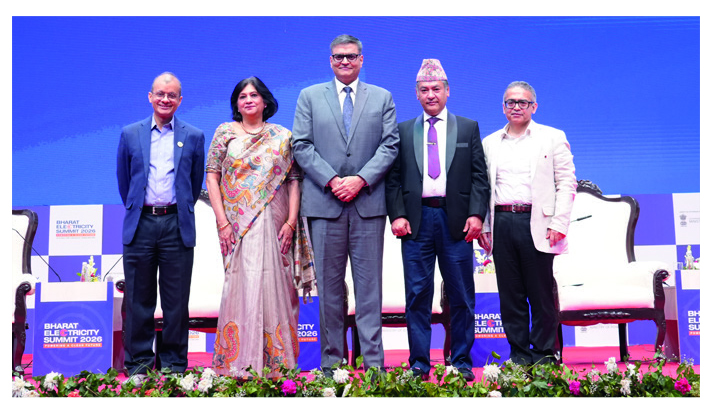
 The BES 2026 session on “OSOWOG market mechanisms for high-renewable energy integration and global energy integration” brought together Dr Vibha Dhawan, Director General, The Energy and Resources Institute; Ashish Khanna, Director General, International Solar Alliance; Hitendra Dev Shakya, Managing Director, Nepal Electricity Authority; and Dr Puneet Chitkara, Senior Vice-President (Strategy), India Energy Exchange. It was moderated by Dr Satish Kumar, President and Executive Director, Alliance for an Energy Efficient Economy. The discussion focused on the practical design challenges shaping regional and global grid integration under the International Solar Alliance’s One Sun, One World, One Grid (OSOWOG) initiative. Edited excerpts…
Global grid integration through OSOWOG
Solar power is increasingly becoming central to decentralised energy systems, with rapid uptake at the village level for applications such as irrigation and local storage. This is transforming rural energy access as well as water use patterns. However, the economics of storage continue to pose a constraint, particularly for distributed applications. In this context, strengthening transmission networks emerges as a critical complement to decentralised deployment. Efficient power transfer across regions can reduce the need for each area to invest in standalone storage, enabling a more optimised system built on shared infrastructure.
This logic extends to the global scale under the OSOWOG framework. By leveraging the geographic diversity of solar resources across time zones, the model enables regions with surplus generation during daylight hours to supply power to those experiencing peak demand elsewhere.
Such cross-border electricity trade can lower overall system costs and reduce dependence on storage. Emerging interconnection initiatives already indicate that distance is becoming less of a barrier, reinforcing the technical feasibility of this vision.
Challenges in integration
While the technical case for interconnected grids is strengthening, implementation hinges on addressing a set of institutional, regulatory and operational challenges. Aligning grid stability protocols, market rules and standards across jurisdictions will be essential to enable seamless cross-border exchanges. Without such coordination, the benefits of physical interconnection may remain underutilised.
At the same time, higher renewable penetration is changing the fundamentals of system reliability. Even as procurement of renewable energy increases, the need for adequate reserves remains critical to maintain grid stability. These reserves, whether in the form of conventional backup capacity or battery storage, must be explicitly recognised and valued within market structures. This points to a structural gap in current market design, which remains largely centred on energy-only transactions.
These challenges are particularly relevant in the South Asian context. Despite significant potential for complementary resource sharing, cross-border electricity flows remain constrained. Strengthening regional interconnections across countries such as India, Nepal, Bhutan and Bangladesh could enable more efficient utilisation of resources, improving both reliability and cost-effectiveness at a system level.
The way forward
Addressing these challenges requires a parallel evolution in power market design. Existing market structures are largely built on marginal cost principles, which are increasingly misaligned with a system where a growing share of generation comes from near-zero marginal cost renewable sources. As a result, energy alone no longer serves as an adequate basis for valuing system performance. In parallel, the role of aggregators and demand-side participation is gaining traction in India.
These mechanisms can provide additional flexibility by enabling consumers to actively participate in balancing the grid. However, the design and adoption of such innovations must be grounded in domestic market conditions, rather than relying solely on international models.
Ultimately, the success of OSOWOG will depend not only on expanding transmission infrastructure, but also on coordinated progress across regulatory frameworks, market design and system operations. Only such an integrated approach can enable a transition from isolated, energy-centric systems to interconnected grids that prioritise flexibility, reliability and cross-border collaboration.


