
The industrial sector is the largest electricity consumer globally, with electric motor systems alone accounting for 70 per cent of its total electricity consumption. The global motors and drives market was valued at $60.10 billion in 2025, and is projected to reach $82.79 billion by 2031, as per Research and Markets.
The Asia-Pacific (APAC) region dominates the global motors and drives market with a share of 45 per cent in 2025, particularly China and India. The AC motors and drives segment accounted for the largest share of around 71 per cent, driven by rapid industrialisation and automation, growth in infrastructure and heating, ventilation and air-conditioning (HVAC) systems, electric vehicle (EV) powertrain demand, and stringent regulatory compliance with mandatory energy efficiency standards.
The expansion of the mining, petrochemical and manufacturing industries in the APAC region continues to increase the demand for reliable, high-power AC motors and drives for process control, while variable frequency drives (VFDs) are modernising operations by improving productivity and enabling precise control.
The medium-voltage (1-6.6 kV) AC motors segment shows significant growth, while the low-voltage (up to 1 kV) DC motors segment holds a dominant share and is the second fastest-growing segment in the global and Indian motors and drives market. Small low-voltage motors are increasingly adopted in industrial robots, automated logistics systems and medical devices, where compact size and precise control are critical. In parallel, demand for low-voltage motors is growing significantly, driven by high-end appliances such as smart fans, washing machines and HVAC systems, with brushless DC motors gaining strong traction due to their superior performance, quieter operation and substantial energy savings within the low-voltage motor segment.
 The manufacturing segment accounts for the largest global motors and drives market share. Strict energy efficiency regulations such as IE4 and IE5 – where IE1 stands for standard efficiency, IE2 for high efficiency, IE3 for premium efficiency, and IE4 for super premium efficiency – are compelling manufacturers to replace traditional motor systems with advanced, drive-controlled motors, helping reduce operational costs and improve performance.
Further, the rapid expansion of large-scale data centres in India and globally is fuelling the adoption of motors and drives for uninterruptible power supply (UPS) systems and cooling applications.
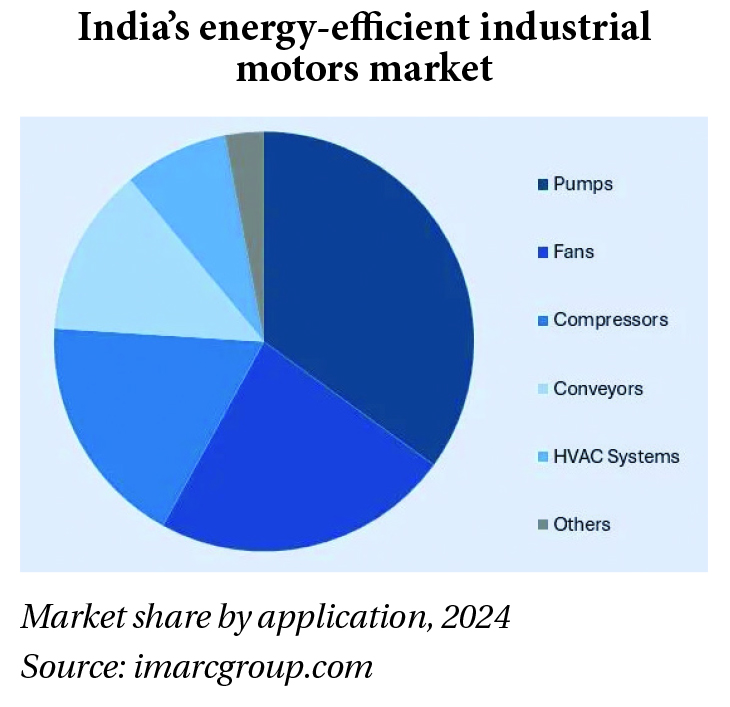
Pumps hold the largest market share of India’s energy-efficient industrial motors market, followed by fans, compressors, conveyors and HVAC systems. These are being used in manufacturing, oil and gas, power generation, automotive, chemicals and petrochemicals, food and beverages, and other smaller sectors.
Energy-efficient motor market potential
The global energy-efficient motor (EEM) market is estimated to grow from $48.52 billion in 2025 to $72.06 billion by 2030, at a CAGR of 8.2 per cent, with the commercial segment likely to be the second largest in the EEM market from 2025 to 2030.
India’s energy-efficient industrial motors market size reached $1.48 billion in 2024, with expectations to reach $2.76 billion by 2033, as per the IMARC Group. The market is registering consistent growth on the back of growing demand for sustainable technologies, regulatory initiatives, efficient industrial operations, infrastructure upgrades and automation. Industries are adopting high-efficiency motors to curb energy consumption and reduce environmental footprint. With ongoing investments and policy push, the outlook for the market remains optimistic.
AC drives market
The Indian AC drives market is experiencing significant growth, driven by the increasing focus on energy efficiency, automation and the modernisation of industrial processes. AC drives, also known as VFDs, control the speed and torque of electric motors by varying input frequency and voltage. They are widely used across the manufacturing, HVAC, water treatment, oil and gas, and transportation sectors.
The growth drivers for India’s AC drives market include government mandates to reduce energy consumption and carbon emissions, driving the adoption of AC drives in motor-driven systems; the requirement for precise motor control and energy savings in automated production lines; upgrades in water treatment, power distribution and HVAC systems, increasing the demand for motor control technologies; lower electricity costs by optimising motor performance and reducing mechanical wear; and expansion of applications in areas such as wind turbine control, EV charging infrastructure and grid stabilisation.
Growing market trends in India’s AC drives market include integration with industrial internet of things and smart monitoring systems; a shift toward compact and modular designs (compact AC drives with plug-and-play configurations are gaining traction in space-constrained environments); adoption in HVAC and building automation; increased use in agricultural and irrigation systems (VSDs help manage pumps and motors used in precision agriculture and irrigation); and original equipment manufacturer integration and industry-specific customisation for verticals such as mining, food processing and marine applications.
There are further potential opportunities in the development of artificial intelligence (AI)-enabled predictive maintenance features, expansion into microgrid and decentralised energy systems, and electrification of transport and logistics (drives are essential in electric forklifts, cranes and transport automation). There is also a growing market for retrofitting, as upgrading legacy motors with AC drives can improve efficiency without significant infrastructure investments.
Policy push and efficiency standards
India’s regulatory framework is driving the faster uptake of energy-efficient industrial motors through the enforcement of stringent energy performance standards and incentive programmes. The Bureau of Energy Efficiency continues to expand its labelling schemes, encouraging manufacturers and consumers towards higher efficiency classes like IE3 and IE4. The National Motor Replacement Programme (NMRP), which supports the replacement of old motors with compliant energy-efficient models, is helping to curb the industrial sector’s energy intensity, which continues to be among the largest in national power consumption. Procurement is further driven by campaigns for energy efficiency awareness and the availability of funding for small and medium enterprises (SMEs).
In 2026, switching to IE3/IE4 motors is essential for industries to cut energy consumption by 20-30 per cent and reduce operational costs. These high-efficiency motors significantly lower electricity consumption for pumps, fans and conveyors, with typical payback periods within months.
 Services market
The motors and drives services market encompasses a range of offerings, including motor installation, electrical design, diagnostics tools, component replacement, health monitoring, harmonic filter selection, drive system optimisation, reliability improvement and various motor performance metrics. According to industry estimates, the global market for motor installation services is projected to reach $15 billion by 2025, growing at a CAGR of 3 per cent from 2020. In contrast, the market for motor health monitoring is projected to expand at a faster pace, with a CAGR of 5 per cent, reaching $7 billion by 2025.
Challenges
Despite favourable growth trends, which led companies such as ABB to announce an investment of approximately $75 million in India in March 2026 to expand manufacturing and research and development for critical electrification and automation solutions, intense price competition and low-cost imports are major challenges in the motors and drives market.
The reduction in subsidies in schemes like PM Electric-Drive Revolution in Innovative Vehicle Enhancement in April 2025 has created immediate challenges for the electric 2W sector, leading to a temporary decline in sales volumes. Further, the adoption of high-efficiency servo motors and electric motors is hindered by high upfront capital requirements, supply chain inefficiencies and shortages of rare-earth magnets, creating a 10 per cent cost disadvantage for local manufacturers compared to competitors like China.
In addition, the transition to advanced automation, such as servo-driven systems, requires specialised skills for configuration and maintenance. A shortage of trained workers, combined with an ageing workforce, acts as a bottleneck, forcing some companies to opt for less advanced motors.
The industry continues to face supply chain bottlenecks due to geopolitical issues and semiconductor shortages, impacting production capacity for both the automotive and industrial sectors.
Anita Khuller