

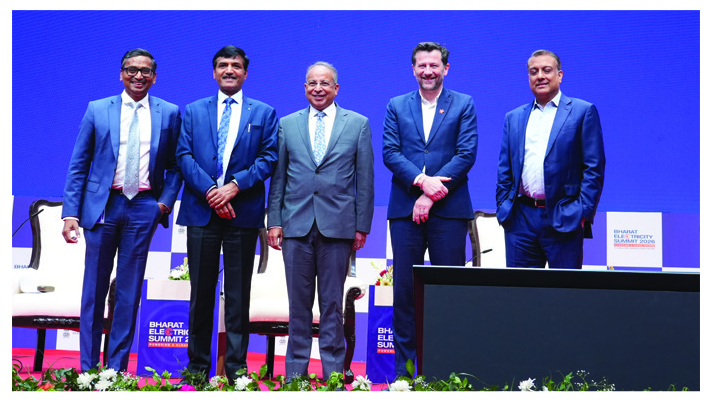
 The session on “India’s Power Sector Roadmap to 2047: Translating National Vision into a Resilient, Integrated and Future-ready Electricity System” highlighted the scale of transformation required across India’s electricity value chain. The discussions focused on the need to strengthen generation, transmission, distribution, supply chains and grid management to support large-scale renewable integration while ensuring reliability and long-term system resilience. The panellists included Dr R.K. Tyagi, Chairman and MD, Power Grid Corporation of India Limited; Dr Praveer Sinha, Chief Executive Officer (CEO) and Managing Director (MD), Tata Power Company Limited; Sumant Sinha, Founder, Chairman and CEO, ReNew; and Guirec Servan, CEO, EDF Power Solutions India. It was moderated by Anish De, Global Head, Energy, Natural Resources and Chemicals, KPMG. Edited excerpts from the discussion…
India’s power sector has witnessed significant progress over the past 25 years, with substantial improvements across generation, transmission and overall electricity infrastructure. The growth has not been limited to a single segment but has taken place across the entire value chain, reflecting coordinated development in generation capacity, transmission networks and system planning.
The sector is expected to experience a phase of major transformation rather than continuing along a traditional growth path. The future energy system is likely to be shaped by increasing penetration of renewable energy and new technologies, which could significantly alter the current structure of the power mix. Coal-based generation, which currently accounts for a large share of electricity supply, is expected to gradually decline in relative terms as cleaner sources of energy expand. Energy system modelling indicates that the share of coal in the energy mix could reduce substantially over the coming decades.
The transmission sector will need to evolve to support the changing energy landscape. The planning and development approaches that have guided transmission expansion over the past two decades may require adaptation to accommodate large-scale renewable integration and new patterns of electricity generation. The distribution segment remains an area where further improvements are necessary. Strengthening distribution utilities and enhancing operational efficiency will be essential to ensure that the benefits of generation and transmission growth are effectively delivered to consumers.
India’s long-term energy transition pathway points to an unprecedented scale of renewable energy expansion over the coming decades. The country will require a massive increase in solar capacity as it moves towards its net zero target by 2070. Achieving this transition will require a several-fold increase in solar deployment over the next two decades, indicating the magnitude of structural changes required across the power sector.
Grid infrastructure and grid management are expected to become increasingly important as renewable penetration rises. The rapid addition of solar capacity is already creating operational challenges for grid operators, particularly in managing peak demand and balancing generation from multiple sources. As solar generation increasingly meets daytime peak demand, system operators will need to ensure that other generation sources remain viable while maintaining overall grid stability.India has also made substantial progress in developing domestic manufacturing capabilities for high voltage transmission equipment. In earlier decades, many technologies relied heavily on imported components. Over time, however, a robust domestic ecosystem has been established, enabling the local manufacturing of several critical transmission technologies.
Going forward, the expansion of the grid will require the deployment of next-generation transmission technologies, including advanced high voltage alternating current systems and high voltage direct current corridors. These technologies will be essential for transporting large volumes of renewable power efficiently across long distances and ensuring grid stability as the share of variable generation increases.
Despite the progress made, several challenges remain. Issues related to right of way for transmission lines, land acquisition and the availability of critical equipment such as transformers can slow project development. Addressing these constraints through supportive policies, improved compensation mechanisms and expanded manufacturing capacity will be essential to ensure that transmission infrastructure keeps pace with the country’s rapidly growing electricity demand and renewable energy ambitions.


