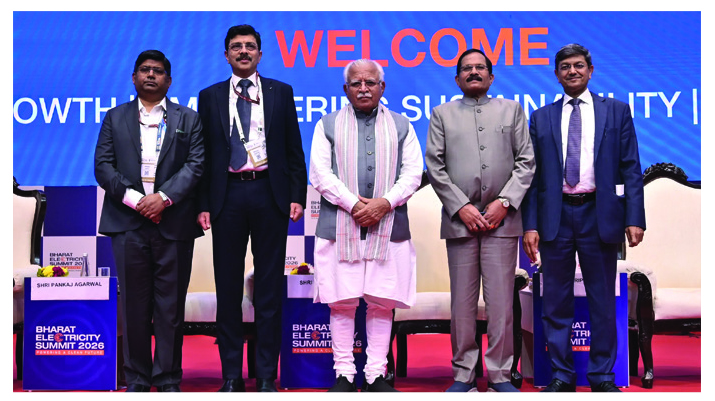
 The valedictory session of Bharat Electricity Summit 2026 marked a fitting conclusion to four days of intensive dialogue, collaboration and forward-looking deliberations. The session brought together key representatives from across the power sector, including Union Minister of Power Manohar Lal Khattar; Minister of State for Power and New & Renewable Energy Shripad Yesso Naik; Pankaj Agarwal, Secretary, Ministry of Power; Piyush Singh, Additional Secretary, Ministry of Power; and Gurdeep Singh, Chairman and Managing Director, NTPC Limited. Edited excerpts…
Powering growth with inclusion and sustainability
Electricity continues to underpin economic growth, industrialisation and quality of life, making reliable and affordable access a national priority. India’s long-term vision of becoming a developed nation by 2047 places the power sector at the centre of this transformation. Expanding access, strengthening infrastructure and ensuring sustainability are key to supporting this trajectory.
Significant progress has been achieved through large-scale electrification programmes and decentralised solutions. Rooftop solar initiatives are enabling households to generate their own power, reducing dependence on conventional supply systems. Rural electrification efforts have already connected vast sections of the population, while ongoing programmes are focused on reaching remote and geographically challenging areas. At the international level, the concept of interconnected grids is gaining traction, particularly through the “One Sun, One Grid, One World” vision. Cross-border linkages with neighbouring countries are being strengthened, with further possibilities being explored across regions.
Maintaining a balanced energy mix remains essential. Renewable energy sources are expanding rapidly, but conventional generation continues to play a stabilising role in the grid. The variability of solar and wind power necessitates investments in storage systems and advanced grid management technologies to ensure uninterrupted supply.
Reform, resilience and the road ahead
An integrated approach to sectoral development is increasingly seen as necessary, covering generation, transmission, distribution and emerging technologies in a coordinated manner. The interconnected nature of the system means that even small inefficiencies or disruptions can affect overall performance, making system-wide strengthening a priority. Reforms in the distribution segment are progressing through measures such as smart and prepaid metering, improved billing and collection systems, and efforts to reduce aggregate technical and commercial losses.
Energy storage is gaining importance as renewable capacity grows, with strong interest in battery-based solutions and pumped storage projects. Developers have indicated readiness to bring substantial storage capacity online within a short timeframe, signalling a shift towards more flexible and resilient power systems.
Digital technologies are transforming the sector, from planning and forecasting to real-time operations. The growing use of artificial intelligence and data-driven systems is improving efficiency, but also introducing new challenges, particularly in cybersecurity. The financial and investment landscape is evolving alongside these changes. Large-scale infrastructure development, system modernisation and clean energy expansion are creating new opportunities for investors and industry stakeholders. Stable policy frameworks and growing demand are expected to sustain long-term interest in the sector. At a broader level, international cooperation continues to expand, with increasing engagement across regions. Partnerships combining technological expertise, financial resources and shared innovation are opening new avenues for growth, particularly in developing markets. These collaborations are expected to play a crucial role in shaping a more connected and sustainable global energy ecosystem.
A key highlight of the session was the release of three important reports: Rating Regulatory Performance of States and Union Territories 2025 by Power Foundation of India; Ash Generation and Utilisation at Coal/Lignite-Based Grid-Connected Thermal Power Stations for 2024–25 by the Central Electricity Authority; and Establishing a Sodium-ion Battery Ecosystem in India by the Council on Energy, Environment and Water.
The summit ultimately reinforced the idea that the journey ahead will require coordinated effort, sustained investment and a shared commitment to innovation. The real measure of success will lie in how these ideas translate into tangible progress across the power sector in the years to come.