
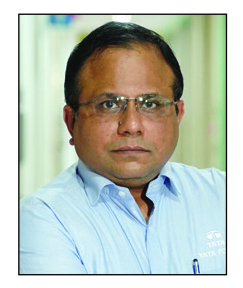
 By Tarun Katiyar, Chief Executive Officer and Managing Director, Tata Power Trading Company Limited
Why utility-as-a-service is India’s next infrastructure shift
India’s infrastructure story is being written at speed, powered by ambitious builds across airports, industrial parks, data centres and smart cities. But beneath the scale of construction, a more fundamental shift is under way in how utilities are planned, financed and operated. As India accelerates towards a low-carbon, digital and service-driven future, old assumptions around utility ownership are being challenged, not because they were wrong, but because they are no longer the most efficient way to build for the future.
Across large infrastructure developments, organisations are now asking a simple but resonant question. What if utilities could be flexible, reliable and performance-guaranteed, delivered as a packaged service, instead of being assets that must be owned, maintained and managed over decades? What if this model could remove the operational burden from infrastructure developers and owners, allowing them to focus on building and scaling their core business rather than running complex utility ecosystems?
This is where utility-as-a-service (UaaS) is beginning to shift from a topic of discussion to a deployment strategy. While it draws lineage from the broader energy-as-a-service (EaaS) concept that has been discussed for some time, UaaS is distinct in its clarity of execution. Unlike EaaS, which often takes a holistic, non-linear and conceptual approach, UaaS is a firm and deployable business model. It integrates engineering, financing, operations and digital intelligence into a single outcome-based framework, shifting the utility mindset from ownership to service, from capex to opex, and from fragmented responsibility to unified accountability.
From EaaS to UaaS
UaaS is best understood as the natural evolution of EaaS, moving beyond a narrow focus on energy procurement or efficiency upgrades. While EaaS is typically centred on demand management, optimisation and consumption reduction, UaaS expands the scope by enabling a full grid-to-gate value chain. It brings together grid interface and renewable integration, downstream electrical networks, HVAC and cooling infrastructure, water systems and building management systems into one integrated delivery model.
Under this approach, a specialised service provider takes end-to-end responsibility to design, finance, build and operate the utility infrastructure on behalf of the customer. Instead of investing upfront capital to create and maintain complex systems, the customer pays a predictable fee for assured outcomes such as power quality, cooling comfort and process reliability. This reconfiguration makes utilities feel less like a permanent operational headache and more like a service experience – structured, measurable and consistently monitored.
The advantage here is not only cost-related, it is managerial and strategic. Large facilities such as airports, industrial parks, educational campuses and manufacturing ecosystems are not meant to become multivendor utility operators. UaaS simplifies the operating landscape by allowing the customer to engage a single partner for utility requirements, improving uptime, making costs predictable and ensuring performance alignment through clearly defined service metrics.
A model powered by continuous engineering and digital intelligence
A defining feature of UaaS is that it does not end with commissioning infrastructure. It introduces continuous engineering innovation across the life cycle of the contract, turning utility delivery into an ongoing performance discipline rather than a one-time project handover. The model is anchored in digital intelligence, where insights from multiple input sources flow into a centralised platform to provide real-time operational visibility.
With SCADA and analytics tools monitoring equipment health, tracking efficiency and producing actionable intelligence, operations are moving decisively from reactive maintenance to proactive performance management. This fusion of physical assets with digital control systems improves reliability, reduces unplanned outages, extends asset life and creates a system that continuously evolves rather than deteriorates over time. In high-stakes environments such as airports and data centres, where downtime is simply unacceptable, this shift is not incremental; it is transformational.
UaaS: Moving from capex to pay-as-you-go
Perhaps the most transformative aspect of UaaS lies not in engineering, but in economics. Traditionally, utility infrastructure has been capital-intensive, requiring large upfront investments in substations, transformers, cabling networks, cooling systems and associated controls. These long gestation assets often tie up capital far beyond what organisations would prefer, especially when they are competing for resources to invest in their core business, expansion and innovation.
UaaS breaks this barrier with a pay-as-you-go model, shifting utility delivery from capex-intensive ownership to opex-based consumption. Instead of committing to large capital expenditure, customers pay through predictable operating contracts for measurable outcomes. This redefines utility systems as services that scale with demand, rather than assets that constrain decision-making. It also makes expansion easier, because capacity augmentation becomes part of a managed life cycle rather than a fresh capital project each time demand rises.
What strengthens this model further is performance-linked accountability. Under UaaS, the provider’s revenue is tied to service delivery metrics such as uptime, response time, efficiency and safety. Customers pay only for verified outcomes, creating shared incentives for continuous optimisation and operational excellence. In effect, UaaS brings utility infrastructure into the same world that modern enterprises now expect from technology and digital services: reliability, transparency and performance assurance.
The bigger shift: Infrastructure enters the service economy
The move from capex to pay-as-you-go is not a standalone trend; it is part of a much larger transformation across industries. Models such as data-centres-as-a-service, mobility-as-a-service, cooling-as-a-service and water as a service all reflect the same underlying principle. Customers increasingly do not want to own and maintain complex systems; they want access to high quality outcomes with minimal risk and maximum flexibility.
UaaS reflects this shift within the energy and utilities domain, blending the engineering depth and operational seriousness of traditional utilities with the agility, accountability and transparency expected in a service-driven economy. In doing so, it introduces a more modern way of thinking about infrastructure – where utility delivery is no longer a one-time investment decision, but a managed performance relationship.
The Noida International Airport model: Tata Power’s flagship UaaS deployment
A compelling example of UaaS in action is Tata Power’s partnership with the Noida International Airport, as one of India’s most comprehensive UaaS deployments. Under a long-term operation, maintenance and service agreement, Tata Power is delivering an integrated grid-to-gate solution that combines renewable energy integration, advanced electrical infrastructure, smart controls and digital monitoring.
The scope includes 33 kV gas-insulated substations, 11 kV and LT networks, transformers and auxiliary systems to ensure efficient power distribution. It also includes systems that strengthen safety and operational visibility, including SCADA, CCTV, access control and fire detection. Critical substations have been designed with N-1 and N-2 redundancies to ensure continuous power supply even during equipment outages, while backup systems, DG synchronisation and reactive power management further strengthen reliability across the network.
What sets this model apart is that it demonstrates UaaS as far more than infrastructure management. It is performance-assured delivery with clear outcomes and clear accountability. With safety as a primary focus, supported by rigorous training and transparent execution, the deployment reinforces that modern utility partnerships must be built not only on assets and systems, but also on governance and operational discipline.
Conclusion: A smarter utility blueprint for India’s next decade
As India builds more infrastructure, UaaS offers a practical and modern way to access reliable power and utility systems without needing to own them. It helps companies save capital, manage costs better and modernise faster by transferring asset ownership and operational risk to specialised service providers. At the same time, it enables organisations to focus on core priorities while utility infrastructure is delivered through long-term, scalable partnerships that are structured around service guarantees.
As demand grows over the life of a project, the utility ecosystem can be progressively augmented by the UaaS partner, backed by performance commitments that ensure long-term sustainability and commercial viability. The outcome is not only steady energy supply, but improved performance and cleaner operations, signalling a transition towards smarter and greener power solutions designed for the future.
In many ways, UaaS marks a decisive shift in how India will build and run its next generation of infrastructure – not by asking every developer to own utilities, but by enabling them to access utility performance as a service: measurable, accountable and built to scale.