
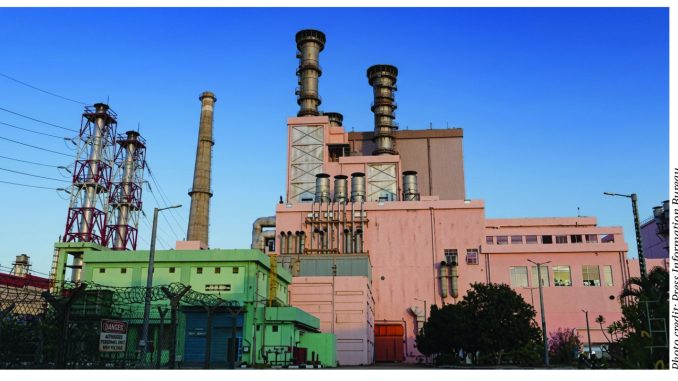
India’s nuclear power programme has reached a significant milestone, with the 500 MWe prototype fast breeder reactor (PFBR) at Kalpakkam, Tamil Nadu, attaining first criticality. This marks the initiation of a controlled and sustained nuclear fission chain reaction. Developed by Bharatiya Nabhikiya Vidyut Nigam Limited (BHAVINI), the PFBR represents India’s entry into the second stage of its three-stage nuclear power programme, a long-term strategy to utilise natural uranium, plutonium and thorium-derived uranium-233 to achieve sustainable and self-reliant nuclear power generation.
Fast breeder reactors (FBRs) are designed to generate more fissile material than they consume, enabling the production of additional fuel during operation. This fuel multiplication capability enhances resource efficiency, allowing India to extract significantly greater energy from its limited uranium reserves while reducing dependence on imports and supporting a gradual transition to its abundant domestic thorium resources. Upon full commissioning, India is expected to become the second country after Russia to operate a commercial fast breeder reactor.
Current nuclear power landscape
India’s installed nuclear power capacity currently stands at 8.78 GW. During 2024-25, nuclear power plants generated 56,681 MUs of electricity, contributing approximately 3.1 per cent of total electricity generation.
Currently, five PHWRs aggregating 3,500 MW are under construction and eight more (5,600 MW) are in the pre-project stage. In addition, four pressurised water reactors with a combined capacity of 4,000 MW are under implementation. These projects are at various stages of execution and are expected to be commissioned in a phased manner by 2031-32. The capacity is projected to rise to about 22 GW by 2031–32.
On the back-end side, two integrated nuclear recycle facilities – the Integrated Nuclear Recycle Plant (INRP) in Tarapur and the Fast Reactor Fuel Cycle Facility (FRFCF) in Kalpakkam – are under development. These facilities will support reprocessing, waste management and fuel fabrication for spent fuels from PHWRs and FBRs, respectively.
Further, the Nuclear Fuel Complex (NFC) in Kota, Rajasthan, is in the final stages of commissioning. The facility is expected to produce 500 tonnes per year of fuel bundles for 700 MWe PHWRs.
 Government initiatives
The government has outlined a long-term roadmap to expand nuclear power capacity. The Nuclear Energy Mission, announced in Union Budget 2025-26, targets 100 GW of nuclear power capacity by 2047. As per government estimates, this would require investments of at least Rs 20 trillion, assuming a baseline cost of Rs 220 million per MW.
The Bhabha Atomic Research Centre (BARC) is leading the development of advanced reactor technologies. Key projects include the 200 MWe Bharat Small Modular Reactor (BSMR-200), the 55 MWe SMR-55, and a high-temperature gas-cooled reactor with a capacity of up to 5 MWth for hydrogen production. An allocation of Rs 200 billion has been made for the development of small modular reactors (SMRs). These reactors are expected to provide flexible, scalable and cost-effective nuclear power solutions. The government has set a target to operationalise at least five indigenously designed SMRs by 2033.
To support sector expansion, the government has enacted the Sustainable Harnessing and Advancement of Nuclear Energy for Transforming India (SHANTI) Act, 2025, which modernises the legal framework for nuclear energy and allows limited private sector participation under regulatory oversight. Further, India has signed an intergovernmental agreement with 18 countries on civil nuclear cooperation for peaceful purposes.
The Atomic Energy Commission has recently approved the foreign direct investment policy in nuclear power, which is currently undergoing interministerial consultations. It also highlighted the benefits of adopting a fleet-mode approach, wherein multiple reactors are developed at a single site to accelerate approvals and streamline construction timelines.
 The way forward
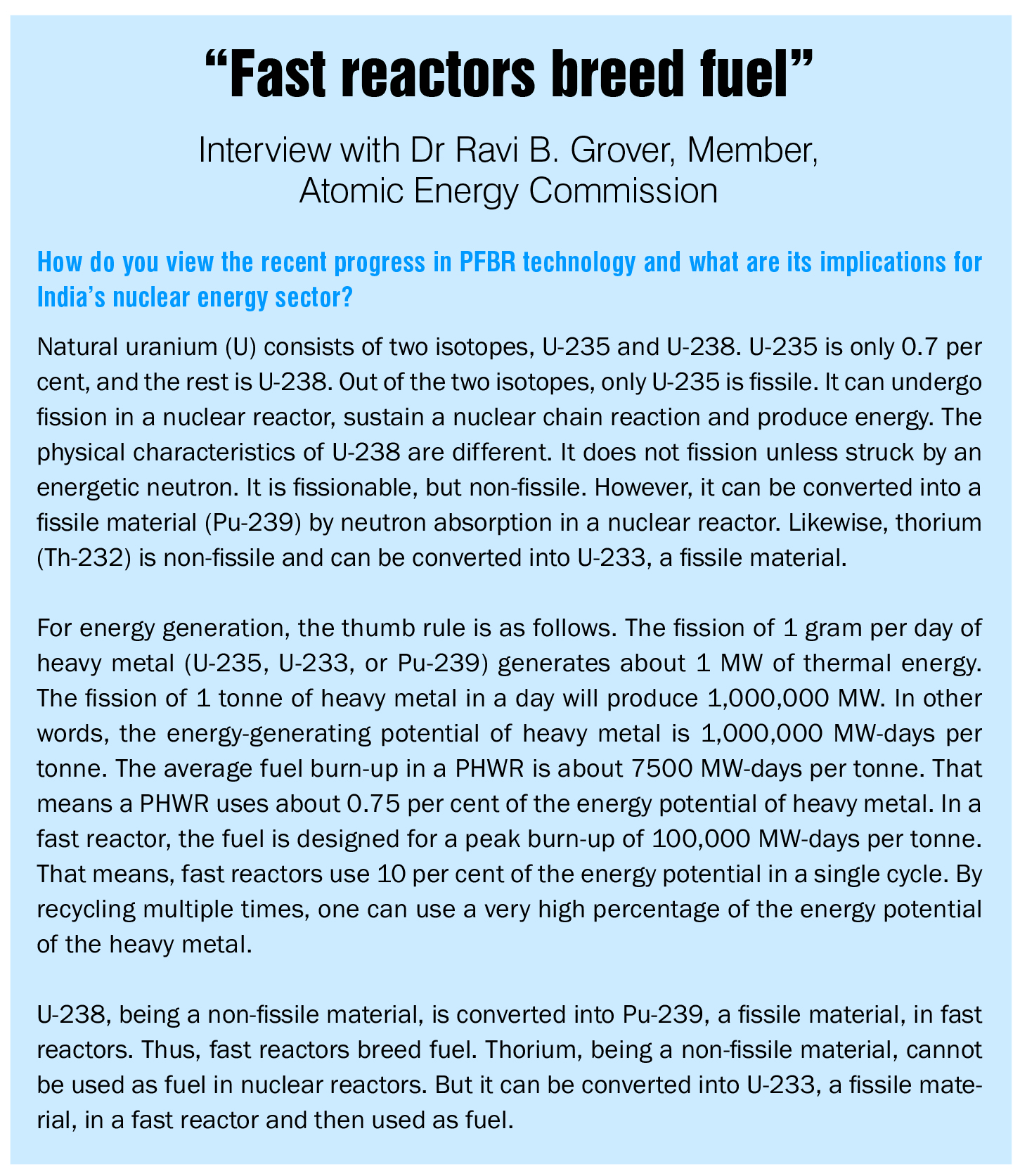
Fast breeder technology serves as a link between the current pressurised heavy water reactors (PHWR) fleet and future thorium-based reactors. PFBRs incorporate advanced safety features, liquid sodium coolant technology and a closed fuel cycle. These features support efficient fuel utilisation, improved safety and reduced nuclear waste.
The Kalpakkam project reflects the development of indigenous capabilities in reactor design, engineering and manufacturing. A large number of domestic institutions, scientists, engineers and industry partners have contributed to the project. The fast breeder programme is also expected to strengthen capabilities in nuclear fuel cycle technologies, advanced materials and reactor physics. These capabilities will support future reactor development and deployment.
As India expands its clean energy portfolio, nuclear power is expected to provide reliable, low-carbon base-load generation. The PFBR milestone supports long-term energy security and aligns with the objective of developing a self-reliant and sustainable energy system.
Aastha Sharma