

The renovation and modernisation (R&M) of power plants has become a key focus area in India’s evolving power sector, particularly as the country seeks to balance rising electricity demand with cost efficiency and sustainability. Over the past two decades, India has added significant generation capacity, but a large share of its conventional fleet, especially coal-based thermal power plants (TPPs), has now entered the ageing bracket of 20-25 years. These plants are characterised by declining operational efficiency, higher forced outages and increasing maintenance
requirements.
In this context, R&M offers a practical and cost-effective alternative to greenfield capacity addition. It involves refurbishing, retrofitting and upgrading existing assets to restore performance levels, improve efficiency and extend plant life. The scope of R&M encompasses boiler-turbine-generator systems, control and instrumentation upgrades, emission control retrofits and digital interventions.
The R&M of power plants represents a significant and growing opportunity, driven by the large fleet of ageing power plants as well as increasing requirements for emission compliance and operational flexibility. Investments in related segments such as power plant equipment, control systems and environmental retrofits indicate a steadily expanding market linked closely with R&M activities.
Key drivers
The primary driver of the R&M market in India is the ageing thermal fleet. A significant portion of coal-based capacity has either crossed or is approaching its designed operational life of 25 years. Ageing leads to deterioration in performance parameters such as heat rate, plant load factor and availability. R&M interventions help restore these parameters and extend plant life by 10-15 years, thereby deferring the need for fresh capital-intensive capacity addition.
Another major driver is the cost advantage associated with R&M. Compared to setting up new power plants, R&M requires significantly lower capital investment and shorter implementation timelines. It also avoids challenges related to land acquisition, environmental clearances and fuel linkages.
The increasing share of renewable energy in the generation mix has also created a need for the flexibilisation of TPPs. Unlike traditional baseload operation, thermal units are now required to operate at lower minimum loads and ramp up or down quickly to balance intermittent renewable generation. R&M enables such operational flexibility through system upgrades and advanced control mechanisms.
Further, the growing adoption of digital technologies is reshaping the R&M landscape. Utilities are increasingly investing in advanced control systems, real-time monitoring tools and predictive maintenance solutions. These technologies not only improve plant performance but also reduce downtime and maintenance costs, making R&M interventions more efficient and attractive.
Progress so far and R&M potential
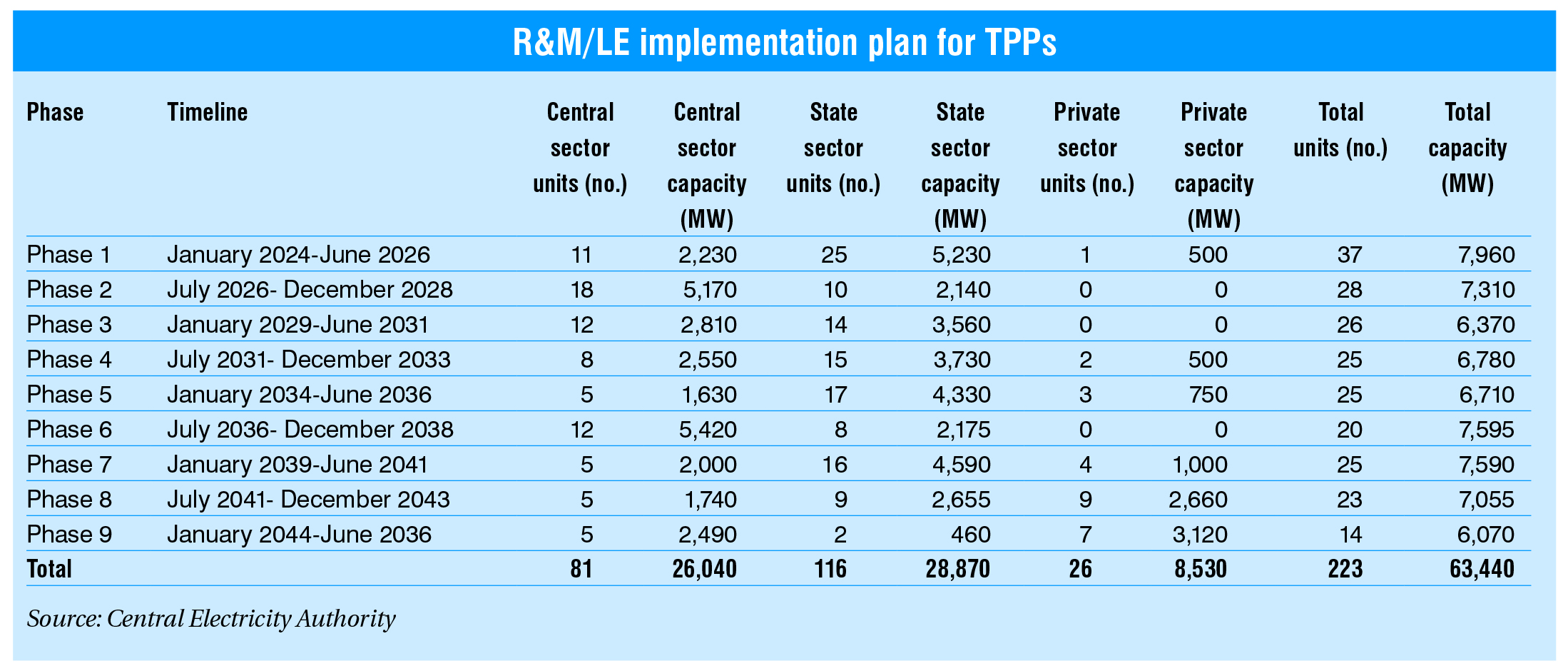
During 2017-22, 1,197 MW of thermal power capacity underwent R&M/life extension (LE) works in the state and central sectors. The Central Electricity Authority has identified 223 potential thermal power units, aggregating 63,440 MW of capacity, for R&M/LE works. These units are over 20 years old as of December 2022. To ensure that refurbishment activities do not lead to significant demand-supply imbalances, the R&M/LE programme is planned to be implemented in nine phases up to 2046.
The first phase of the R&M plan, covering the period from January 1, 2024, to June 30, 2026, includes 37 thermal units with a total installed capacity of 7,960 MW across the central, state and private sectors. In the central sector, out of 11 TPP units with a total capacity of 2,230 MW, 8 units (1,600 MW) are undergoing need-based R&M, while the remaining 3 units (630 MW) are under implementation of the R&M programme.
In the state sector, 25 units with an aggregate capacity of 5,230 MW have been considered. Of these, 9 units (1,890 MW) are undergoing need-based R&M, and 10 units (2,090 MW) are under implementation of the R&M programme. In addition, two units (420 MW) are undergoing R&M along with life extension studies. The remaining four units, totalling 830 MW, have been retired. In the private sector, one unit of 500 MW capacity has been identified; however, it does not intend to undertake R&M activities due to the short tenure of its power purchase agreement, which is limited to five years and permits only minimal capex.
A review of the year-wise and state-wise progress of R&M schemes at hydropower stations during 2022-27 indicates a staggered implementation trajectory. In 2022-23, a total of 1,469.8 MW capacity across seven schemes was completed, followed by 831 MW under three schemes in 2023-24. In 2024-25, the 200 MW Kopili Power Station completed R&M. In 2025-26, out of a total planned capacity of 221 MW across four schemes, 46 MW has been completed so far, while the remaining 175 MW is scheduled for completion within the year. Looking ahead, a significant scale-up is anticipated in 2026-27, with 2,062.75 MW across 11 schemes slated for completion, indicating a strong pipeline of R&M activity in the hydro segment.
Emerging trends
One of the most notable trends in the R&M of power plants is the shift towards digitalisation and predictive maintenance. Utilities are leveraging data analytics, artificial intelligence and internet of things-based systems to monitor equipment health in real time and anticipate failures before they occur. This marks a transition from reactive to proactive maintenance strategies, significantly improving reliability and efficiency.
Another emerging trend is the increasing focus on LE projects. Rather than merely restoring performance, utilities are now undertaking comprehensive upgrades aimed at extending the operational life of plants well beyond their original design limits. These projects are gaining traction as they offer higher returns on investment compared to partial refurbishments.
There is also a growing emphasis on integrating environmental, social and governance considerations into R&M strategies. Investments in cleaner technologies, emission reduction systems and water efficiency measures are becoming integral to modernisation plans. This aligns with India’s broader energy transition goals and commitments to reduce carbon intensity.
 Issues and challenges
Despite its benefits, the R&M segment in India faces several challenges. Financial constraints remain a major hurdle, particularly for state-owned utilities that are already burdened with debt and operational inefficiencies. Limited access to funding often delays or restricts the scope of R&M projects. Another significant challenge is the requirement for plant shutdowns during R&M implementation. Taking units offline for refurbishment can be difficult in regions with tight demand-supply conditions, leading to reluctance among utilities to undertake such projects. This often results in postponement or partial execution of R&M activities.
Technical complexity is another barrier. Integrating modern technologies into ageing infrastructure can be challenging due to compatibility issues and a lack of standardisation. In some cases, the condition of existing equipment may limit the extent of feasible upgrades, reducing the effectiveness of R&M interventions.
Conclusion
The R&M of power plants in India represents a critical and evolving segment of the power sector, offering a pragmatic solution to the challenges posed by ageing infrastructure, rising demand and environmental compliance requirements. Going forward, the importance of R&M is expected to increase further as India advances its energy transition agenda. By enabling existing assets to operate more efficiently and flexibly, R&M supports grid stability in a system with a rising share of renewable energy. At the same time, it provides a cost-effective pathway for capacity augmentation without the need for large-scale new investments.
To fully realise its potential, however, the sector will need to address key challenges related to financing, implementation and stakeholder participation. Strengthening institutional mechanisms, promoting innovative business models and accelerating the adoption of advanced technologies will be crucial. Overall, R&M stands out as an essential strategy for ensuring reliable, sustainable and economically viable power generation in India.
Akanksha Chandrakar