
Gas-insulated substations (GISs) are widely used in power transmission systems due to their compact design, high reliability and suitability for space-constrained areas. Unlike conventional air-insulated substations (AISs), GIS equipment is enclosed in metal chambers filled with insulating gas. Traditionally, sulphur hexafluoride (SF6) has been used for this purpose due to its excellent insulating and arc-quenching properties. These characteristics have enabled the development of compact substations capable of handling high voltages and large fault currents, particularly in locations where land availability and right-of-way constraints limit the use of AIS.
However, SF6 is also a highly potent greenhouse gas with a global warming potential (GWP) of 24,300 times that of carbon dioxide (CO2) and a long atmospheric lifetime. In view of growing environmental concerns, utilities and manufacturers across the world are developing alternative technologies that can reduce or eliminate the use of SF6 while maintaining comparable performance and reliability. These technologies are commonly referred to as green GIS technologies. Recently, in 2024, Power Grid Corporation of India Limited proposed the upgradation of its ageing 132 kV Badarpur switching station from AIS to GIS. During discussions, it was suggested that green GIS technology could be considered instead of conventional SF6-based GIS.
Accordingly, the Central Electricity Authority (CEA) constituted a technical committee to examine the deployment of green GIS technologies in the Indian grid. The committee held meetings with various original equipment manufacturers (OEMs) in the green GIS field and studied the available technologies, implementation challenges, testing requirements, interoperability issues and the scope for indigenisation in India.
Available technology options
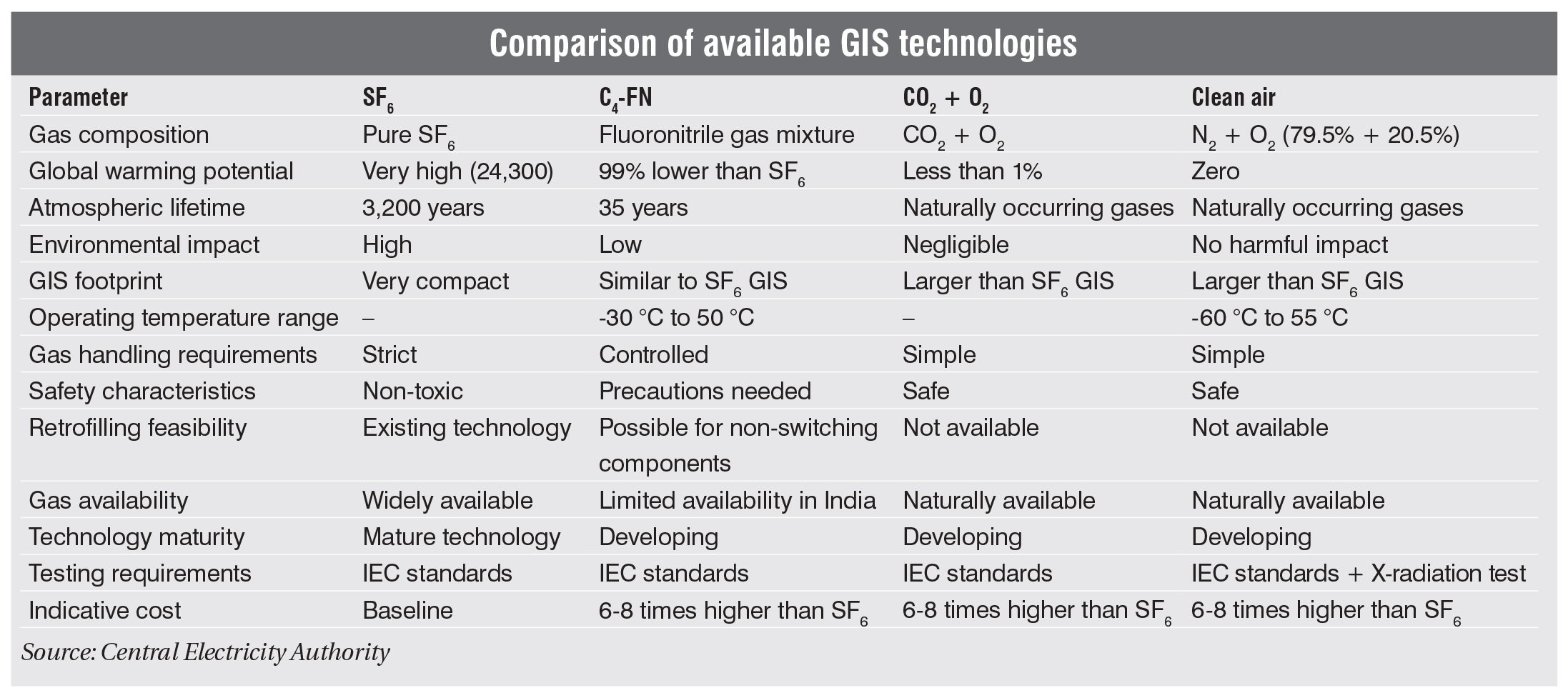
Global switchgear manufacturers have developed several technological alternatives to SF6-based GIS systems. The main approaches currently being adopted include fluoronitrile (C4-FN) mixed with gases such as CO2 and oxygen (O2); natural gas mixtures comprising nitrogen (N2), CO2 and O2; and vacuum interruption combined with clean air (N2 + O2) insulation.
Several OEMs have introduced their proprietary solutions. Hitachi Energy has developed the EconiQ technology, which uses C4-FN mixed with gases such as CO2, O2 or N2 depending on the application. These gas mixtures have zero ozone depletion potential and around 99 per cent lower GWP compared to SF6. Similarly, GE Vernova has introduced its g³ technology, which primarily uses a mixture of CO2, O2 and C4-FN, reducing GWP by nearly 99 per cent while providing electrical performance comparable to SF6-based equipment.
Siemens Energy has adopted a different approach through its blue GIS technology, combining vacuum interruption with clean air insulation, which is a mixture of N2 and O2. Since the technology does not use fluorinated gases, it offers zero GWP and avoids dependence on patented gas mixtures. However, clean air-based equipment generally has a larger footprint than conventional GIS and fluoronitrile-based alternatives. Meanwhile, Toshiba has developed the AEROXIA solution based on natural gas mixtures comprising N2, CO2 and O2, without the use of fluorinated compounds.
 Retrofilling and retrofitting
Retrofilling of existing conventional GIS systems uses a gas mixture comprising CO2, O2 and C4-FN in proportions designed to match the dimensions and operating characteristics of conventional SF6 switchgear. However, such retrofilling is currently feasible only for gas-insulated lines and gas-insulated busducts (GIBs). It is not considered feasible to switch equipment such as circuit breakers and disconnectors, as these components are specifically designed for particular insulating and arc-quenching media. Any deviation from the original gas design can adversely affect interruption capability, dielectric strength and overall equipment reliability. In contrast, retrofitting involves the replacement of existing equipment with new green GIS equipment. This may include the conversion of AIS to green GIS or the replacement of conventional SF6-based GIS. While such projects generally require the complete replacement of primary equipment, fluoronitrile-based green GIS solutions may allow the reuse of existing GIS buildings and civil structures, subject to detailed engineering assessment.
Key challenges
Despite the availability of green GIS technologies globally, the manufacturing and type testing of these systems are currently carried out outside India. As a result, green GIS equipment remains significantly more expensive than conventional SF6-based GIS. Its indicative costs are estimated to be around six to seven times higher due to dependence on imports. This high upfront cost limits the commercial competitiveness of green GIS technologies. Dependence on imported equipment also affects project execution timelines. Green GIS projects are currently expected to take around 20-25 per cent longer to execute than conventional GIS projects. As such, the need of the hour is greater indigenisation, including the domestic manufacturing of GIS equipment as well as local capability for sourcing, handling and quality assurance of alternative insulating gases.
Additionally, interoperability is a major technical challenge. Conventional SF6-based GIS systems supplied by different OEMs can be interconnected using interface adaptor modules, since all systems use the same insulating gas. However, green GIS technologies developed by different OEMs use different insulating gas mixtures. As a result, any unintended intermixing of gases could affect dielectric strength, arc-quenching capability and thermal performance, thereby impacting equipment reliability and operational safety. At present, practical field installations demonstrating interoperability between different SF6-free technologies, or between SF6-free GIS and conventional SF6 GIS within the same system, are not available. Consequently, such arrangements remain at an exploratory stage and would require further engineering studies and pilot implementation.
The way forward
In view of these challenges, developing indigenous manufacturing capability for green GIS equipment is crucial. Existing SF6-based GIS manufacturing facilities can potentially be expanded and adapted for green GIS production, which would help reduce capital costs and dependence on imports. Since installation and handling requirements for green GIS are expected to be broadly similar to conventional GIS, utilities and engineering, procurement and construction contractors may be able to adopt the technology with limited additional training. Several OEMs have also expressed willingness to establish manufacturing facilities in India if sufficient long-term demand emerges.
Accordingly, a road map for gradual reduction in the use of SF6 has been recommended. As an initial step, pilot projects have been proposed for a full 132 kV green GIS and a 400 kV green GIB from 2027-28 onwards. The report has also recommended pilot retrofitting projects at select 220 kV and 400 kV AISs, along with retrofilling trials at existing SF6-based GISs. Based on operational experience from these pilots, SF6-free solutions can gradually be introduced in 132 kV and above GIS projects, particularly for new substations and ageing assets approaching the end of life. Green GIS technologies may initially be adopted in 10 per cent of new GIS projects planned under the next National Electricity Plan (NEP) (2027-28 to 2031-32), with implementation beginning from 2029-30 or 2030-31. This share may subsequently be increased in phases under future NEPs.
Hybrid GIS has also been identified as a practical solution for the phased modernisation of existing substations. In such a configuration, critical equipment such as circuit breakers, disconnectors and earthing switches is housed within compact, gas-insulated metal enclosures, while busbars and external connections continue to use air or solid insulation. This reduces the substation footprint by 50-70 per cent compared to conventional AIS, while also minimising the extent of civil works and construction time.
To promote the development of green GIS technologies, incentives can be provided to organisations such as the Central Power Research Institute and manufacturers willing to establish domestic manufacturing facilities and facilitate technology transfer. Green GIS can also potentially be added under India’s climate finance taxonomy to enable access to green financing. In addition, projects adopting green GIS may become eligible for carbon credits under the Paris Agreement due to avoided SF6 emissions. Overall, green GIS is a promising long-term solution for reducing the environmental impact of transmission infrastructure. With phased implementation focused on technology validation, domestic manufacturing, financial support and skilled manpower, a gradual transition from conventional SF6-based GIS to green GIS can be achieved.