Recently, the Central Electricity Authority released a report proposing a framework for rationalising consumer fixed charges and improving fixed cost recovery by discoms. The report highlights the significant mismatch between the fixed costs incurred by discoms and the fixed charges recovered from consumers. Fixed costs, transmission charges, employee salaries and infrastructure maintenance account for nearly 38-56 per cent of a discom’s total annual revenue requirement. In contrast, fixed charges currently contribute only 9-20 per cent of the total revenue, underscoring a structural imbalance between cost incidence and tariff recovery mechanisms. The recommendations outlined in the report will be placed before the Forum of Regulators for consideration. Power Line presents the key highlights of the report…
Challenges of current low fixed charge model
While rebalancing fixed and energy charges may not significantly affect the overall revenue recovery of distribution licensees, rationalising tariff components remains important from the perspective of tariff design and the financial stability of the distribution sector. However, the following challenges are associated with the lower fixed charge recovery model presently followed by regulators.
Volume risk: Discoms are obligated to pay fixed capacity charges to generators irrespective of the actual power drawn under long-term “take-or-pay” arrangements. However, when a substantial portion of these fixed costs is recovered through variable energy charges, discom revenues become highly dependent on electricity sales volumes. During periods of lower demand, energy sales decline while payment obligations to generators remain unchanged. This mismatch creates cash flow pressures and liquidity challenges for discoms, particularly until tariff true-ups are undertaken.
Stranded costs: High-paying industrial and residential consumers are increasingly shifting to captive power, open access procurement, or rooftop solar systems, reducing their dependence on discom-supplied electricity. However, these consumers continue to remain connected to the grid and rely on discom infrastructure for backup and reliability. As their energy consumption declines, discoms struggle to recover the fixed costs associated with maintaining network infrastructure and contracted generation capacity.
Tariff distortions: Recovering fixed costs through energy charges also weakens the principle of cost-to-serve pricing. Consumers with high contracted demand but low actual consumption contribute relatively little towards the infrastructure required to serve them, despite imposing network costs. In contrast, high-consumption users often end up bearing a disproportionate share of fixed cost recovery through higher energy charges. This distortion becomes more pronounced in cases where distribution costs are not recovered through a separate wheeling charge applicable to all consumers.
Impacts of increasing fixed charges
A sharp increase in fixed charges may lead to several unintended consequences. For industrial consumers, particularly those operating at low load factors, higher fixed charges could substantially increase overall electricity costs and adversely affect competitiveness. It may also encourage a reduction in contracted demand, as consumers increasingly shift towards captive solar generation and energy storage systems. For residential consumers, higher fixed charges could disproportionately impact small, low-income and rural households with lower electricity consumption, as they would continue to bear relatively high monthly bills despite limited usage.
 Key recommendations
Fixed cost components: The report recommends the adoption of a uniform framework for fixed cost calculation across states to ensure consistency, transparency and greater cost reflectivity in tariff design. The fixed cost component should comprise power purchase costs, transmission charges, load despatch centre charges and distribution-related costs, including return on equity, interest on loans, depreciation, operation and maintenance expenses, and interest on working capital.
Target fixed cost recovery levels by consumer category: The fixed charge component of retail tariffs may be progressively increased over the next five years (by 2030) to strengthen the financial viability of utilities by ensuring more predictable and stable revenue streams. Such rationalisation should be implemented in a phased manner, taking into account existing tariff design frameworks, regulatory decisions, and improvements in metering infrastructure to provide greater clarity and certainty to consumers.
Standardise two-part tariff structure across consumer categories: A uniform approach to tariff design should be adopted across consumer categories to ensure consistency, transparency and cost-reflective pricing. In many states, the fixed charge component for residential consumers is levied as a flat amount and is not linked to the consumer’s demand. It is recommended that fixed charges be standardised for different consumer categories as follows:
Standardisation of billing demand: To ensure greater uniformity and consistency in tariff design, it is recommended that billing demand be determined based on the higher of the following:
- a specified percentage of contract demand,
- actual monthly peak demand, or
- a percentage of the actual billing demand recorded during preceding 11 months (for C&I consumers).
kVAh-based billing: Replacing power factor (PF) incentives and penalties with kVA (apparent power) fixed/demand charges and kVAh (apparent energy) billing for consumers with loads above 50 kW (or state-specific thresholds) can simplify tariff structures while addressing reactive power costs more effectively. Under this approach, separate PF adjustments in kWh-based billing would no longer be required, as inefficiencies arising from poor PF would be automatically reflected in higher kVAh consumption.
Separate tariff categories for net metering consumers: Creating separate tariff categories for net metering consumers, with differentiated fixed charges and time-of-day (ToD) tariffs, acknowledges their distinct pattern of grid interaction in terms of electricity injection and drawal. Accordingly, separate fixed, variable and ToD tariff structures may need to be considered for net metering consumers as well.
Separate standby charges for open access/captive consumers: Open access and captive consumers often reduce their dependence on the discom for electricity supply while continuing to retain grid connectivity for backup during outages, maintenance periods or peak demand. In the absence of separate standby charges, this arrangement creates multiple challenges for discoms. First, it leads to stranded capacity, as discoms are required to procure and maintain power through long-term power purchase agreements and supporting infrastructure to meet occasional standby demand, despite reduced energy offtake from such consumers. Second, the reduction in sales to high-paying consumer categories widens the cross-subsidy gap, given that C&I consumers often subsidise residential tariffs. To address these concerns, separate standby charges may be introduced for full open access and captive consumers that source a significant share of their electricity externally while retaining grid connectivity for backup support. A three-tier structure may be considered, which could include a fixed commitment charge linked to contracted standby capacity on a monthly basis, along with separate tariffs for planned standby usage and unplanned standby support.
Conclusion
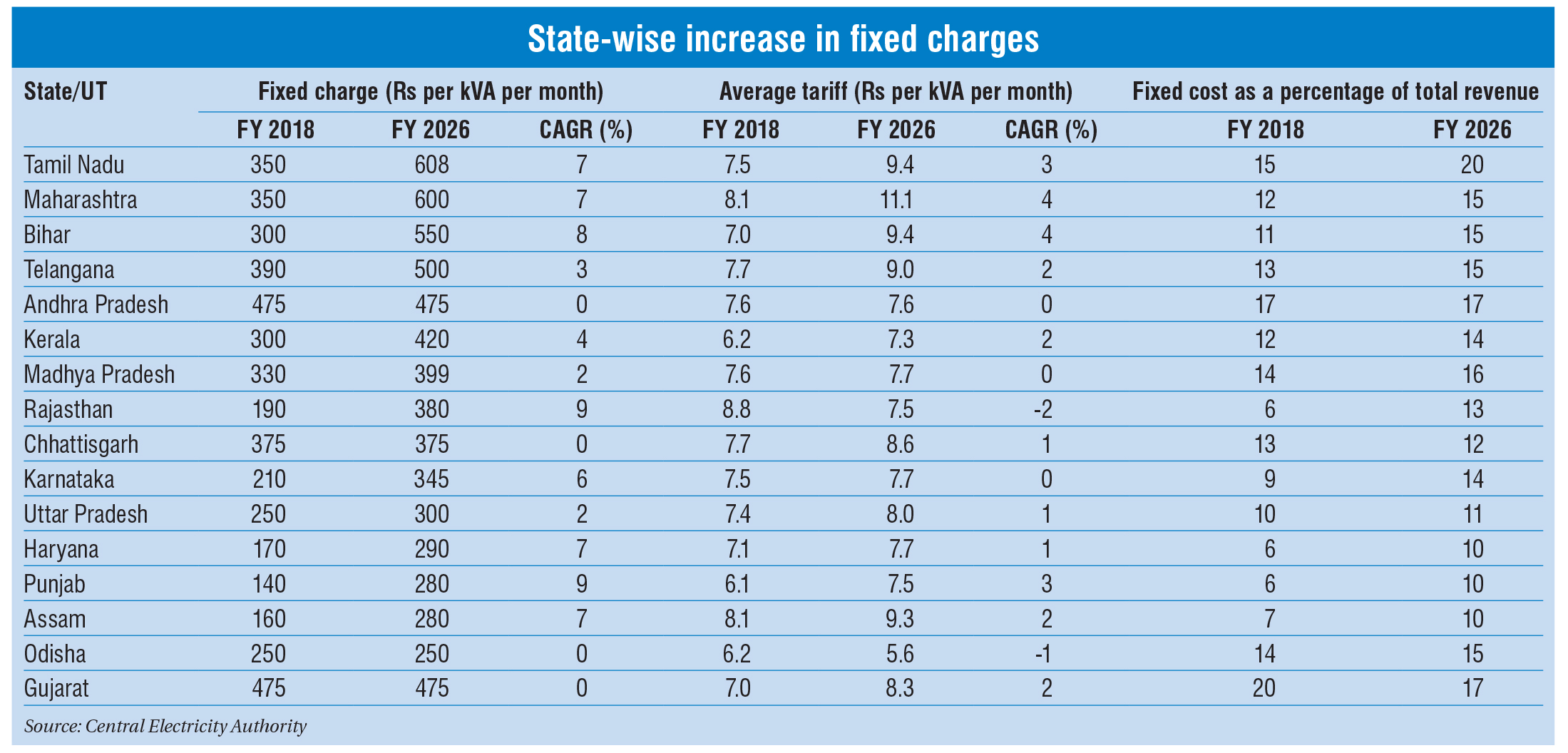
A cost-reflective tariff structure should recover fixed costs through fixed or demand charges, while variable costs should be recovered through energy charges. When utilities recover a large share of fixed costs through energy sales, revenues become vulnerable to consumption fluctuations and may fall short during periods of lower demand. At the same time, high-consumption consumers effectively bear a disproportionate share of infrastructure costs, resulting in cross-subsidisation.Over the years, most states have gradually increased fixed charges, leading to a higher contribution of these charges to total utility revenues, even as overall tariffs have risen. However, while making fixed charges fully reflective of actual fixed costs is consistent with the principle of cost reflectivity, its implementation poses significant challenges. Despite these concerns, there remains a strong case for a calibrated and progressive increase in the share of fixed charges in selected states.
Akanksha Chandrakar