The industrial sector is one of the largest consumers of energy in India and accounts for over 45 per cent of the country’s total energy demand. According to the Ministry of Statistics and Programme Implementation’s Energy Statistics India 2026 report, the sector accounted for 40.39 per cent of the total electricity consumption during 2024-25, making it the largest consumer of electricity in the country. This was followed by the domestic sector (25 per cent), agricultural sector (16 per cent) and commercial sector (8 per cent).
At the same time, the industrial sector also offers significant potential for energy savings, estimated at nearly 49 billion kWh annually. Given the scale of consumption, managing energy costs has become a key priority for industrial consumers. Rising electricity tariffs, fuel price volatility and increasing pressure to improve operational efficiency are compelling industries to adopt more structured energy management practices. As a result, industries are increasingly focusing on measures such as captive and open access procurement, renewable energy adoption, equipment modernisation, process optimisation, and the deployment of energy-efficient technologies to reduce costs and improve overall operational efficiency.
Trends in energy savings
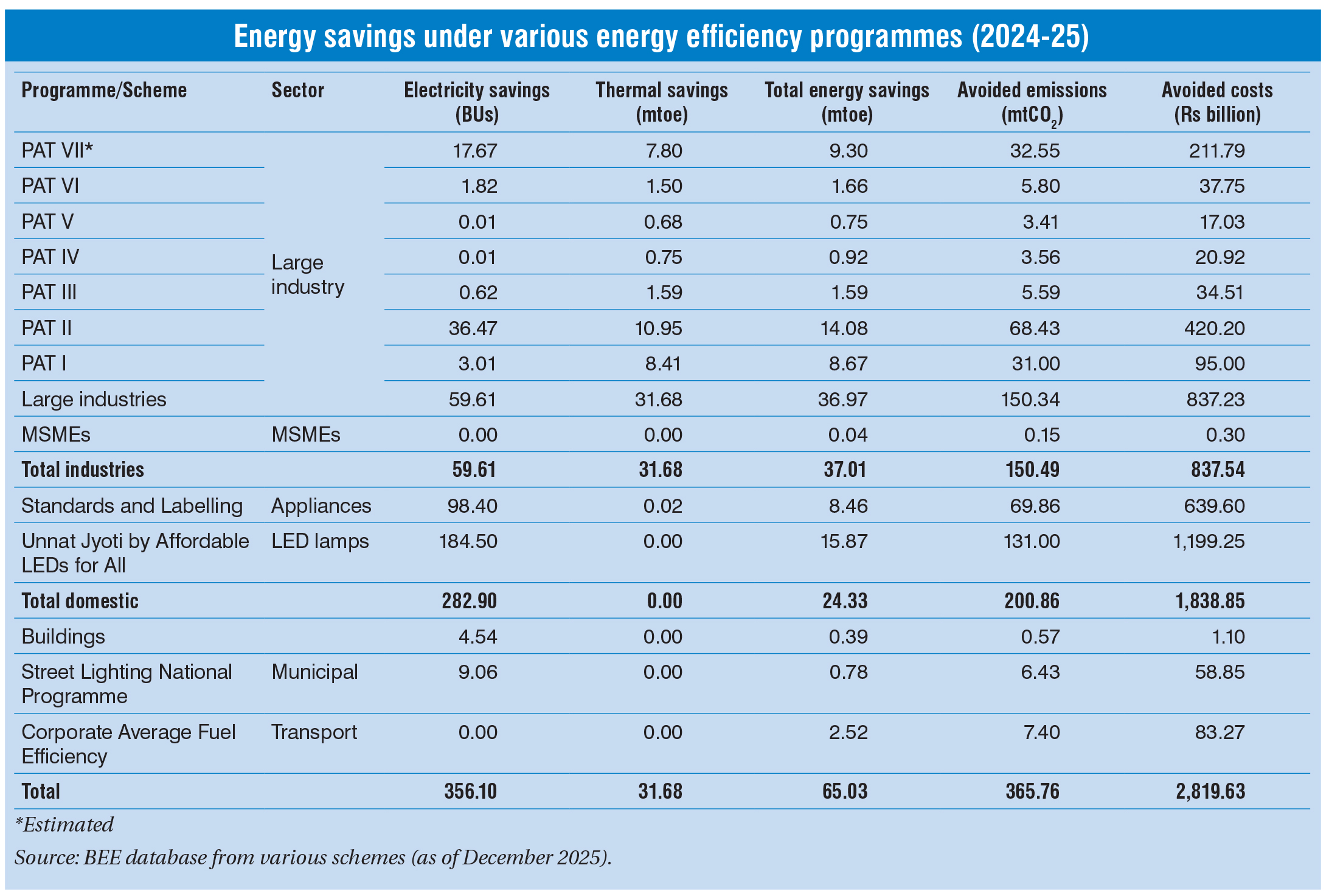
According to the Bureau of Energy Efficiency’s (BEE) India Energy Scenario 2024-25 report, significant energy and cost savings have been achieved through the implementation of various national-level energy efficiency programmes across industry, buildings, transport, and micro, small, and medium enterprises (MSMEs).
The report assesses the impact of major programmes such as the Standards and Labelling (S&L) programme, the Perform, Achieve and Trade (PAT) scheme for energy-intensive industries, and the Assistance for Deployment of Energy Efficient Technologies in Industries and Establishments (ADEETIE) scheme for MSMEs. According to the assessment, these programmes have resulted in savings of 31.68 million tonnes of oil equivalent (mtoe) of thermal energy and 356.1 billion units (BUs) of electricity across sectors. This has translated into overall energy savings of 65.03 mtoe. The initiatives have also helped avoid energy costs of nearly Rs 2.82 trillion while reducing greenhouse gas emissions by about 365.76 million tonnes of CO2 equivalent. Among all sectors, the industrial sector accounted for the largest share of total energy savings at nearly 57 per cent, resulting in avoided energy costs of about Rs 837.54 billion.
Managing the cost of energy
Managing industrial energy costs requires continuous assessment of how and where energy is being consumed across operations. Energy audits help industries analyse consumption patterns, equipment performance, and operational inefficiencies across motors, compressors, boilers, heating, ventilation and air conditioning (HVAC) systems, lighting infrastructure, and production processes.
Alongside audits, real-time monitoring using smart meters, IoT-enabled sensors and AI-based analytics tools provides continuous visibility into energy usage and equipment performance. Further, submetering of production lines and major equipment helps identify peak consumption areas and inefficient operations. The resulting data can support optimisation of operating schedules, a reduction in idle equipment usage and improved load management. It also enables predictive analytics by helping anticipate peak loads and optimise operations in real time. In addition, it supports the development of automated energy management systems that can shed non-critical loads during peak demand periods, optimise equipment sequencing and alert operators about unusual consumption patterns.
At the same time, replacing outdated motors, compressors, pumps and HVAC systems with energy-efficient alternatives can significantly lower electricity consumption. Variable frequency drives are being widely deployed across facilities with motor-driven systems such as pumps, fans, blowers and compressors. These systems regulate motor speed according to operational requirements instead of allowing equipment to run continuously at full capacity. This helps reduce electricity consumption during partial-load operations. In large industrial facilities, medium-voltage drive systems are being deployed to improve the energy performance of high-capacity motors.
Similarly, compressed air systems can be optimised through leak detection programmes using ultrasonic detectors. System layouts can also be improved by reducing unnecessary fittings and minimising the length of air distribution lines to avoid pressure drops and excess power consumption.
In addition, energy consumption can be optimised through the use of efficient chillers, cooling towers, energy recovery ventilators, smart thermostats and automated temperature controls. Improved insulation and sealing of duct leakages can also minimise energy losses. Geothermal heating and cooling systems are gaining attention due to their higher operating efficiency compared to conventional systems. Similarly, LED lighting systems, along with smart lighting controls, occupancy sensors, automated dimming systems, demand-based lighting, and daylight optimisation technologies, can significantly improve energy efficiency.
 Power procurement strategies
Electricity tariffs constitute among the largest variable cost components for industrial consumers. These tariffs are influenced by factors such as generation costs, transmission and distribution charges, fuel mix, and system losses. In addition, industrial and commercial consumers continue to subsidise agricultural and domestic categories, resulting in relatively higher industrial tariffs in several states.
Long-term power purchase agreements with renewable energy developers can help industries manage energy costs effectively. Such arrangements help secure relatively stable electricity prices over time while reducing exposure to fuel price volatility. In parallel, hedging strategies, forward contracting and supplier diversification enable the mitigation of risks arising from supply uncertainty.
Further, rooftop solar installations, wind-solar hybrid systems, and other on-site generation solutions reduce dependence on grid power. When combined with battery energy storage systems, these solutions improve load management and enhance reliability during peak demand hours.
Recently, Tata Power Solaroof and Tata Capital launched the SunSmart Flexi EMI scheme for commercial and industrial consumers to make rooftop solar adoption more affordable. Under the scheme, businesses can install rooftop solar systems without major upfront investment and repay the cost through monthly EMIs or lease rentals linked to estimated solar power generation. This “pay as you save” model helps businesses reduce electricity costs and improve cash flow management.
Apart from this, green energy open access allows industries to source power directly from generators and bypass higher standard discom tariffs. Captive and group captive renewable projects are being widely adopted owing to exemptions from cross-subsidy surcharge and additional surcharge. In particular, group captive solar projects can deliver 20-40 per cent savings compared to grid tariffs for industrial users.
In March 2026, the Electricity (Amendment) Rules, 2026 were notified which provide greater clarity on captive power frameworks. The rules include a provision to prevent discoms from imposing charges on captive consumers pending verification of captive status. The amendment is expected to improve ease of doing business, enable access to cost-competitive captive power and encourage investment in such projects.
Demand response programmes offered by discoms also provide an additional avenue for cost optimisation. By reducing consumption during peak demand periods, industries can earn financial incentives while simultaneously lowering monthly electricity bills through better load management.
 Policy measures as catalysts
The government has implemented a range of policy interventions aimed at enhancing the competitiveness of Indian industry through improved energy efficiency and cost reduction.
The Standards and Labelling programme, launched by BEE in 2006, provides consumers with clear information on energy-saving appliances and equipment. It currently covers 34 appliances.
In July 2025, the ADEETIE scheme was introduced with a budgetary outlay of Rs 10 billion. It offers interest subvention of 5 per cent for micro and small enterprises, and 3 per cent for medium enterprises on loans over three years to adopt energy-efficient technologies. The scheme also supports MSMEs with investment-grade energy audits, detailed project reports, and monitoring and verification. It covers MSMEs across 60 industrial clusters in 14 energy-intensive sectors.
The PAT scheme, initiated in 2012, is a market-based mechanism to improve energy efficiency in energy-intensive industries. It assigns specific energy consumption reduction targets to designated consumers and allows trading of energy saving certificates. Currently, a transition is under way from PAT to the Carbon Credit Trading Scheme (CCTS), 2023. In December 2025, several energy-intensive sectors such as aluminium, cement, petrochemicals, refineries, pulp and paper, textiles, and chlor-alkali were moved to the CCTS compliance framework.
Notably, external policy measures such as the Carbon Border Adjustment Mechanism are acting as a driver for export-oriented industries to adopt energy-efficient technologies, renewable energy, and industrial electrification.
Additionally, the Draft Electricity (Amendment) Bill, 2025, and the Draft National Electricity Policy 2026, propose phasing out cross-subsidy for manufacturing industries, railways and metro railways within five years of enactment. Measures such as merit order despatch, a reduction in aggregate technical and commercial losses under the Revamped Distribution Sector Scheme, and optimisation of fuel linkages for generating stations are also improving utility finances. This is expected to translate into lower tariffs for industrial consumers.
In sum, by reducing energy consumption and waste, industries can achieve significant cost savings and improve process efficiency. Policy measures are acting as a catalyst for energy cost optimisation, enhanced industrial competitiveness and the transition towards cleaner industrial operations.