By Shashi Bala, Chief Officer, Govt. Relations, Ador Powertron
Electric utilities worldwide are entering a digital era, where data has become as critical as physical grid infrastructure. With smart meters, supervisory control and data acquisition (SCADA) systems, geographic information system (GIS) platforms, distributed energy resources (DERs), electric vehicle (EV) charging networks and internet of things devices generating several terabytes of data daily, utilities must shift from siloed, IT-centric data handling to structured, enterprise-wide governance. This paper examines the 2025 landscape of data management and data governance in electric utilities, highlighting how modern utilities treat data as a strategic asset for reliability, consumer engagement, renewable integration and operational efficiency.
Leading utilities across the world now adopt federated governance models comprising enterprise governance councils, domain data stewards and data centres of excellence. These structures ensure clear ownership, strong data quality processes, unified master data across customers and assets, and consistent policies for metadata, lineage, cybersecurity and regulatory compliance (including GDPR and NERC-CIP). Modern utilities have also moved from legacy data warehouses to cloud-first medallion architectures (Bronze → Silver → Gold), enabling the seamless integration of advanced metering infrastructure, SCADA, outage management systems, distributed energy resource management systems, GIS and billing systems. This architecture supports advanced analytics such as predictive maintenance, load forecasting, outage prediction, non-technical loss detection and customer-centric services.
The digitalisation of distribution utilities (discoms) in India started with the Restructured Accelerated Power Development and Reforms Programme a decade ago, which introduced GIS, automated meter reading of feeders, integrated billing systems, customer service centres and also built data centres. This led to several central and state-level programmes adding different layers of digital technologies. Now, with 250 million smart metering programmes under the Revamped Distribution Sector Scheme, utilities in India are on the fast track to digitalisation. Utilities today have large volumes of data that are underutilised, and they lack clear policies on data management, data sharing mechanisms and data governance frameworks.
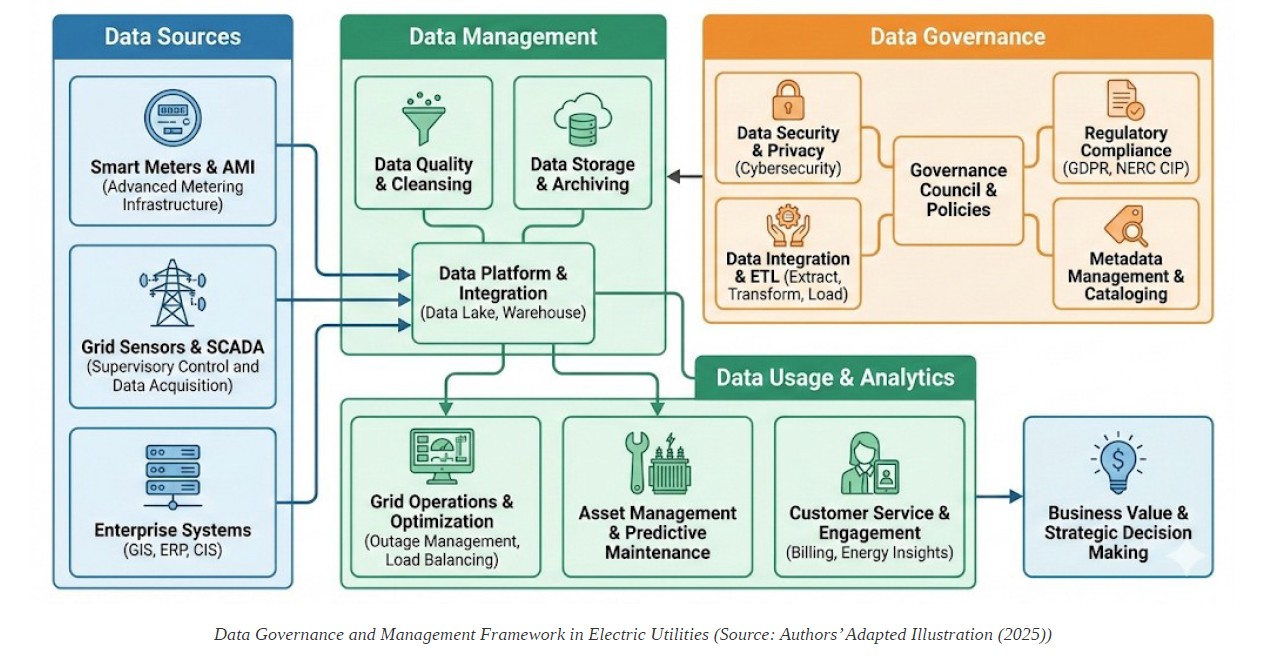
This paper is an attempt to present state-of-the-art practises with respect to data management and data governance practices in electric utilities globally, and suggest a roadmap for Indian discoms on the adoption of such best practices. The paper also introduces a data governance and management framework, illustrating the flow from data sources → data management → governance → analytics → business value, integrating both OT and IT ecosystems.
Emerging priorities for 2025-26 include the governance of DER and grid edge data, secure and standardised data exchange with third-party service providers, responsible artificial intelligence governance for transparency and traceability, and the adoption of zero-trust cybersecurity models. The paper concludes by outlining short-, medium- and long-term action steps to help Indian discoms evolve from fragmented data practices to fully data-driven digital utilities.
Utilities must shift from siloed, IT-centric data handling to structured, enterprise-wide governance.