India’s power sector generates vast amounts of data every day. Yet, much of it remains scattered across generating companies, load despatch centres, transmission and distribution licensees, regulators and other agencies. Differences in data formats and definitions, limited interoperability and the absence of a common governance framework make this data difficult to discover, access and use. This limits its potential to support planning, regulation and research.
To address these challenges, the Ministry of Power (MoP) released the draft National Electricity Data Sharing Framework, 2026 in June 2026. The framework proposes common principles for secure and transparent data sharing, with a focus on improving data discoverability, consistency and interoperability. It also seeks to balance wider data access with safeguards for consumer privacy, cybersecurity and critical infrastructure.
Additionally, the framework proposes a national electricity data centre (NEDC) and national electricity data portal (NEDP) as a common platform to facilitate data discovery and sharing across the sector. However, adoption of the framework has been left voluntary for sectoral entities.
Objectives of the framework
A key objective of the framework is to facilitate the discovery and exchange of power sector data across the electricity value chain, including generation, transmission, distribution and grid operations, as well as data held by electricity regulatory commissions, government agencies and energy market participants. It seeks to establish common principles for data classification, protection and governance, while promoting non-discriminatory access.
 The proposed NEDC and NEDP are central to this approach. The NEDC will develop, operate and maintain the NEDP, which is envisaged as a common digital platform for discovering and sharing power sector data. Data sets would be made available in standardised, machine-readable formats, making information currently spread across multiple websites easier to locate and use. Data issuers may continue to share data sets through their own portals or, after onboarding, use the NEDP as a shared service. Importantly, ownership of the data will remain with the agencies or companies that generate or maintain it.
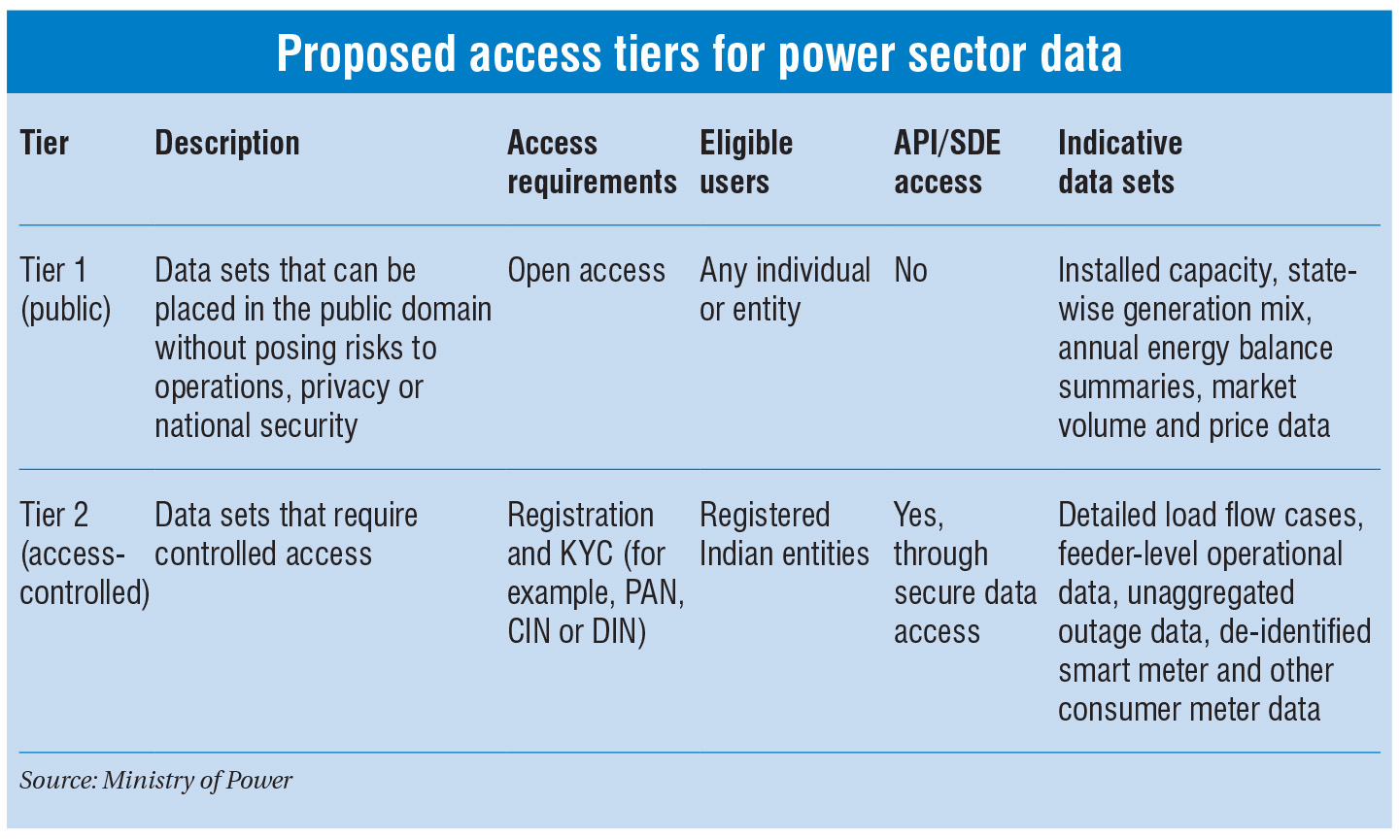
The framework proposes a two-tier classification of shareable data: public and access-controlled. Public data sets are those that can be placed in the public domain without compromising operations, privacy or national security. The draft identifies 66 data sets spanning generation, transmission, distribution, energy demand and supply, renewable energy, and regulatory and policy information that could be made publicly available. Meanwhile, access-controlled data sets would require users to register and complete know-your-customer (KYC) verification. Highly sensitive information, including cyber defence protocols, real-time strategic telemetry, defence installation data, transmission corridor vulnerabilities and power exchange bid data before market clearing, would remain outside the scope of the framework.
The framework also proposes differentiated access charges. While public data sets would generally be free to view, data issuers could levy charges for bulk downloads and commercial application programming interface (API) access. To prevent this from becoming a barrier to research and public sector use, academic and training institutions could receive reduced or zero-cost access for research. In addition, government agencies and statutory authorities would not be charged.
Modalities for data sharing
For access-controlled data sets, data issuers may provide access through APIs, secure data environments (SDEs) or other suitable mechanisms, depending on the nature of the data and the level of authorisation required. SDEs could be particularly useful for sensitive information as they allow authorised users to analyse data sets in a controlled environment without having to download or transfer the underlying data. The framework also permits data exchange through state-level data exchange platforms, the India Urban Data Exchange and data dumps.
To improve interoperability, the framework encourages data issuers to adopt common API standards in line with the Ministry of Electronics and Information Technology’s (MeitY) Open API Policy, and, where applicable, the India Energy Stack (IES). Entities using legacy systems that cannot directly support APIs may deploy data wrappers based on the IES architecture or similar standards.
The framework also requires data issuers to publish metadata for every shareable data set. This would provide information on the data set’s description, source, structure, update frequency and classification. Making such metadata available in machine-readable formats through APIs, registries or other discovery mechanisms could make data sets easier to identify, compare and use across the sector.
Renewable energy data
For the renewable energy sector, better data is increasingly important for tracking capacity additions, generation and grid integration. The framework proposes making public data available on installed capacity across solar, wind, biomass and small hydropower, along with state-wise rooftop solar capacity and installations. It also includes data on renewable energy generation and its share in the total electricity generation, as well as national-level data on pumped hydro storage capacity, including projects installed and under construction.
At present, renewable energy data is spread across different agencies. It is also often published in varying formats and at different frequencies. A common data framework could make it easier to compare deployment across states, track the gap between capacity additions and actual generation, and assess the pace of India’s energy transition. For researchers and investors, consistent and accessible data could support better assessment of market opportunities and emerging investment needs.
Privacy and cybersecurity
Greater access to power data also brings privacy and cybersecurity risks, particularly where data sets contain consumer information or sensitive details about power infrastructure. Therefore, the framework proposes safeguards alongside wider data sharing. Before data sets containing personally identifiable information are shared, data issuers will be required to de-identify the information using techniques such as anonymisation, pseudonymisation, tokenisation and aggregation. Data classification and sharing must also comply with the Digital Personal Data Protection Act, 2023 and applicable MeitY guidelines.
On cybersecurity, the NEDC and data issuers will have to comply with applicable laws and guidelines. Hosting infrastructure must undergo cybersecurity testing, including vulnerability assessment and penetration testing, as well as checks on access controls and encryption, before being deployed.
Implementation
To oversee implementation, data issuers may appoint a data governance officer (DGO) for managing data classification, processing access requests and handling grievances. The DGO may also execute user agreements or non-disclosure agreements where required. A two-level grievance redressal mechanism has been proposed to resolve disputes related to data access.
Additionally, the framework sets out timelines for creating and maintaining data catalogue. Within 12 months of its effective date, adopting entities may publish metadata for all data sets they hold, along with details of the designated DGO. Within 18 months, metadata for public data sets may also be made discoverable through the NEDC portal in a standardised, machine-readable format. The catalogues would then need to be updated at least once every six months, while new data sets should be classified and added within 90 working days of their creation or acquisition. The Central Electricity Authority has been entrusted with developing and periodically updating standard data structures and formats for publishing data sets. Data issuers will be expected to align their data sets with these specifications.
Outlook
The framework is expected to extend the use of electricity data beyond the power sector by enabling interoperability with adjacent sectors such as transport, urban planning, climate action and financial services. This could support applications ranging from electric vehicle charging infrastructure and building energy efficiency to climate reporting and green finance.
The framework could also enable more advanced applications within the sector, including demand forecasting, artificial intelligence (AI)-based analytics and digital twins. The framework’s provision for preferential access to data for Indian AI developers and start-ups could further encourage research and innovation based on power sector data sets.
However, the success of the framework depends on how widely sectoral entities adopt it. If major data holders continue to use different standards or withhold important data sets, it may not fully address the fragmentation it seeks to overcome. Implementation will also require investment in digital infrastructure, particularly for entities operating legacy systems.
To support this, electricity regulatory commissions have been advised to allow prudent implementation costs to be recovered through pass-through in the annual revenue requirement. Ultimately, broad participation, backed by effective privacy and cybersecurity safeguards, will be critical to building a more interoperable and data-driven electricity sector.
Khushi Rohatgi