


 By S.K. Soonee, Former and Founding Chief Executive Officer, POSOCO, now Grid Controller of India Limited (GRID-INDIA); Debasis De, Former Executive Director, National Load Despatch Centre, GRID-INDIA; Dr Deb Chattopadhyay, Senior Energy Specialist, The World Bank
The Indian power system has undergone a remarkable transformation over the past three decades. What began as a collection of regional grids has evolved into one of the world’s largest synchronously operated power systems. The development of an extensive extra-high voltage (EHV) transmission network, market reforms, point-of-connection (PoC) charging, general network access (GNA), centralised system operation and increasing cross-border interconnections have collectively enabled the grid to function as a true national common carrier. The achievements are significant. Peak demand has crossed 270 GW, renewable integration continues at an unprecedented pace and electricity today routinely travels a long distance from generating stations to load centres.
Yet, amidst these successes, a relatively simple question receives surprisingly little attention:
How effectively does the topology of the transmission network guide the physical flow?
Electrical power flows according to network impedances and system conditions, the law of physics, often diverging from commercial schedules, geographical expectations and administrative boundaries. Such behaviour is commonly described as loop, parallel, circulating, or unscheduled flows. This article neither views such flows as undesirable nor advocates regulatory intervention. Instead, it explores whether circulation patterns and flow alignment can provide useful planning and operational insights into an increasingly meshed and renewable-rich power system. The observations are based on an exploratory analysis of interregional energy exchanges and corridor flows. The objective is to stimulate discussion and identify areas for further investigation.
Power flow follows physics
This distinction has been recognised for decades by pioneers such as H.H. Happ, Fred Schweppe and other researchers in transmission pricing, wheeling, spot pricing and network economics. Their work highlighted a fundamental reality – commercial arrangements determine who buys and sells electricity, but the transmission network determines how power actually flows.
A generator may be scheduled to serve a distant load, yet the associated power flows are distributed across multiple parallel transmission paths rather than a single contractual route.
As power systems have evolved from vertically integrated utilities to large interconnected networks with multiple market participants, this distinction between commercial transactions and physical flows has become increasingly important.
India’s power sector has progressively moved from path-specific transactions to a common-carrier framework. Mechanisms such as PoC charging, GNA, market coupling initiatives and harmonised scheduling and settlement arrangements have reduced reliance on contract-path concepts, simplified network access and supported market development.
The SAMAST framework further reinforced the distinction between commercial transactions and physical power flows. While energy is scheduled and settled across multiple control areas, actual power transfers occur through the interconnected network in accordance with electrical laws.
As a result, a flow that appears indirect from an administrative perspective may represent a perfectly natural and efficient electrical outcome. The key question is, therefore, not whether power follows unexpected paths, but it is whether certain network topologies produce more aligned flow patterns and what implications these may have for losses, congestion, transfer capability and future transmission expansion. This is where the discussion on loop flows begins.
A grid built on loops
Transmission systems are often visualised as corridors that carry power from generating stations to load centres. While broadly correct, this view overlooks a defining feature of modern grids: They are highly meshed networks with multiple interconnected paths.
As networks expand to satisfy N-1 reliability requirements, accommodate generation growth and strengthen interconnections, new electrical loops are naturally created. From a graph-theoretic perspective, the number of possible closed paths grows rapidly with network size, making loops an inherent characteristic of large interconnected power systems.
A simple exercise on an abstract model of the Indian transmission network produced a surprising result. Instead of a few isolated loops, it revealed thousands of closed paths, including loops within loops, ranging from local substations to corridors spanning entire regions. It only highlighted a fundamental reality – the Indian grid is best viewed as a network of alternative pathways rather than a collection of radial transmission corridors.
Loops are not a weakness of the transmission system; they are one of the reasons large interconnected grids are reliable. By providing multiple pathways for power flow, they enhance redundancy, transfer capability and resilience. The key question is, therefore, not whether loops should exist, but whether the resulting flows remain reasonably aligned with intended transfers or lead to significant circulation within the network.
The distinction between network topology and actual power flow is important (Table 1). The presence of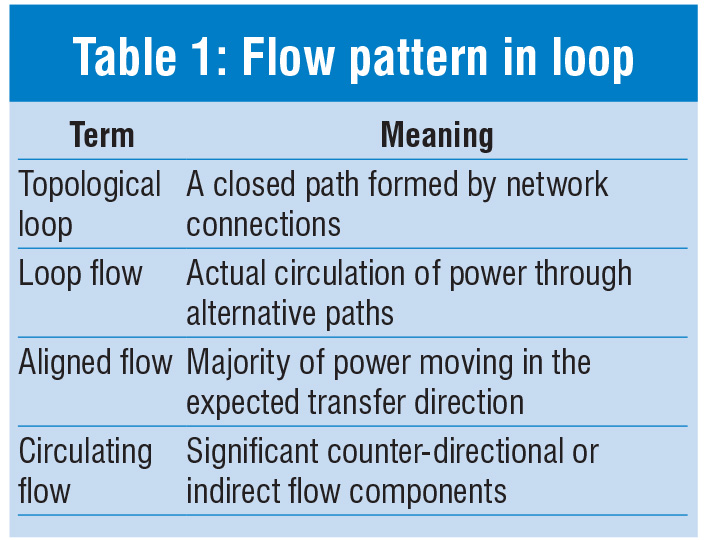 a topological loop merely creates the possibility of alternative flow paths; A loop simply provides alternative pathways, while the actual circulation depends on generation patterns, load distribution, network impedances and operating conditions. As India’s grid expands through renewable energy zones, green energy corridors and cross-border interconnections, these interactions are likely to become increasingly complex.
Flow alignment and transfer capability
Long before the term “loop flow” entered mainstream transmission discussions, planners and operators implicitly recognised the importance of overall flow patterns through the determination of total transfer capability (TTC) and available transfer capability (ATC). These assessments have never been based solely on bilateral transfers between two regions. Rather, they depend on the combined pattern of generation, demand and power exchanges across the interconnected network.
As a result, identical transfers between two areas can produce very different network loadings under different operating conditions. Even a simplified five-region representation of the Indian grid permits numerous interregional exchange configurations, allowing the same net transfer to be realised through different flow patterns and resulting network loadings.
This naturally raises an interesting question: Are some flow patterns more aligned than others? To explore this issue, daily interregional energy exchanges across major interregional corridors were reviewed. Although such data cannot reveal the complete network picture, recurring patterns in interregional flows may offer useful clues about the underlying network behaviour. The intent is not to draw definitive conclusions, but to examine whether these observations can act as pointers for more detailed studies of flow alignment and circulation within the grid.
A preliminary examination suggests that different interfaces exhibit distinctly different characteristics. Some corridors display strong directional consistency, with most lines carrying power in the same direction. Other corridors exhibit simultaneous forward and reverse flows across different lines connecting the same regions. Such behaviour does not necessarily indicate inefficiency or abnormality. It simply reflects the complex manner in which power distributes itself through a meshed network.
Interface such as ER-SR often exhibit highly aligned behaviour, with the majority of corridors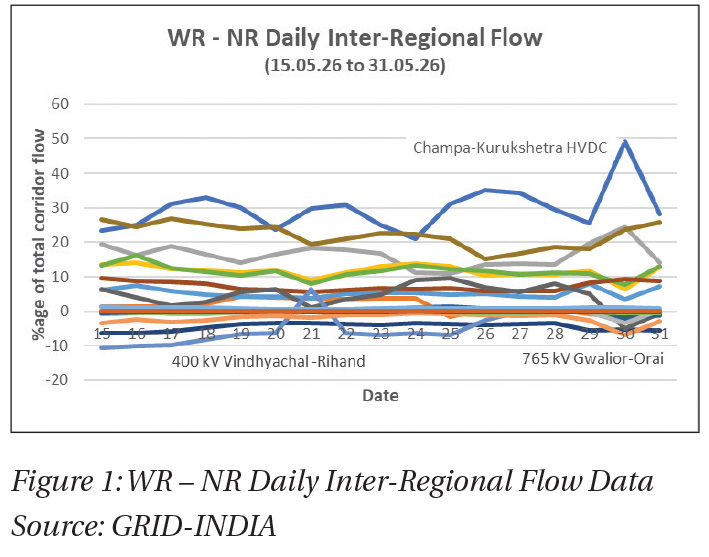 supporting the dominant transfer direction. However, interfaces such as WR-NR exhibits simultaneous counterflows as shown in Figure 1, suggesting a circulation within the wider network.
In contrast, the ER – NR interfaces show some major counter flows, suggesting a strong circulatory flow.
These observations should not be interpreted as indicators of good or bad performance. Rather, they suggest that different parts of the network possess different flow signatures.
Just as transmission losses, congestion patterns and voltage profiles provide valuable operational insights, flow alignment may offer an additional perspective on how effectively the topology supports prevailing transfer requirements. Rather than focusing on individual reverse flows, the objective is to identify recurring patterns and assess their relevance to planning and operation.
Circulation: Beneficial or avoidable?
The term “loop flow” often carries a negative connotation, although some degree of circulation is a natural and beneficial feature of a highly interconnected grid. By utilising multiple parallel pathways, power can relieve stress on individual corridors, improve reliability and enhance resilience under contingencies. The relevant question is, therefore, not whether circulation exists, but whether its extent is broadly aligned with the underlying transfer requirements or not.
The interpretation of circulation depends on the perspective adopted. A flow that appears circuitous across state or regional boundaries may represent the most efficient electrical path in an integrated national grid, while an apparently direct transfer may involve substantial circulation through parallel corridors. This distinction is particularly relevant in India, where PoC and GNA frameworks have largely moved away from contract-path concepts and recognise that physical power flows are determined by the interconnected network rather than commercial arrangements. Accordingly, the objective is not to eliminate circulation, but to understand its characteristics and implications.
Rather than categorising flows as either normal or abnormal, it may be more useful to view them along a spectrum ranging from highly aligned transfers to conditions exhibiting greater circulation. Most operating states of a large meshed network lie somewhere between these extremes.
Can flow alignment be a useful indicator?
Without defining a formal metric, flow alignment may be viewed as a spectrum ranging from highly aligned transfers to conditions exhibiting greater circulation. The distinction is not inherently good or bad, but it may provide an additional perspective on network behaviour, much like losses, congestion levels and transfer margins.
This raises several practical questions. Do highly circulatory patterns influence losses, transmission utilisation, TTC, or ATC assessments? Could future network reinforcements improve both transfer capability and flow alignment? While these questions remain open, they suggest that circulation patterns may deserve a closer examination.
The objective is not to minimise circulation. In a secure meshed network, some circulation is both natural and beneficial. The more relevant challenge is to distinguish between circulation that supports reliability and redundancy, circulation with little operational significance and circulation that may warrant attention during future planning studies. As renewable penetration, transfer distances and network complexity continue to increase, such distinctions may become increasingly relevant.
HVDC: More than bulk transfer
Historically, power flows were largely determined by network topology, generation despatch and load distribution. The modern Indian grid is gradually changing this paradigm through HVDC links, renewable energy resources and cross-border interconnections that provide greater controllability, alongside increased variability. With one of the world’s largest HVDC portfolios and centrally coordinated operation through Grid-India, India now possesses tools that can influence power flow patterns across the wider AC network. Beyond facilitating bulk transfers, HVDC links may, therefore, serve as flow-shaping instruments capable of improving flow alignment, managing circulation patterns and enhancing effective transfer capability. While these possibilities remain beyond the scope of this article, they represent an interesting area for future research.
Renewable energy and dynamic flow patterns
Renewable energy introduces significant temporal and seasonal variability into power flows. As solar, wind and hydro generation reshape injection patterns across regions and seasons, network flow behaviour and alignment can change considerably over time. Flow alignment should, therefore, be viewed as a dynamic rather than a static characteristic of the grid, requiring assessment across multiple seasons, demand conditions and generation scenarios rather than a single operating snapshot.
The need for long-term observation
Daily interregional energy exchanges provide useful indicators of recurring circulation behaviour, but they represent aggregated outcomes that may mask significant intra-day variations in flow patterns. A more comprehensive understanding would, therefore, require analysis of time-resolved flows across different seasons, renewable generation conditions, demand levels, hydrological cycles, maintenance outages and major transmission additions. Such studies could help distinguish circulation patterns that are persistent characteristics of network topology from those that arise primarily from changing operating conditions.
Concluding remarks
The Indian power system has evolved into one of the world’s largest synchronised grids through sustained advances in transmission expansion, system operation, market development, renewable integration and regional cooperation. Throughout this journey, reliability, adequacy, congestion management, transfer capability and economic efficiency have remained the primary objectives of planning and operation.
The present discussion does not challenge these priorities. Instead, it offers an additional perspective arising from the observation that interregional corridors exhibit markedly different flow characteristics. While some corridors appear strongly aligned with dominant transfer directions, others display greater circulation. Such behaviour is a natural feature of a highly meshed network, yet it raises several intriguing questions. Can recurring circulation reveal insights into the evolving topology of the grid? Are some transmission reinforcements more effective than others in improving flow alignment? Can HVDC links influence the utilisation of the wider AC network? How do renewable generation patterns alter circulation characteristics across seasons? Is there a relationship between flow alignment, losses, congestion and transfer capability? Most importantly, how should circulation be interpreted in a national common-carrier system, where administrative boundaries, commercial transactions and physical power flows represent different perspectives of the same network?
Definite answers to these questions may not yet exist, nor is that the purpose of this article. Many important developments in power systems began not with solutions but with observations. The objective here is simply to stimulate discussion on whether circulation patterns and flow alignment can provide additional insights into the planning and operation of an increasingly interconnected and renewable-rich grid.